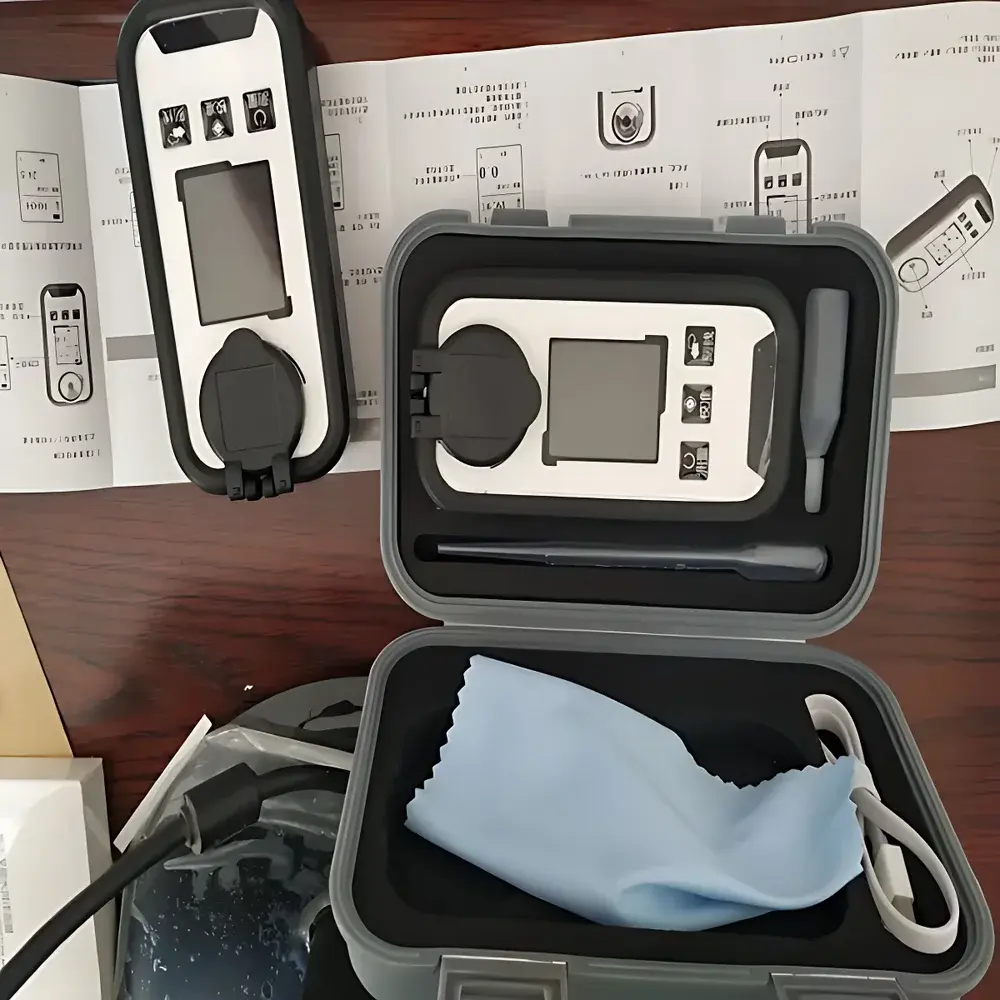
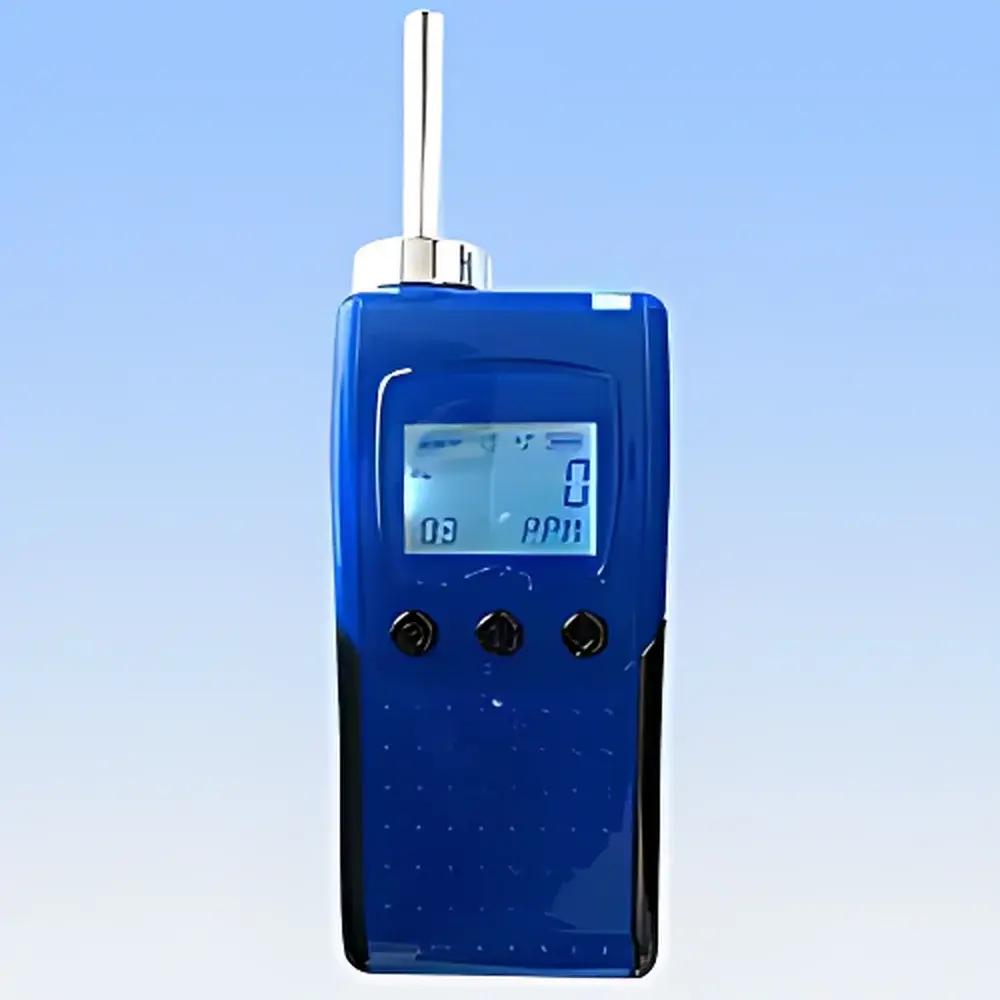
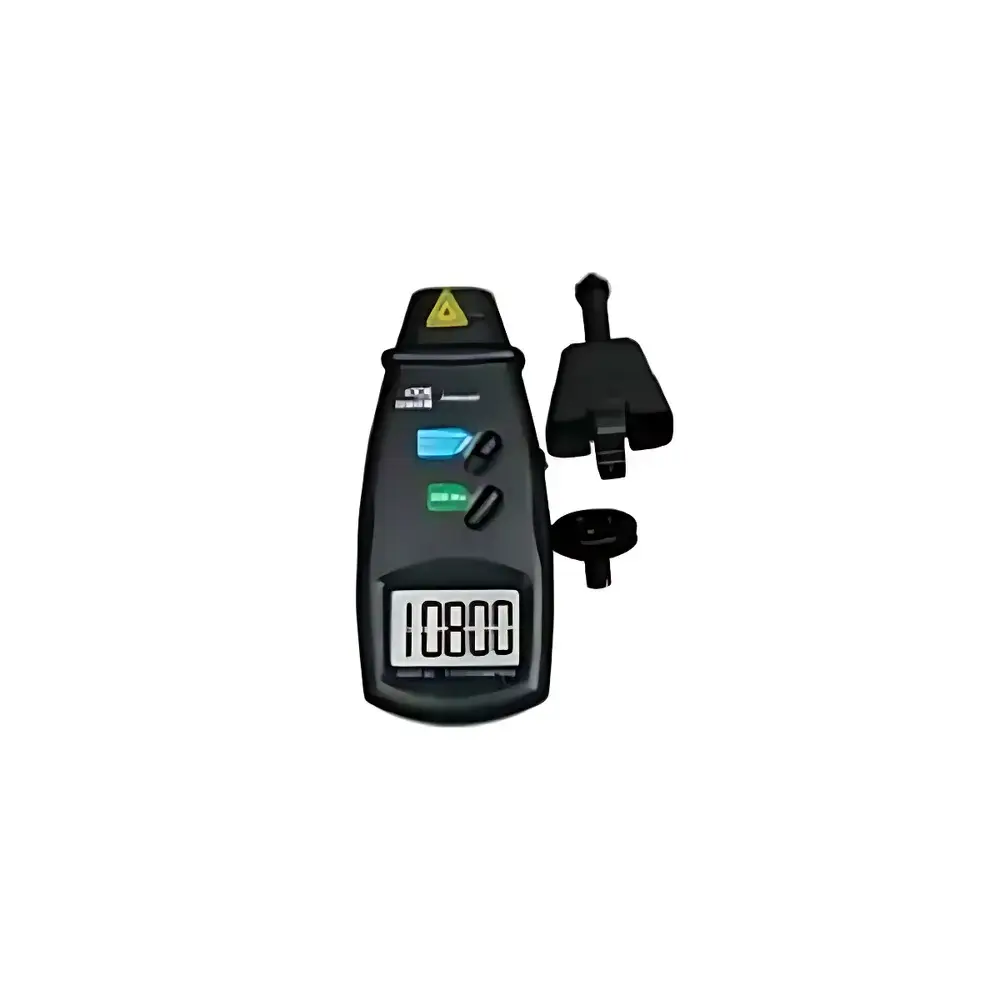
HengaoDe H17902 Handheld Digital Ammonia Water Refractometer
| Brand | HengaoDe |
|---|---|
| Origin | Beijing, China |
| Manufacturer Type | Authorized Distributor |
| Country of Origin | China |
| Model | H17902 |
| Price | USD 28.50 (FOB) |
| Measurement Principle | LED-based critical-angle refractometry via optical fiber and sapphire prism |
| Range | 0.0–30.0 wt% NH₃ in aqueous solution |
| Accuracy | ±0.3 wt% |
| Resolution | 0.1 wt% |
| Temperature Range | 0–40 °C (with built-in Peltier temperature compensation) |
| Measurement Time | ≤2 s |
| Sample Volume | >0.2 mL |
| Dimensions | 120 × 58 × 26 mm |
| Net Weight | 125 g (incl. rechargeable Li-ion battery) |
| Power Supply | Rechargeable 3.7 V Li-ion battery (USB-C charging) |
Overview
The HengaoDe H17902 Handheld Digital Ammonia Water Refractometer is an optical precision instrument engineered for rapid, field-deployable quantification of ammonia concentration in aqueous solutions—primarily used in industrial cooling water systems, wastewater treatment plants, chemical manufacturing, and laboratory QC environments. It operates on the principle of critical-angle refractometry: a collimated LED beam is guided via optical fiber to a sapphire prism surface in contact with the sample; the angle at which total internal reflection occurs is directly correlated to the solution’s refractive index, which—within the 0.0–30.0 wt% NH₃ range—is linearly calibrated against concentration. The instrument employs a high-stability linear CCD array to detect the precise position of the reflected light boundary, enabling traceable, repeatable measurements without reagents or consumables. Integrated Peltier-based temperature compensation ensures metrological integrity across ambient conditions from 0 to 40 °C, conforming to ISO 21748:2017 guidelines for temperature correction in refractive index measurement.
Key Features
- Optical path constructed with sapphire prism and fused silica optical fiber—resistant to corrosion, abrasion, and chemical degradation from ammonia vapors or alkaline residues.
- Dual-mode operation: direct drop-on measurement (≥0.2 mL) and flow-cell compatible mode for inline process monitoring integration.
- Auto-zero function with dry-prism calibration routine, eliminating drift from residual film or condensation.
- Backlit graphical LCD display (128 × 64 pixels) with real-time temperature readout, unit toggle (wt%, g/100g), and pass/fail indicator against user-defined specification limits.
- IP65-rated enclosure with rubberized ergonomic grip—designed for glove-compatible operation in industrial settings.
- On-device data logging (up to 500 records) with USB-C interface for CSV export and traceability under GLP-compliant workflows.
Sample Compatibility & Compliance
The H17902 is validated for use with aqueous ammonia solutions containing ≤5% non-volatile dissolved solids (e.g., ammonium salts, carbonates). It is not intended for use with organic solvents, viscous emulsions, or suspensions exceeding 1 µm particle size. Calibration verification follows ASTM D1152–19 (Standard Test Method for Formaldehyde in Aqueous Solutions) adapted for NH₃ systems, with NIST-traceable sucrose reference standards employed for factory calibration. The device meets CE marking requirements per Directive 2014/30/EU (EMC) and 2014/35/EU (LVD); its optical design complies with ISO 17025:2017 clause 6.4.4 for measurement uncertainty estimation (k = 2, U = ±0.42 wt% at 20 °C). Routine verification is supported by included calibration check fluid (10.0 ± 0.1 wt% NH₃).
Software & Data Management
Data export is performed via USB-C to Windows-based PC using HengaoDe RefractoLink v2.1 software (included). The application supports audit trail generation with operator ID, timestamp, environmental temperature, and calibration history—fully compliant with FDA 21 CFR Part 11 requirements when deployed with electronic signature configuration. Raw CCD intensity profiles, temperature-compensated refractive index values (nD), and concentration outputs are stored in structured .CSV format with embedded metadata headers. Batch reporting includes statistical summaries (mean, SD, CV%), trend charts, and out-of-spec alerts. No cloud connectivity or remote firmware updates are implemented—ensuring air-gapped security for regulated laboratories.
Applications
- Real-time verification of ammonia dosing in municipal wastewater denitrification basins (per EPA Method 350.1).
- In-process control of ammonia concentration in semiconductor wet etch baths and cleaning solutions.
- Field validation of refrigerant charge purity in industrial chiller systems (ASHRAE Standard 15).
- QC release testing of pharmaceutical excipient solutions where NH₃ serves as pH adjuster (USP ).
- Educational demonstration of colligative properties and refractive index-concentration relationships in analytical chemistry curricula.
FAQ
Does the H17902 require periodic recalibration by an accredited lab?
No. Field recalibration is performed using the included 10.0 wt% NH₃ standard and dry-prism zero routine. Annual verification against NIST-traceable standards is recommended for ISO 17025-accredited labs.
Can it measure ammonia in saltwater or seawater matrices?
Not without matrix-matched calibration. High ionic strength alters refractive index contribution per unit NH₃; users must generate custom calibration curves using synthetic seawater spiked with certified NH₃ standards.
Is the sapphire prism replaceable in the field?
Yes. The prism module is tool-free serviceable; replacement part number H17902-PRISM-SAP is available with full optical alignment jig and certification report.
What is the measurement uncertainty budget at 25.0 wt% NH₃?
At 25.0 wt% and 25 °C, expanded uncertainty (k=2) is ±0.45 wt%, derived from contributions of temperature compensation error (±0.12 wt%), CCD linearity (±0.18 wt%), and reference standard uncertainty (±0.15 wt%).
Does it comply with explosion-proof requirements for use in Zone 1 hazardous areas?
No. The H17902 carries no ATEX or IECEx certification. For hazardous location deployment, it must be operated outside classified zones or housed in an approved purge enclosure per IEC 60079-13.