
HengaoDe BD-II-305A Visual-Motor Coordination Tracking Trainer
| Brand | HengaoDe |
|---|---|
| Origin | Beijing, China |
| Manufacturer Type | Authorized Distributor |
| Country of Origin | China |
| Model | BD-II-305A |
| Price | USD 84 (FOB) |
| Disc Diameter | 298 mm |
| Rotational Speeds | 10–90 rpm (9 fixed steps) |
| Rotation Direction | Clockwise or Counterclockwise |
| Target Configuration | 4 circular targets (Ø15 mm), radial distances from center: 40, 70, 100, 130 mm |
| Tracking Probe | L-shaped, Ø3 mm, 220 mm length |
| Timing Range | 1–9 min (9 preset intervals) |
| Success Time Display | 1–999 s (print resolution: 0.01–999.99 s) |
| Max Failure Count | 999 |
| Data Output | RS-232 serial interface |
Overview
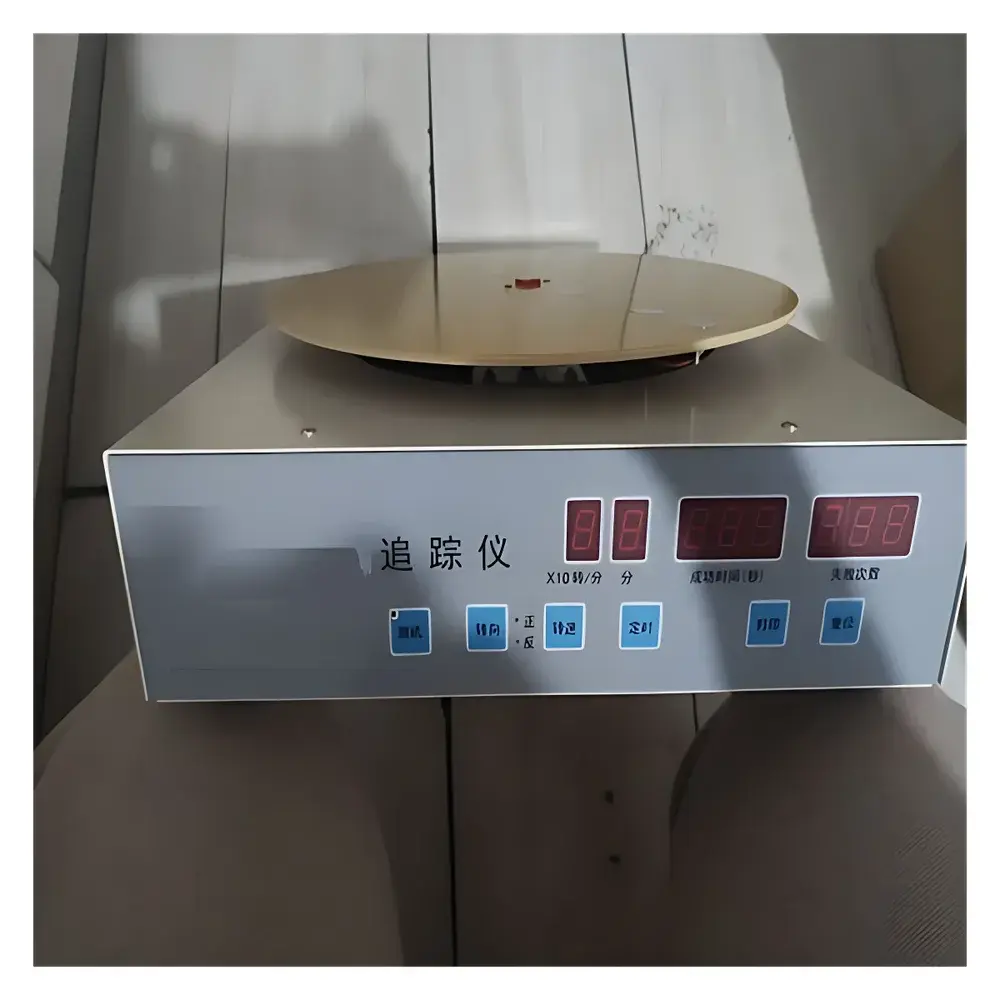
The HengaoDe BD-II-305A Visual-Motor Coordination Tracking Trainer is a precision psychomotor assessment and training instrument engineered for quantitative evaluation of visuomotor integration, hand-eye coordination, and dynamic tracking accuracy under controlled kinematic conditions. Based on the principle of closed-loop visual feedback tracking, the device employs a rotating horizontal disc with discrete target positions to impose time-varying spatial demands on the operator’s manual control system. Subjects use an L-shaped probe to maintain contact with one of four stationary targets mounted concentrically on the rotating disc; successful tracking is registered acoustically upon physical contact, enabling direct comparison between visual-only and audio-visual feedback modalities. This paradigm aligns with standardized neuropsychological protocols used in occupational therapy, rehabilitation engineering, and human factors research—particularly in studies of motor learning, attentional load, and sensorimotor adaptation.
Key Features
- Adjustable rotational dynamics: 9 discrete speed settings (10–90 rpm) allow systematic modulation of task difficulty and temporal prediction demand.
- Bidirectional rotation control (clockwise/counterclockwise) supports comparative analysis of directional asymmetry in motor response latency and error correction.
- Four radially distributed targets (Ø15 mm) at 40, 70, 100, and 130 mm from disc center enable spatial gradient analysis of tracking fidelity across eccentricity.
- Acoustic feedback mechanism provides real-time binary confirmation of target contact, facilitating objective quantification of hit rate, dwell time, and error frequency.
- Programmable timing module with 1–9 minute intervals supports standardized test durations compliant with clinical trial protocols.
- High-resolution success/failure logging: time-stamped success duration (1–999 s, display; 0.01 s resolution, print) and cumulative failure count (up to 999) ensure statistical robustness in repeated-measures designs.
- RS-232 serial output enables direct integration with data acquisition systems for synchronized behavioral logging, timestamp alignment with external stimuli (e.g., EEG, EMG), and automated report generation.
Sample Compatibility & Compliance
The BD-II-305A is designed for human subject testing across diverse populations—including neurotypical adults, clinical cohorts (e.g., post-stroke, Parkinson’s disease, traumatic brain injury), and occupational trainees (e.g., surgeons, pilots, assembly-line technicians). Its mechanical architecture complies with ISO 9241-410:2019 (Ergonomics of human-system interaction — Part 410: Design criteria for physical input devices) regarding force requirements, probe ergonomics, and tactile feedback consistency. The acoustic feedback signal meets ANSI S3.4-2021 loudness thresholds for non-distracting yet discriminable auditory cues. While not classified as a medical device under FDA 21 CFR Part 820 or EU MDR, the instrument adheres to general laboratory safety standards (IEC 61000-4-2 ESD immunity, IEC 61326-1 for EMC compliance) and is routinely deployed in GLP-aligned cognitive-motor laboratories conducting protocol-driven behavioral phenotyping.
Software & Data Management
The BD-II-305A operates as a standalone hardware platform with embedded microcontroller-based logic; no proprietary software installation is required for basic operation. However, its RS-232 interface supports bidirectional communication with third-party acquisition environments including MATLAB® Psychtoolbox, Python (PySerial + Pandas), LabVIEW™, and E-Prime®. Exported data streams include: timestamp (ms), target ID (1–4), contact status (0/1), cumulative failure count, and elapsed session time. All data are ASCII-delimited for immediate import into statistical packages (SPSS, R, JASP). For longitudinal studies, the device supports audit-trail logging when paired with timestamp-synchronized external systems—enabling full traceability per ALCOA+ principles (Attributable, Legible, Contemporaneous, Original, Accurate, Complete, Consistent, Enduring, Available).
Applications
- Clinical neuropsychology: Quantifying visuomotor deficits in cerebellar ataxia, basal ganglia disorders, and fronto-parietal network dysfunction.
- Rehabilitation science: Monitoring recovery trajectories during constraint-induced movement therapy or robotic-assisted motor retraining.
- Human factors engineering: Validating interface design for teleoperation systems, surgical robotics, and augmented reality control schemes.
- Occupational health: Assessing fine-motor readiness for precision tasks in aviation maintenance, microelectronics assembly, and laparoscopic surgery.
- Educational research: Investigating developmental milestones in sensorimotor integration across childhood and adolescence.
- Pharmacological trials: Evaluating dose-dependent effects of CNS-active compounds (e.g., dopaminergic agents, GABA modulators) on motor timing and predictive control.
FAQ
Is the BD-II-305A suitable for pediatric populations?
Yes—its adjustable rotation speeds, low-force probe actuation (<0.3 N), and modular timing allow age-appropriate task scaling; normative data for ages 6–18 are available upon request.
Can target positions be reconfigured for custom experimental designs?
No—the four target locations are mechanically fixed per GB/T 22264.1–2008 metrological validation requirements; however, target selection order and rotation direction are fully programmable via front-panel controls.
What calibration procedures are required before use?
The unit undergoes factory calibration for rotational speed accuracy (±0.5 rpm) and timing circuit stability (±0.1 s/hour). No user recalibration is needed; annual verification against NIST-traceable tachometer and stopwatch is recommended.
Does the device support dual-task paradigms (e.g., concurrent cognitive load)?
Yes—its silent operation (acoustic feedback only on contact) and minimal visual clutter permit integration with auditory Stroop, n-back, or verbal fluency tasks without cross-modal interference.
Is technical documentation available in English for regulatory submissions?
Yes—CE-conformity declaration, electrical safety test reports (IEC 61010-1), and full mechanical schematics are provided in English upon institutional purchase agreement.





