
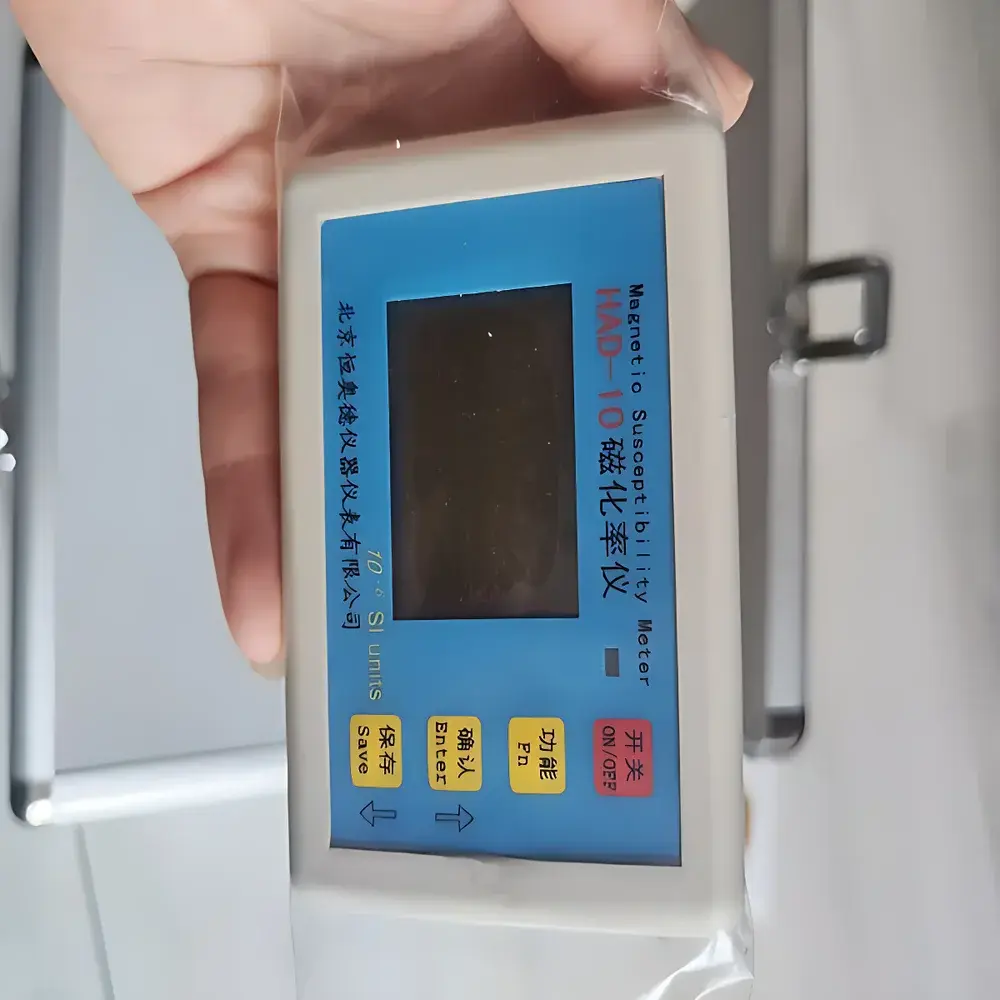
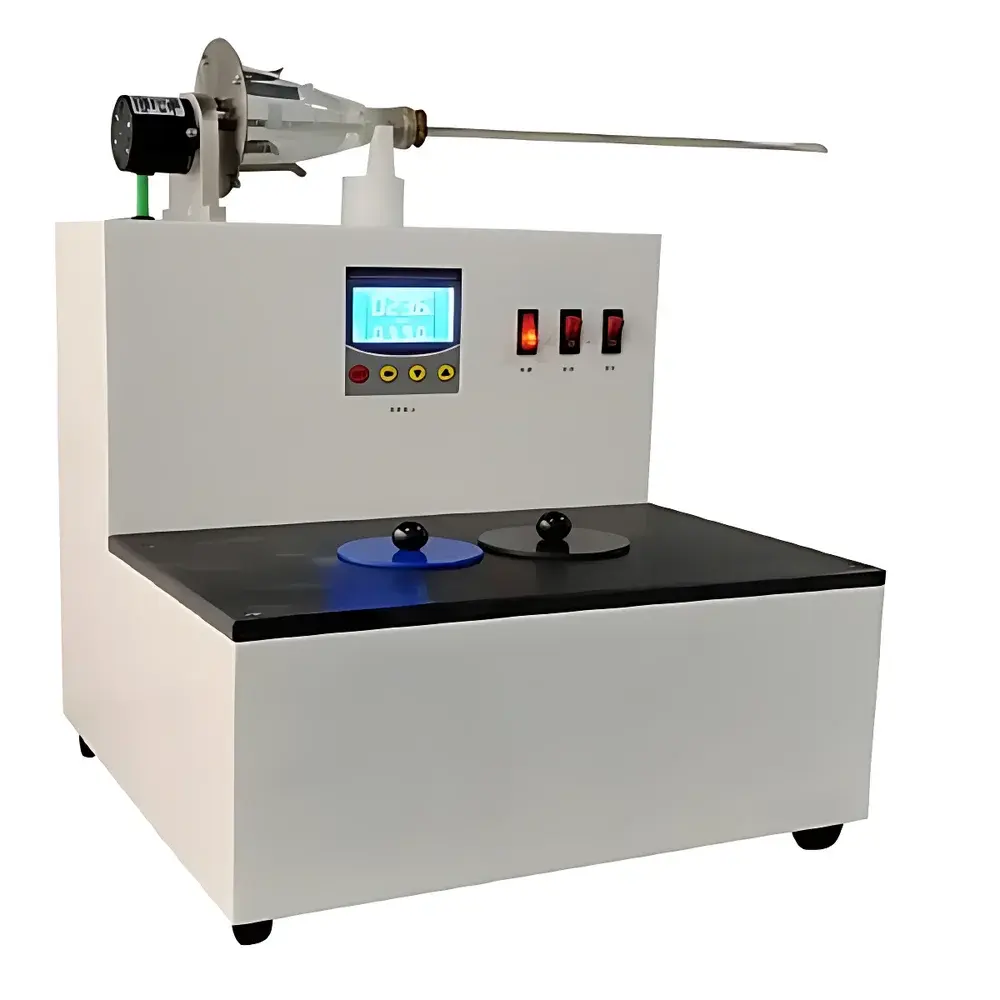
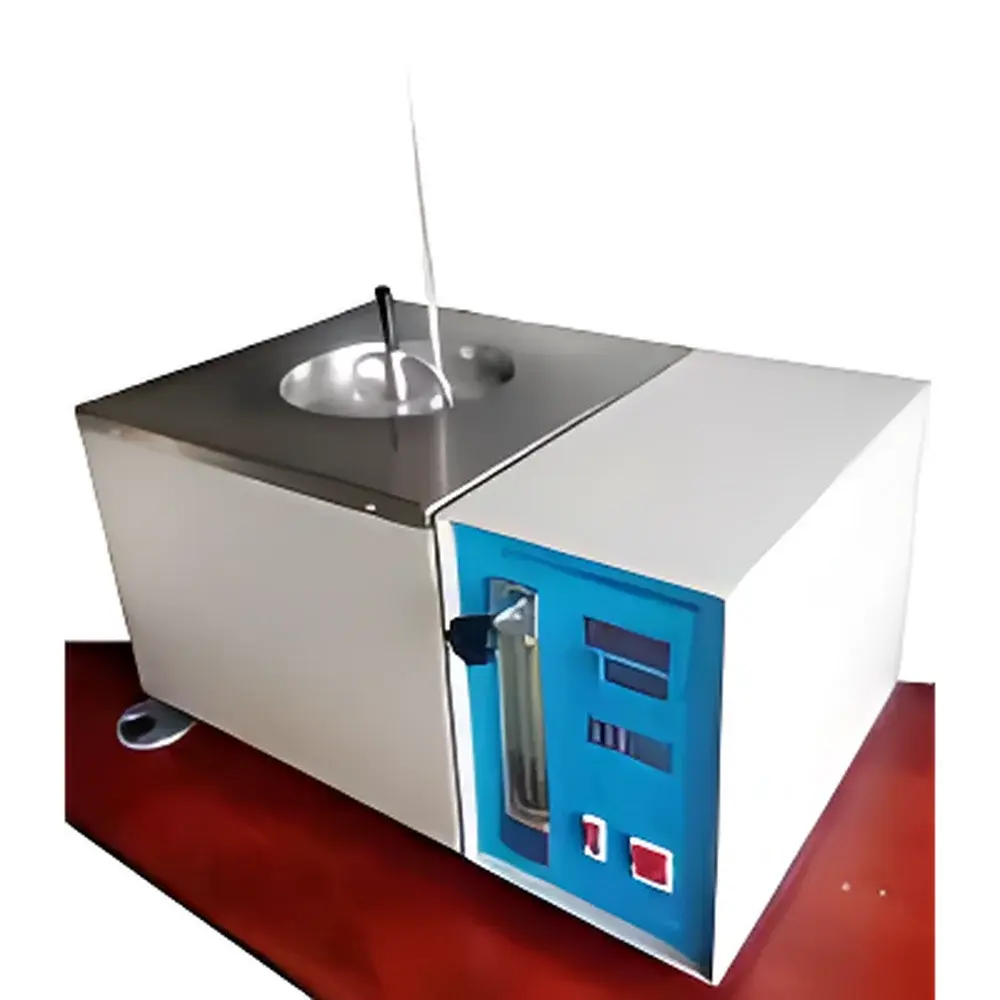
HengaoDe HAD-10 Portable Magnetic Susceptibility Meter
| Brand | HengaoDe |
|---|---|
| Origin | Beijing, China |
| Manufacturer Type | Authorized Distributor |
| Country of Origin | China |
| Model | HAD-10 |
| Price | USD 275 (FOB) |
| Sensitivity | 1×10⁻⁶ SI units |
| Measurement Range | 0–10 SI |
| Dimensions | 90×70×30 mm |
| Weight | 0.18 kg |
| Operating Frequency | 8 kHz |
| Measurement Time | ~3 s (basic mode) |
| Display | LED LCD |
| Control | 4-button interface |
| Data Storage | 255 measurements |
| Coil Diameter | 50 mm |
| Operating Temperature | −20°C to +50°C |
| Power | Rechargeable Li-ion battery (28 h runtime) |
| Charging Interface | USB 2.0 |
| Communication Interface | USB 2.0 |
Overview
The HengaoDe HAD-10 Portable Magnetic Susceptibility Meter is a compact, field-deployable instrument engineered for rapid, high-resolution measurement of volumetric magnetic susceptibility (χ) in geological and environmental samples. It operates on the principle of low-frequency alternating current (AC) induction within a precisely wound excitation coil, detecting minute changes in induced eddy currents caused by sample magnetization under a controlled 8 kHz field. This method conforms to established geophysical protocols for non-destructive, bulk-sample characterization—particularly suited for distinguishing paramagnetic, diamagnetic, and ferromagnetic mineral assemblages in unprocessed rock chips, core segments, or soil specimens. Its sub-milligram mass and shirt-pocket footprint enable seamless integration into field survey workflows, while its calibrated SI-unit output ensures direct comparability with laboratory-based susceptometers used in academic and regulatory contexts (e.g., ISO 11272:2020 Soil quality — Determination of magnetic susceptibility). The device does not require sample preparation beyond size reduction to fit within the 50 mm coil aperture, making it ideal for real-time stratigraphic logging and rapid lithological screening.
Key Features
- High-resolution detection limit of 1×10⁻⁶ SI units—sufficient to resolve subtle variations between hematite-rich shales and quartz-dominant sandstones.
- Robust, temperature-compensated signal processing architecture that maintains accuracy across −20°C to +50°C ambient conditions—validated per IEC 60068-2 environmental testing standards.
- Integrated rechargeable lithium-ion battery with USB-C charging port and 28-hour continuous operation—eliminating dependency on external power during extended field campaigns.
- Onboard data logger storing up to 255 timestamped measurements, each tagged with operator ID and location metadata (via optional Bluetooth GPS module).
- Four-button ergonomic interface with intuitive menu navigation; no software installation required for basic operation.
- IP54-rated enclosure resistant to dust ingress and incidental water splashing—suitable for outdoor use in humid or dusty environments.
Sample Compatibility & Compliance
The HAD-10 accepts solid, non-conductive, and semi-conductive samples with maximum dimensions of 45 mm × 45 mm × 25 mm. It is routinely deployed for analysis of drill core fragments, outcrop hand specimens, sediment cores, and archaeological ceramics. While not intended for liquid-phase or highly conductive metallic samples, its design complies with ASTM D7111–22 Standard Practice for Determining Magnetic Susceptibility of Soils and Rocks using Portable Instruments. Instrument calibration traceability is maintained via factory-certified reference standards (NIST-traceable Ni-Cu alloy disks), with annual recalibration recommended per GLP guidelines. All firmware and hardware revisions are documented under ISO 9001:2015 quality management system controls.
Software & Data Management
Data export is supported via USB 2.0 connection to Windows/macOS/Linux systems. A vendor-provided, open-format CSV exporter enables direct import into Excel, R, Python (pandas), or GIS platforms such as QGIS and ArcGIS Pro. No proprietary drivers or cloud dependencies are required. Audit trails—including measurement timestamps, battery voltage at time of acquisition, and user-defined sample IDs—are embedded in every exported record. For regulated environments (e.g., EPA Region 10 field assessments or EU EEA monitoring programs), the device supports 21 CFR Part 11-compliant electronic signatures when paired with validated third-party data capture software (e.g., LabArchives or Benchling).
Applications
- Field-based lithological discrimination during mineral exploration, especially in iron oxide-copper-gold (IOCG) and banded iron formation (BIF) terrains.
- Rapid assessment of paleomagnetic overprinting in Quaternary sediments for relative dating and provenance studies.
- Soil contamination screening—elevated susceptibility often correlates with anthropogenic heavy metal loading (e.g., Pb, Zn, Cr) in urban and industrial sites.
- Archaeogeophysical prospection: mapping buried kilns, hearths, and fired-clay structures through localized magnetic enhancement anomalies.
- Quality control in construction aggregate sourcing—identifying magnetite-rich fractions that may compromise concrete durability or radiofrequency shielding performance.
FAQ
Is the HAD-10 suitable for measuring powdered samples?
Yes—provided the powder is packed into a non-magnetic cylindrical container (e.g., plastic vial) with consistent geometry and density; bulk susceptibility remains proportional to volume fraction.
Does the instrument require daily zeroing?
No—factory calibration is stable for ≥12 months under normal use; however, a quick air-zero check (measuring empty coil) is recommended before each field session.
Can it distinguish between magnetite and maghemite?
Not definitively on its own—both exhibit strong ferrimagnetism. However, sequential heating-cooling cycles (using an external oven) combined with repeated HAD-10 readings can reveal Verwey transition behavior diagnostic of stoichiometric magnetite.
What is the minimum detectable mass for a typical basalt chip?
Approximately 12 g at 1×10⁻⁶ SI sensitivity—equivalent to a 2 cm³ fragment with χ ≈ 0.01 SI.
Is USB data transfer compatible with macOS Ventura or later?
Yes—the device enumerates as a standard CDC ACM serial device; no kernel extensions or third-party drivers are needed.





