HengaoDe HAD-FKC-III Impactor Airborne Microbial Sampler
| Brand | HengaoDe |
|---|---|
| Origin | Beijing, China |
| Manufacturer Type | Authorized Distributor |
| Country of Origin | China |
| Model | HAD-FKC-III |
| Price | USD 92.50 (FOB) |
| Sampling Flow Rate | 100 L/min |
| Adjustable Sampling Volume | 10–9999 L |
| Sampling Delay | 1–60 s |
| Sampling Modes | 3-step programmable |
| Power Source | Rechargeable Li-ion battery (16.8 V, 8.8 Ah), ≥6 h continuous operation |
| Weight | 6 kg (full 316L stainless steel construction) |
| Petri Dish Size | Ø90 × 15 mm |
| Display | High-brightness LCD |
| Operating Temperature | 0–50 °C |
| Relative Humidity | 10–90 % RH |
| Calibration Interval | Annually |
| Material | 316L stainless steel sampling head |
| Noise Level | Low-noise diaphragm pump |
| Compliance | Designed per ISO 14698-1 & EU GMP Annex 1 principles for viable particle monitoring |
Overview
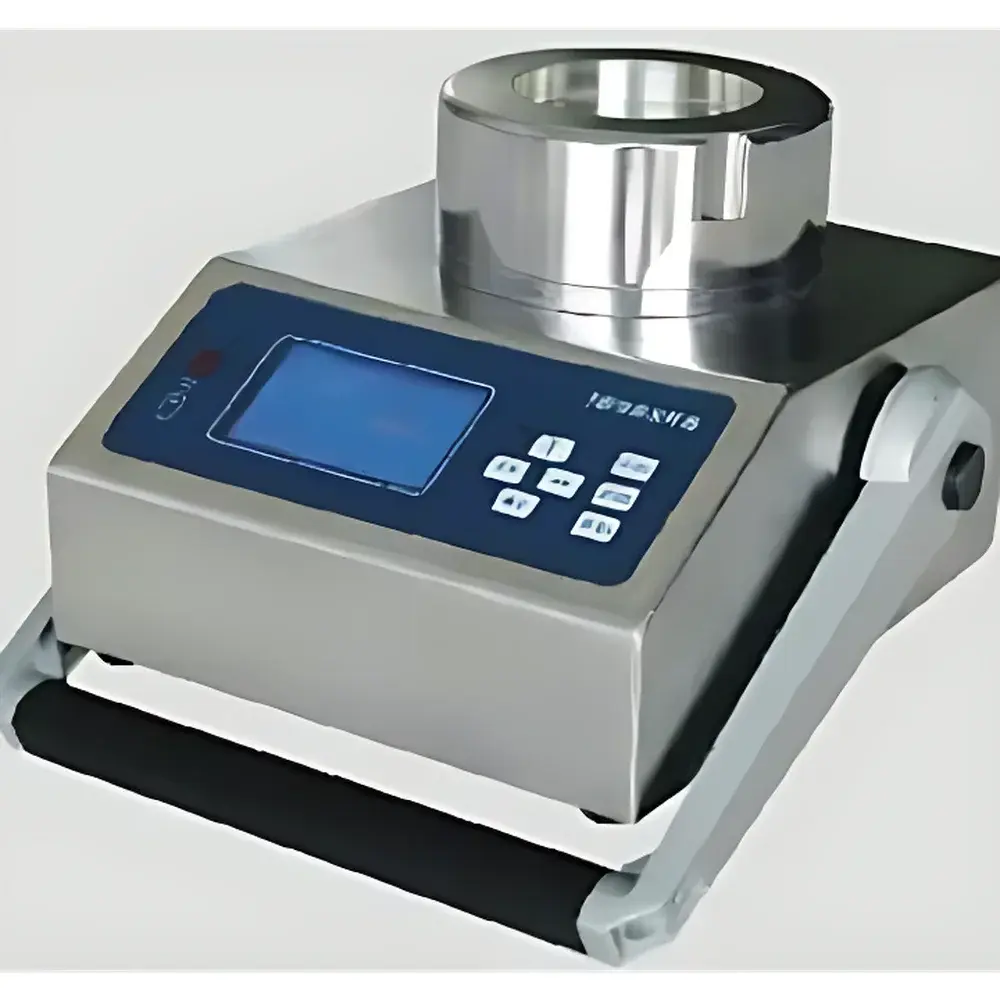
The HengaoDe HAD-FKC-III Impactor Airborne Microbial Sampler is a precision-engineered, multi-orifice inertial impactor designed for quantitative collection of viable airborne microorganisms in controlled environments. It operates on the principle of isokinetic sampling—maintaining equivalence between the inlet jet velocity and the ambient air velocity within cleanrooms or isolators—to ensure representative capture of microbial aerosols without particle bounce or re-entrainment. Air is drawn at a constant 100 L/min through 400 precisely aligned micro-orifices; microorganisms are inertially deposited onto standard 90 mm agar plates with high biological recovery efficiency (>90% for 1–5 µm particles per ISO 14698-2 validation protocols). The instrument’s fully stainless-steel (316L) construction ensures compatibility with autoclaving, VHP, and ethanol-based sterilization—critical for pharmaceutical Grade A/B cleanroom qualification and routine environmental monitoring (EM) programs.
Key Features
- Isokinetic sampling head with real-time flow stabilization to match cleanroom airflow profiles
- Three-step programmable sampling volume selection (10–9999 L) with adjustable pre-delay (1–60 s) for synchronized integration into facility EM schedules
- Low-noise, brushless diaphragm pump delivering stable 100 L/min flow across full operating pressure range (up to 25 kPa backpressure)
- Integrated high-capacity Li-ion battery (16.8 V / 8.8 Ah) enabling ≥6 hours of uninterrupted field operation—ideal for multi-point monitoring in large-scale facilities
- Full 316L stainless-steel chassis and sampling head, resistant to corrosion from disinfectants and compatible with ISO 14698-2 cleaning validation
- Backlit LCD interface with intuitive menu navigation, real-time flow verification, and error logging (e.g., low battery, flow deviation >±5%)
- Remote control capability via IR receiver for hands-free operation in aseptic zones
Sample Compatibility & Compliance
The HAD-FKC-III accepts standard 90 × 15 mm Petri dishes filled with TSA, SDA, or other pharmacopeial media (USP , EP 2.6.12, JP 4.07). Its impactor geometry complies with the aerodynamic cut-off criteria defined in ISO 14698-1 for viable particle enumeration and supports qualification per EU GMP Annex 1 (2022) Section 8.61–8.65 for environmental monitoring system design. While not certified to ISO/IEC 17025, the device is engineered to support GLP/GMP audit readiness: all calibration records, maintenance logs, and operational parameters (flow rate, volume, time stamp) are traceable via manual entry and stored in operator documentation. Annual recalibration against NIST-traceable flow standards is recommended per internal SOPs and regulatory expectations.
Software & Data Management
The HAD-FKC-III operates as a standalone hardware platform with no embedded firmware-based data export. However, its deterministic sampling parameters—start time, duration, total volume, and delay—are manually logged alongside plate identifiers in paper-based or LIMS-integrated environmental monitoring records. For digital workflow integration, users may pair the sampler with external time-stamped loggers or barcode-scanned plate tracking systems. The device’s mechanical reliability and repeatable flow performance (±2% repeatability over 500 cycles per ISO 14698-2 Annex C) reduce variability in colony-forming unit (CFU) enumeration—supporting robust statistical process control (SPC) analysis in long-term EM trend reports.
Applications
- Pharmaceutical aseptic processing line monitoring (Grade A–D zones per EU GMP Annex 1)
- Biotechnology cleanroom qualification (IQ/OQ/PQ) and routine surveillance
- Hospital pharmacy compounding suites and sterile product manufacturing areas
- Medical device packaging clean environments requiring ISO 14644-1 Class 5–8 verification
- Research laboratories conducting airborne pathogen aerosol studies under BSL-2 containment
- Food production facilities validating hygienic design and environmental hygiene controls
FAQ
What is the recommended calibration frequency?
Annual calibration against a primary flow standard (e.g., bubble meter or mass flow controller traceable to NIST) is required to maintain measurement integrity per ISO 14698-2 Clause 7.3. Internal flow verification should be performed before each sampling shift.
Can the HAD-FKC-III be used in ISO Class 5 laminar flow hoods?
Yes—its isokinetic inlet design and low-vibration pump allow direct placement within unidirectional airflow zones without disrupting laminar flow patterns or inducing turbulence-induced particle resuspension.
Does the unit comply with FDA 21 CFR Part 11 requirements?
No—the HAD-FKC-III has no electronic data storage or user authentication. Compliance with Part 11 must be achieved at the system level (e.g., via LIMS or validated electronic lab notebook integration), not by the sampler itself.
How is biological recovery efficiency validated?
Recovery testing shall follow ISO 14698-2 Annex D using Bacillus atrophaeus spores (1.0–1.5 µm) aerosolized at known concentrations; typical recovery rates exceed 92% at 100 L/min with Tryptic Soy Agar.
Is the 316L stainless-steel head suitable for hydrogen peroxide vapor (VHP) decontamination?
Yes—316L exhibits excellent resistance to VHP exposure up to 1000 ppm concentration and 60 °C, provided surfaces are dried post-cycle to prevent chloride-induced pitting.