
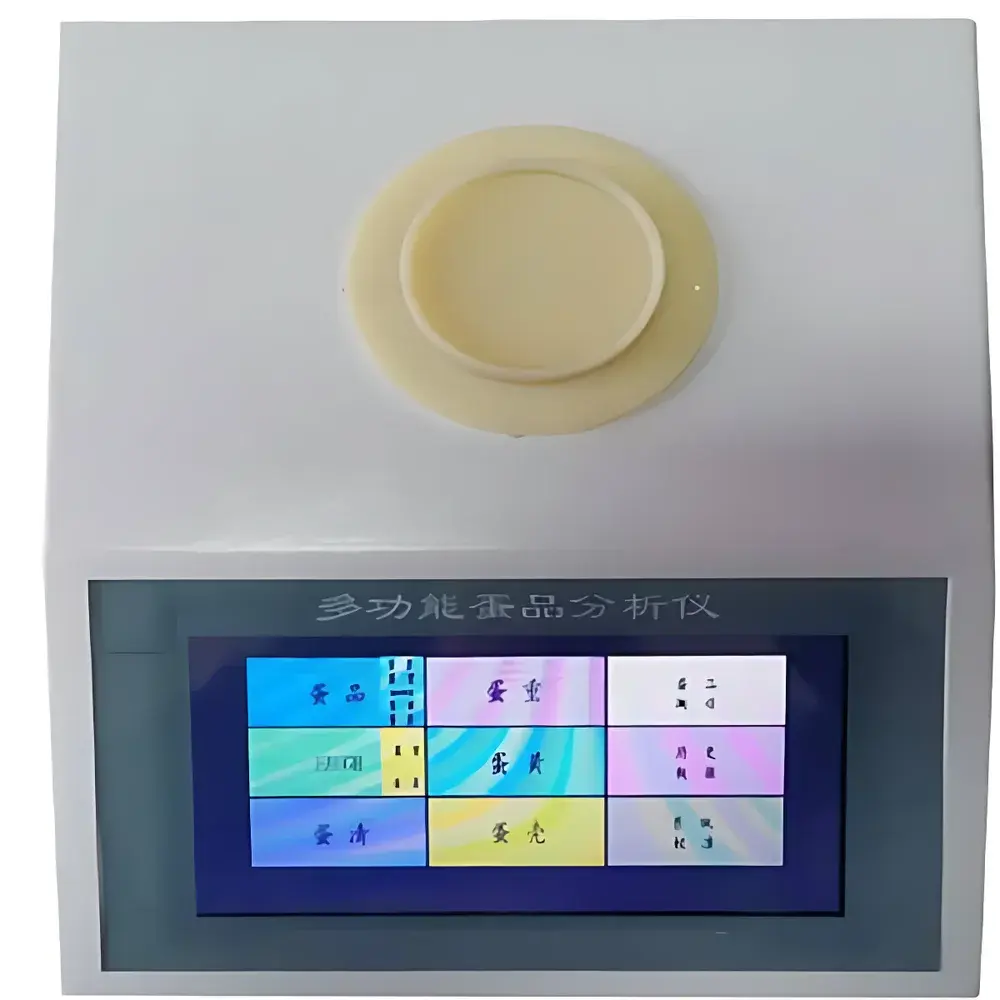
HengaoDe MA2 Multi-Function Egg Quality Analyzer – Albumen Height, Haugh Unit, Shell Thickness & Yolk Color Tester (Model H18064)
| Brand | HengaoDe |
|---|---|
| Origin | Beijing, China |
| Manufacturer Type | Authorized Distributor |
| Country of Origin | China |
| Model | H18064 |
| Price | USD 1,850 (FOB Beijing) |
| Albumen Height Range | 0.00–25.00 mm |
| Resolution | 0.01 mm |
| Egg Weight Range | 0–250 g |
| Resolution | 0.1 g |
| Haugh Unit Range | 0–130 |
| Yolk Color Scale | 1–18 (Roche Yolk Color Fan equivalent) |
| Shell Thickness Range | 0.00–25.00 mm |
| Resolution | 0.01 mm |
| Display | 7-inch color capacitive touchscreen |
| Data Interface | USB 2.0 + RS232 |
| Software | Windows-compatible data management suite with statistical analysis, export (CSV, Excel), and GLP-compliant audit trail |
| Printer | Integrated portable thermal printer (optional) |
| Sample Stage | Acrylic leveling platform with four-point height adjustment |
| Sample Tray | Removable acrylic egg-white collection tray |
| Compliance | ASTM E1193-22 (Egg Quality Testing), ISO 6571:2021 (Eggshell Thickness Measurement), USDA AMS Grade Standards |
Overview
The HengaoDe MA2 Multi-Function Egg Quality Analyzer (Model H18064) is an integrated, microprocessor-controlled instrument engineered for objective, repeatable assessment of avian egg quality parameters in agricultural research laboratories, poultry processing QA/QC facilities, and regulatory testing centers. It employs precision digital displacement sensing combined with calibrated mechanical probing to simultaneously quantify albumen height, yolk height, shell thickness, egg weight, and yolk color—each measured according to internationally recognized methodologies. The device calculates Haugh Units (HU) in real time using the standardized formula: HU = 100 × log(h − 1.7 × w0.37 + 7.6), where *h* is albumen height (mm) and *w* is egg weight (g). Its measurement architecture conforms to the physical principles defined in AOAC Official Method 966.07 and ISO 6571, ensuring metrological traceability and inter-laboratory comparability.
Key Features
- Simultaneous multi-parameter acquisition: albumen height, shell thickness, yolk height, egg mass, and yolk color—all within a single automated measurement cycle.
- High-resolution linear optical displacement sensors with ±0.01 mm repeatability for both albumen and shell thickness measurements.
- Intelligent probe mode recognition: automatic switching between albumen height and shell thickness modes based on contact resistance detection at the liquid-air or solid-shell interface.
- 7-inch full-color capacitive touchscreen with intuitive icon-driven workflow—no external keyboard or mouse required.
- Integrated sample numbering system with timestamping and operator ID logging (supports up to 1,000 unique sample IDs per session).
- Acrylic test platform with independent four-corner leveling screws ensures consistent probe perpendicularity across variable egg curvature.
- Removable, autoclavable acrylic egg-white collection tray minimizes cross-contamination and facilitates rapid cleaning between samples.
- Onboard thermal printer (optional) enables immediate hard-copy reporting compliant with internal QA documentation requirements.
Sample Compatibility & Compliance
The MA2 accommodates standard chicken eggs (Grade A–C, 50–75 g) as well as duck, turkey, and quail eggs via adjustable cradle positioning. Shell thickness measurements are validated for calcified avian shells with surface roughness < 5 µm Ra (per ISO 4287). All quantitative outputs—including Haugh Unit classification (AA ≥ 72, A = 60–71, B = 31–59, C ≤ 30)—align with USDA Agricultural Marketing Service grading standards and EU Commission Regulation (EC) No 589/2008. Instrument calibration is traceable to NIST-traceable gauge blocks and certified reference weights. The system supports GLP-compliant operation through password-protected user roles, electronic signature capability, and tamper-evident audit logs embedded in exported datasets.
Software & Data Management
The included Windows-based software (v3.2+) provides full lifecycle data governance: real-time visualization of measurement curves, batch-level statistical summaries (mean, SD, CV%, min/max), trend charting over time, and customizable report generation (PDF, CSV, XLSX). Raw sensor voltage traces and intermediate calculation steps are stored alongside final results, satisfying FDA 21 CFR Part 11 requirements for electronic records and signatures when configured with user authentication and audit trail activation. Data export includes metadata headers (operator ID, calibration date, ambient temperature/humidity), enabling seamless integration into LIMS environments. Firmware updates are delivered via encrypted USB key with SHA-256 checksum verification.
Applications
- Quality assurance in commercial hatcheries and table-egg packing plants.
- Genetic selection programs evaluating hen lines for albumen stability and shell integrity.
- Feed formulation studies assessing impacts of dietary calcium, phosphorus, and vitamin D3 on shell ultrastructure.
- Storage stability trials monitoring Haugh Unit decline during refrigerated or ambient shelf life.
- Regulatory compliance testing for national egg grading authorities (e.g., USDA AMS, CFIA, RASFF).
- Academic research in avian physiology, food science, and post-harvest technology.
- Validation of novel egg washing or coating technologies on functional quality parameters.
FAQ
What standards does the MA2 comply with for Haugh Unit calculation?
The instrument implements the exact mathematical definition from USDA AMS Handbook 75 and ISO 6571:2021, including mandatory correction for egg weight and use of natural logarithm base.
Can the device measure eggs with cracked or abnormally thin shells?
Yes—shell thickness mode operates independently and delivers valid readings down to 0.12 mm; however, accuracy below 0.15 mm requires manual validation against cross-sectional SEM imaging.
Is yolk color measurement spectrophotometric or fan-based?
It uses a calibrated RGB image capture module aligned to the Roche Yolk Color Fan (1–18 scale), with automatic white balance and ambient light compensation.
How is calibration maintained between daily use?
A two-point mechanical calibration (zero and 10.00 mm reference block) is recommended before each shift; full NIST-traceable recalibration is advised every 6 months or after 5,000 measurements.
Does the software support multi-user environments with role-based access?
Yes—administrator, analyst, and reviewer roles can be assigned with differential permissions for data modification, report approval, and system configuration.






