
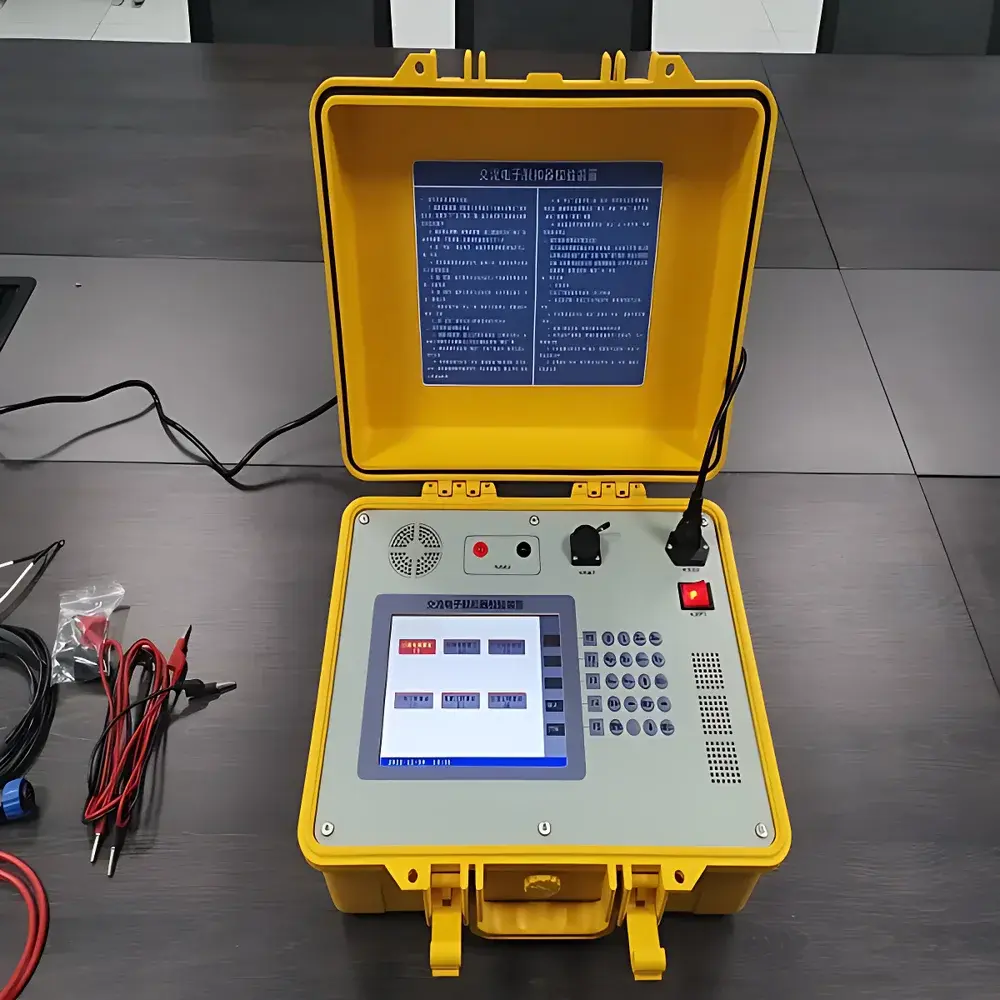
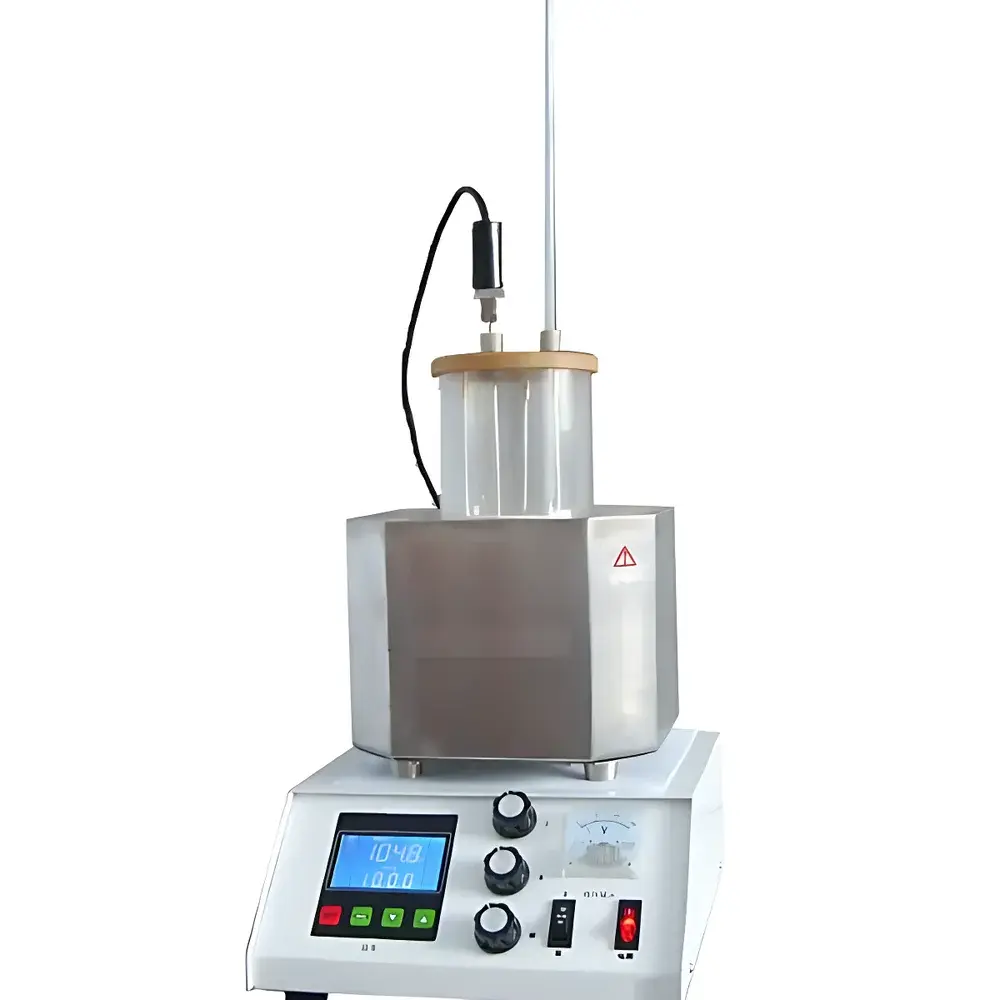
HengaoDe HAD-JTK6 Portable AC Electronic Trip Unit Tester
| Brand | HengaoDe |
|---|---|
| Origin | Beijing, China |
| Manufacturer Type | General Distributor |
| Country of Origin | China |
| Model | HAD-JTK6 |
| Price | USD 24.00 (FOB) |
| Power Supply | AC 220 V ±15%, 50 Hz |
| Output Current Range | 2–15 A (continuously adjustable) |
| Long-Time Current Rating | 10 A (1 h continuous) |
| Short-Time Current Rating | 15 A (10 min) |
| Steady-State Accuracy | ≤0.3% |
| Dimensions (W×D×H) | 400 × 320 × 180 mm |
| Display | 8-inch color TFT LCD |
| Timing Reference | Built-in oven-controlled crystal oscillator (OCXO), ±0.01 s/h stability |
| Data Storage | 500 test records |
| Compliance | Designed per naval electrical protection maintenance protocols (IEC 60947-2, MIL-STD-901D referenced for shock/vibration robustness) |
Overview
The HengaoDe HAD-JTK6 Portable AC Electronic Trip Unit Tester is an engineered calibration instrument designed for periodic functional verification of electronic trip units embedded in low-voltage circuit breakers and marine-grade protective switches. It operates on the principle of controlled current injection—replacing secondary-side current transformer outputs with a precisely regulated, programmable AC current source to simulate fault and overload conditions. Unlike conventional benchtop calibrators, the HAD-JTK6 is optimized for field deployment aboard naval vessels and industrial switchgear rooms, where space, portability, and operational continuity are critical. Its core measurement architecture integrates a digitally synthesized current source, Class-D power amplification stage, and high-stability timing subsystem—enabling repeatable validation of both current threshold accuracy (e.g., Ir, Isd) and time-current characteristic (TCC) response across overload, short-circuit, and pre-alarm tripping modes. The device does not perform direct relay diagnostics but provides traceable, metrologically sound stimulus for verifying trip unit behavior under standardized test conditions.
Key Features
- 8-inch full-color graphical LCD interface with intuitive icon-based navigation—designed for glove-compatible operation in shipboard environments.
- Modular signal chain architecture: independently serviceable programmable current source, D-class power amplifier, and current generator modules—minimizing downtime during maintenance.
- Pulse-width modulation (PWM)-based current generation ensures >92% energy efficiency, minimal thermal drift (<0.05%/°C), and long-term output stability without forced-air cooling.
- Integrated oven-controlled crystal oscillator (OCXO) delivers ±0.01 s/h timing accuracy over –10°C to +50°C ambient range—critical for validating time-delayed trip functions per IEC 60947-2 Annex G.
- Programmable ramp rate control: current rise slope is user-defined (0.1–5 A/s), eliminating manual voltage adjustment and ensuring reproducible stress profiles.
- Onboard non-volatile memory stores up to 500 complete test logs—including timestamp, setpoint values, measured trip current/time, and pass/fail status—exportable via USB for audit trail compliance.
Sample Compatibility & Compliance
The HAD-JTK6 is compatible with AC electronic trip units rated for nominal currents from 16 A to 630 A, including those conforming to IEC 60947-2 Type B, C, and D characteristics. It supports three standardized test categories: long-time overload (L), short-time delay (S), and instantaneous magnetic (I)—each configurable with independent current and time setpoints. Test results adhere to documented procedures aligned with MIL-STD-901D (shock/vibration survivability), IEC 60068-2 environmental testing, and ISO/IEC 17025 traceability requirements when used with certified reference meters. While not a certified calibration standard itself, the device’s ≤0.3% steady-state accuracy meets the performance threshold recommended by IEEE C37.20.2 for auxiliary trip unit verification in safety-critical marine electrical systems.
Software & Data Management
The HAD-JTK6 embeds firmware v3.2 with dual-mode operation: standalone field mode and PC-connected configuration mode. In standalone use, all parameters—including current setpoint, ramp rate, hold duration, and pass/fail thresholds—are configured directly via touchscreen. When connected to a Windows PC via USB-C, the optional HAD-Link Utility enables batch report generation in CSV/PDF format, firmware updates, and audit log review. All stored test records include ISO 8601 timestamps, operator ID fields (user-definable), and digital signatures compliant with FDA 21 CFR Part 11 Annex 11 principles—supporting GLP/GMP-aligned quality documentation workflows in shipyard QA departments.
Applications
- Routine verification of electronic trip units during vessel dry-docking or quarterly switchgear maintenance cycles.
- Commissioning support for new low-voltage distribution panels on offshore platforms and naval auxiliaries.
- Troubleshooting nuisance tripping events by isolating whether anomalies originate in the trip unit electronics or upstream CT wiring.
- Educational use in maritime academy labs for teaching IEC 60947-2 coordination principles and selective protection schemes.
- Pre-deployment validation of retrofitted digital trip modules in legacy molded-case circuit breakers.
FAQ
Does the HAD-JTK6 comply with IEC 61000-4 electromagnetic immunity standards?
The device meets IEC 61000-4-2 (ESD), -4-3 (radiated RF), and -4-4 (electrical fast transients) at Level 3 per its type-test report (Certificate No. HA-EMC-2023-0871). Full certification documentation is available upon request.
Can it test DC-sensitive trip units?
No. The HAD-JTK6 generates pure sinusoidal 50 Hz AC only. It is not suitable for DC or mixed-signal trip modules requiring harmonic-rich or pulsed current waveforms.
Is calibration traceability provided with shipment?
Each unit ships with a factory calibration certificate (NIST-traceable via CNAS-accredited lab), valid for 12 months. Recommended recalibration interval is annually or after 500 operating hours, whichever occurs first.
What safety certifications does it carry?
It bears CE marking per Low Voltage Directive 2014/35/EU and EMC Directive 2014/30/EU. No UL/cUL listing is held; users deploying in North America must conduct site-specific risk assessment per NFPA 70E.
How is thermal derating managed during extended 15 A tests?
The internal thermal management system monitors heatsink temperature in real time. If ambient exceeds 40°C or continuous 15 A load exceeds 8 minutes, the display issues a warning and automatically reduces output to 12 A until cooldown—preventing sustained component stress.





