
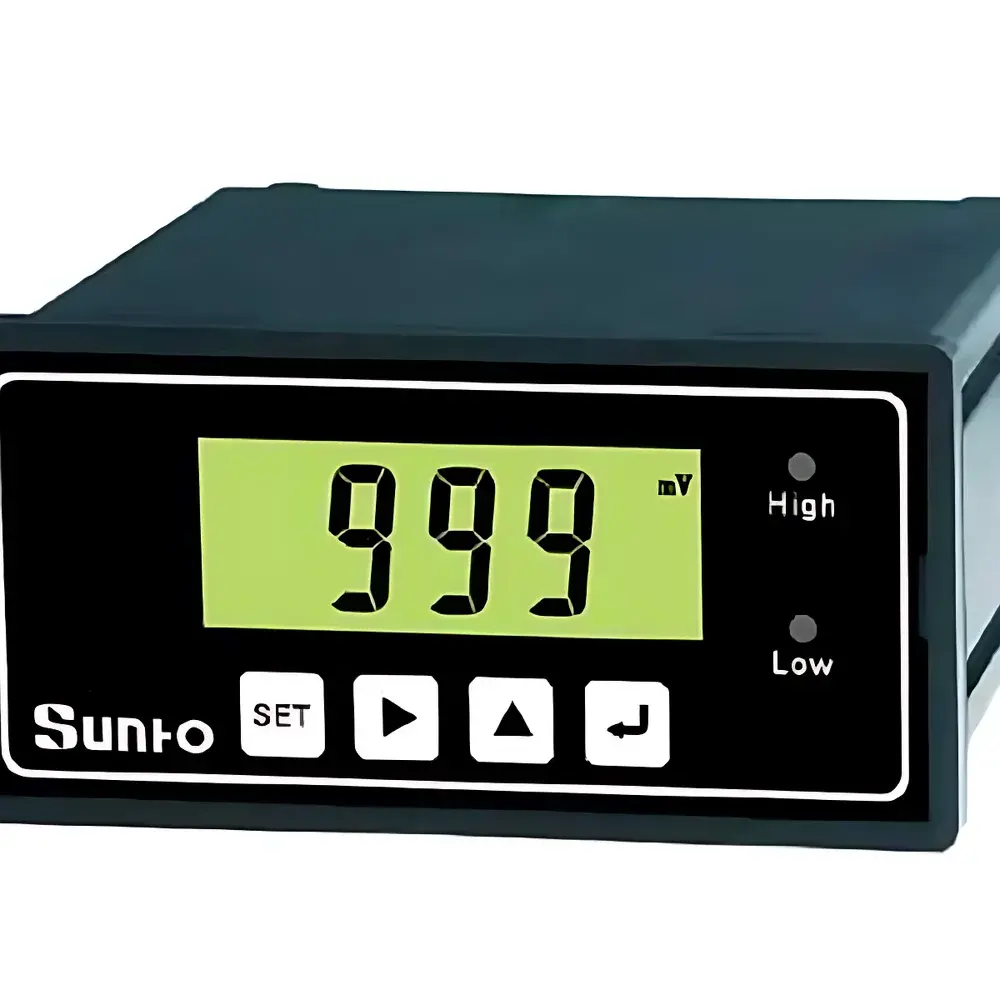
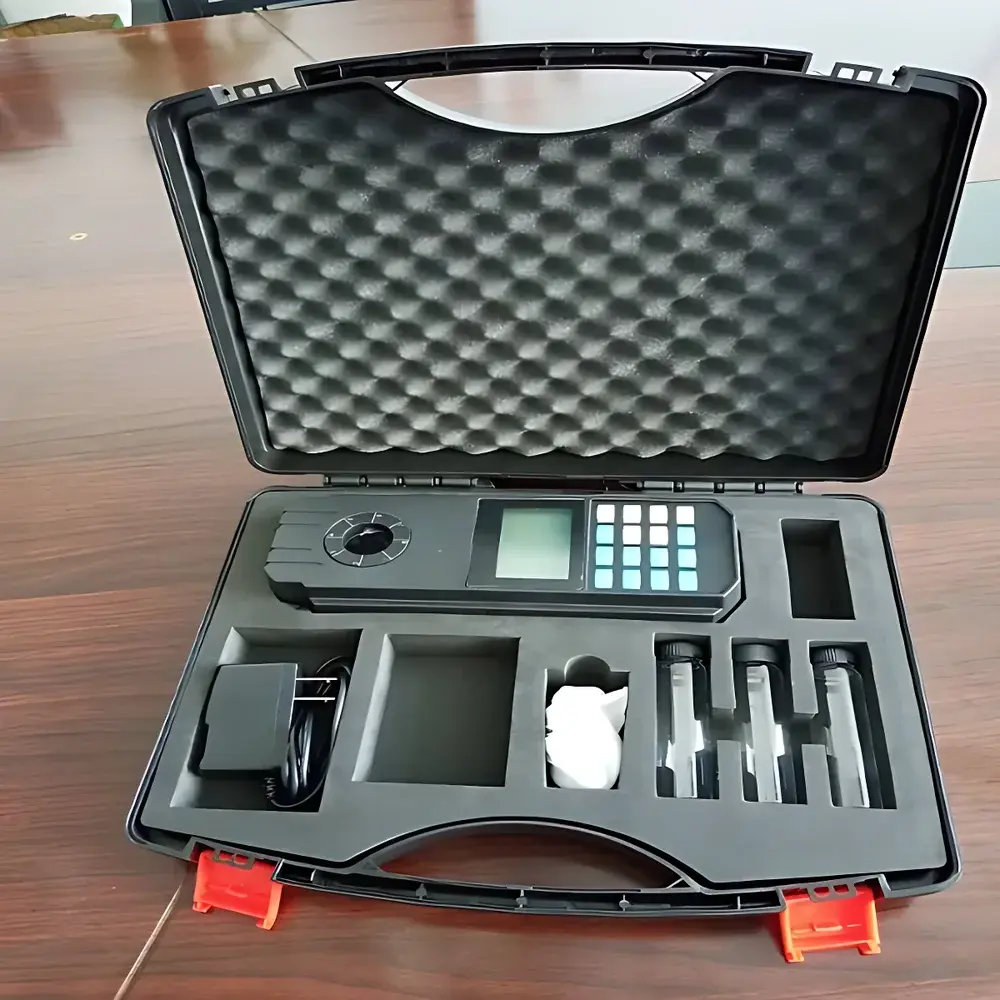
HengaoDe ZQ/ORP-760 & ZQ/ORP-860 Online ORP Monitor and Controller
| Brand | HengaoDe |
|---|---|
| Origin | Beijing, China |
| Manufacturer Type | Authorized Distributor |
| Country of Origin | China |
| Model | ZQ/ORP-760 / ZQ/ORP-860 |
| Price | USD 24.50 (FOB) |
| Measurement Range | −1000 to +1000 mV |
| Accuracy | ±2 mV |
| Input Impedance | >10¹² Ω |
| Display | 3½-digit backlit LCD |
| Output | Optically isolated 4–20 mA analog output |
| Control Output | Dual SPDT relays (high/low limit, adjustable hysteresis) |
| Power Supply | AC 220 V ±10%, 50/60 Hz |
| Operating Temperature | 0–50 °C |
| Relative Humidity | ≤85% RH |
| Enclosure Dimensions | 48 × 96 × 100 mm (H×W×D) |
| Panel Cutout | 45 × 92 mm (H×W) |
| Mounting | Panel-mount |
Overview
The HengaoDe ZQ/ORP-760 and ZQ/ORP-860 are industrial-grade online oxidation-reduction potential (ORP) monitors engineered for continuous, high-stability electrochemical measurement in aqueous process streams. Based on the Nernst equation principle, these instruments measure the reversible potential difference between a noble-metal sensing electrode (typically platinum or gold) and a stable reference electrode (e.g., Ag/AgCl), reporting results in millivolts (mV) relative to the Standard Hydrogen Electrode (SHE). Designed for integration into water treatment plants, electroplating lines, chemical dosing systems, and wastewater bioreactors, the units deliver real-time insight into redox-driven processes—including chlorine disinfection efficacy, cyanide destruction, nitrate reduction, and advanced oxidation reactions—enabling closed-loop control without operator intervention.
Key Features
- Microprocessor-based signal conditioning with digital filtering to suppress electrical noise and improve long-term baseline stability
- Ultra-high input impedance (>10¹² Ω) ensures minimal current draw from ORP electrodes, preserving electrode longevity and measurement fidelity
- Dual independent relay outputs configurable as high-limit, low-limit, or window alarms—with user-adjustable hysteresis to prevent chatter in fluctuating environments
- Galvanically isolated 4–20 mA current loop output compliant with IEC 61000-4 immunity standards, supporting transmission over distances up to 1 km
- Robust DIN-rail compatible housing with IP65-rated front panel and conformal-coated PCBs for operation in humid, corrosive, or splash-prone locations
- Front-panel keypad navigation with password-protected calibration and configuration modes to meet GLP audit requirements
Sample Compatibility & Compliance
The ZQ/ORP series interfaces seamlessly with all standard two-electrode and three-electrode ORP sensors meeting ISO 11277 and ASTM D1129 specifications. It supports both refillable and gel-filled reference electrodes, as well as combination pH/ORP probes where applicable. The instrument complies with CE marking directives (EMC Directive 2014/30/EU and LVD Directive 2014/35/EU), RoHS 2011/65/EU, and meets EN 61326-1:2013 for industrial electromagnetic compatibility. While not certified for SIL or ATEX applications, its design aligns with functional safety principles outlined in IEC 61511 for non-safety-critical monitoring layers.
Software & Data Management
No proprietary software is required for basic operation; however, optional Modbus RTU firmware (via RS485 adapter) enables integration into SCADA, DCS, or PLC-based supervisory systems using standard protocol stacks. The unit logs alarm events with timestamps and stores up to 256 entries in non-volatile memory. All calibration data—including electrode offset, slope, and date/time stamps—is retained during power loss per IEC 62304 Class B software safety classification. Audit trail functionality supports FDA 21 CFR Part 11 compliance when paired with validated host systems that enforce electronic signature and change control workflows.
Applications
- Chlorine residual control in municipal drinking water distribution networks
- Redox monitoring during electrochemical wastewater polishing (e.g., Cr⁶⁺ → Cr³⁺ reduction)
- Process validation in semiconductor rinse tanks where ultra-low ORP thresholds (<−200 mV) indicate deionized water purity
- Biological nutrient removal (BNR) optimization in activated sludge systems via nitrate/nitrite redox transitions
- Quality assurance in pharmaceutical purified water (PW) and water-for-injection (WFI) loops per USP
- Monitoring passivation effectiveness in stainless steel piping after acid wash cycles
FAQ
Does this instrument support automatic temperature compensation (ATC) for ORP measurements?
No. ORP is an absolute potential measurement; temperature correction is not applied mathematically. However, the unit operates reliably across 0–50 °C ambient conditions, and users are advised to maintain consistent sample temperature for comparative trending.
Can I connect a pH/ORP combination electrode?
Yes—provided the electrode features a dedicated ORP output channel and shares common reference junction architecture. Verify compatibility with the electrode manufacturer’s datasheet before installation.
Is calibration traceable to NIST standards?
Field calibration uses certified quinhydrone or Zobell’s solution standards (e.g., +228 mV at 25 °C). While the instrument itself does not carry NIST-traceable certification, it meets repeatability and linearity requirements specified in ISO 15839 for online water quality sensors.
What maintenance intervals are recommended?
Electrode cleaning and reference electrolyte refilling should occur every 3–6 months depending on fouling risk. Instrument verification against standard solutions is recommended prior to critical batch operations or at least quarterly.
Does the relay output support dry-contact isolation for PLC interfacing?
Yes—each relay provides SPDT (Form C) contacts rated for 5 A @ 240 VAC resistive load, suitable for direct connection to safety-rated PLC inputs without external optocouplers.






