
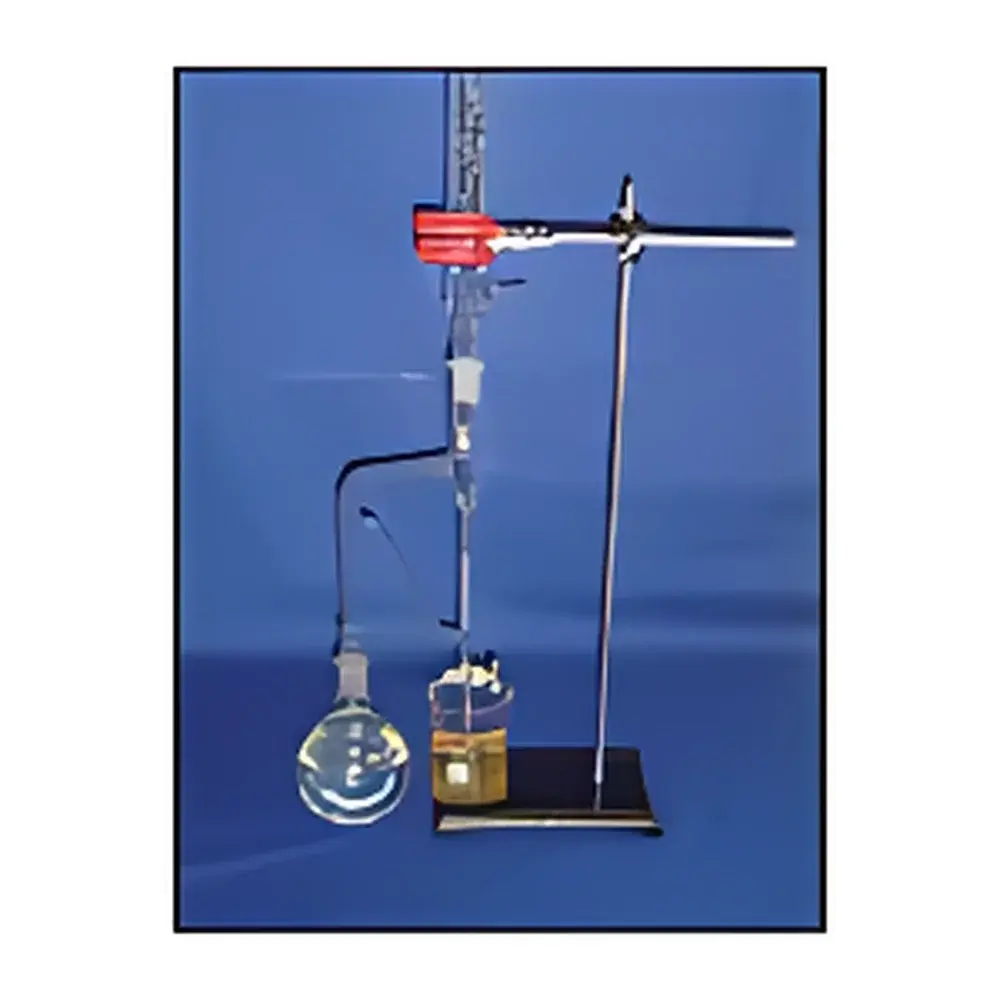
Hengao De HAD-1785 Essential Oil Determination Apparatus (Clevenger-Type Distillation Assembly)
| Brand | Hengao De |
|---|---|
| Origin | Beijing, China |
| Manufacturer Type | Authorized Distributor |
| Country of Origin | China |
| Model | HAD-1785 |
| Price | USD 92.50 (FOB Beijing) |
Overview
The Hengao De HAD-1785 Essential Oil Determination Apparatus is a precision-engineered Clevenger-type distillation assembly designed for quantitative determination of volatile oil content in botanical materials—particularly those yielding oils with specific gravity greater than 1.0 g/mL. Based on the principle of steam distillation and phase separation, the apparatus enables selective condensation and volumetric collection of immiscible volatile oils atop an aqueous distillate layer. Its design conforms to pharmacopoeial methods including Chinese Pharmacopoeia (ChP) Volume I, Section 2331 “Determination of Volatile Oil”, and aligns with ISO 9232:2016 (Essential oils — General guidelines for sampling and analysis). The unit operates under atmospheric pressure and requires no vacuum or auxiliary gas control, making it suitable for routine QC laboratories, herbal medicine quality control units, and academic phytochemistry workflows.
Key Features
- Calibrated receiving tube with 0–5 mL scale, 0.1 mL graduation intervals, and integrated stopcock for controlled oil recovery
- Standardized reflux condenser with inner/outer diameter compatibility (18–20 mm O.D.), effective cooling length of 110 mm, and ground-glass joint (ISO K29/32) for leak-tight connection
- Optimized vapor path geometry ensuring minimal oil adhesion and high recovery reproducibility (>95% for eucalyptus and clove oil reference standards)
- Heat-resistant borosilicate glass construction (DIN 7080 / ASTM E438 Type I, Class A) compliant with GLP handling requirements
- No moving parts or electronic components—mechanical reliability ensures long-term calibration stability without recalibration drift
Sample Compatibility & Compliance
The HAD-1785 accommodates solid, powdered, or coarsely chopped plant matrices—including roots, leaves, seeds, and bark—when processed with appropriate particle size reduction (≤2 mm) and water saturation pre-treatment. It is validated for use with ChP-monographed herbs such as Agastache rugosa, Cinnamomum cassia, and Mentha haplocalyx. All glass components meet ISO 3585 specifications for chemical resistance and thermal shock tolerance (ΔT ≥ 120 °C). The apparatus supports method validation per ICH Q2(R2) for accuracy, repeatability (RSD ≤ 3.5% at n=6), and intermediate precision across operators and days. Documentation includes traceable calibration certificate for the receiving tube (NIST-traceable volumetric standard, uncertainty ±0.02 mL at 20 °C).
Software & Data Management
As a fully manual, non-electronic analytical device, the HAD-1785 does not incorporate embedded firmware, data logging, or digital interfaces. Quantitative results are recorded manually into laboratory notebooks or LIMS-compatible spreadsheets. To support 21 CFR Part 11 compliance in regulated environments, users may integrate the apparatus into validated SOPs that define observation protocols, measurement transcription rules, and reviewer sign-off procedures. Optional accessories include certified reference standards (e.g., USP Essential Oil RS kits) and volumetric verification tools compatible with ISO/IEC 17025-accredited calibration labs.
Applications
- Pharmaceutical QC release testing of herbal extracts and traditional medicine formulations
- Botanical authentication and adulteration screening in nutraceutical supply chains
- Academic research on essential oil yield optimization (e.g., hydrodistillation kinetics, co-distillation effects)
- Regulatory submissions requiring pharmacopoeial-compliant volatile oil assay data
- Teaching laboratories demonstrating classical separation principles in analytical chemistry curricula
FAQ
Is the HAD-1785 compatible with ISO or USP methods?
Yes—the geometry, material specification, and operational parameters comply with ISO 9232:2016 and USP <561> “Volatile Oil Determination”, provided steam generation and condensation conditions are maintained per method requirements.
What is the maximum sample weight the apparatus can accommodate?
Recommended loading is 50–100 g of comminuted material in 500 mL water, adjusted to maintain a 1:5–1:10 solid-to-liquid ratio per ChP guidelines.
Does the receiving tube require periodic recalibration?
Per ISO/IEC 17025, volumetric glassware should be verified annually using gravimetric calibration; a certificate of conformance is supplied with each unit.
Can the apparatus be used for oils with specific gravity < 1.0?
No—the design assumes top-layer collection; low-density oils (e.g., citrus peel oils) require modified Clevenger variants with inverted collection chambers.
Are replacement parts available separately?
Yes—standardized condensers (K29/32), receiving tubes (0–5 mL, Class A), and stopcocks are stocked and interchangeable with other Clevenger assemblies meeting DIN 12321 specifications.






