
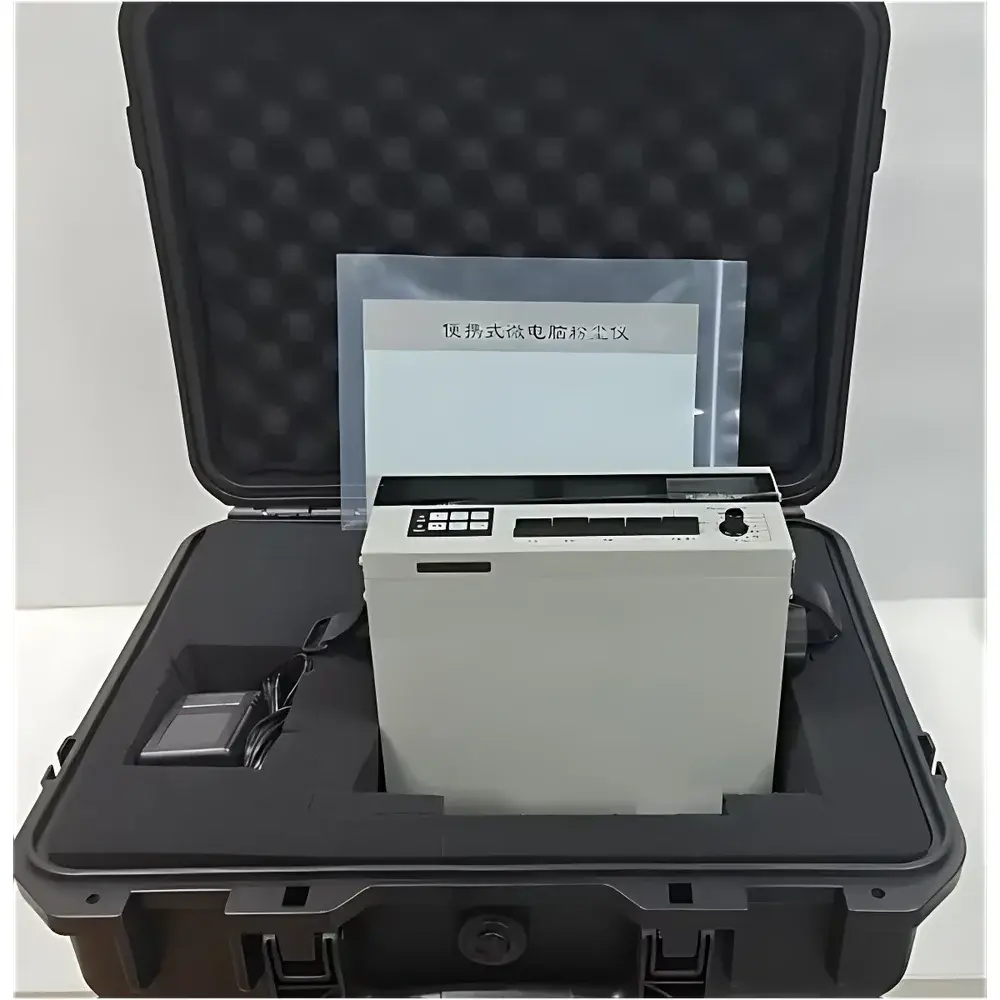
HengaoDe HAD-P5L2C Portable Microcomputer-Based Dust Monitor with Real-Time PM10 Measurement and Data Logging
| Brand | HengaoDe |
|---|---|
| Origin | Beijing, China |
| Manufacturer Type | Authorized Distributor |
| Country of Origin | China |
| Model | HAD-P5L2C |
| Price | USD 42.50 (based on ¥298 at 7.0 CNY/USD) |
| Measurement Principle | Light Scattering (Nephelometry) |
| PM10 Range | 0.01–100 mg/m³ (extendable to 1000 mg/m³) |
| Detection Limit | 0.01 mg/m³ |
| Repeatability Error | <2% |
| Accuracy | ±10% |
| Sampling Duration Options | 0.1, 1, 3, 5, 10, 15 min + manual setting |
| Display | 4-digit LCD showing CPM and mass concentration (mg/m³) |
| Data Output | USB-to-PC interface, optional thermal printer support |
| Memory Capacity | 99 measurement sets |
| Operating Temperature | 0–40 °C |
| Power | Rechargeable Li-ion battery (10 h continuous use), 220 V / 9 V charger |
| Dimensions | 172 × 84 × 183 mm |
| Compliance | WS/T 206–2001, LD 98–1996, TB/T 2323–92 |
Overview
The HengaoDe HAD-P5L2C Portable Microcomputer-Based Dust Monitor is a field-deployable, light-scattering (nephelometric) instrument engineered for rapid, on-site quantification of respirable suspended particulates—specifically PM10—in occupational and environmental settings. It operates in accordance with internationally referenced public health and industrial hygiene standards, including WS/T 206–2001 (China’s Public Health Standard for Inhalable Particulate Matter), LD 98–1996 (Labor Industry Standard for Dust Concentration by Light Scattering), and TB/T 2323–92 (Railway Industry Standard for Mass Concentration Conversion). The device employs a calibrated optical sensing chamber with a high-efficiency LED light source and photodetector array to convert scattered light intensity into mass concentration (mg/m³) using factory-established calibration curves traceable to NIST-traceable aerosol reference materials. Its microprocessor-controlled sampling logic enables configurable integration times—from 0.1 minute to 15 minutes—ensuring adaptability across varying dust dynamics in factories, construction sites, mining operations, and indoor air quality assessments.
Key Features
- Real-time dual-mode display: Simultaneous readout of counts-per-minute (CPM) and gravimetric PM10 concentration (mg/m³) on a backlit 4-digit LCD
- Extended dynamic range: Standard 0.01–100 mg/m³ measurement span, expandable up to 1000 mg/m³ via firmware-configurable gain adjustment
- Battery-powered portability: Integrated rechargeable lithium-ion battery supports ≥10 hours of continuous operation; includes universal 220 V AC / 9 V DC charging adapter
- Onboard data management: Stores up to 99 complete measurement sessions with timestamp, duration, and concentration metadata
- Programmable alarm thresholds: User-defined upper limits trigger visual alerts and audible indicators during active monitoring
- PC connectivity and reporting: Direct USB interface enables data export to CSV or Excel-compatible formats; compatible with Windows-based analysis software for trend visualization and compliance reporting
- Ruggedized housing: IP54-rated enclosure resists dust ingress and incidental water splashing, suitable for workshop and outdoor deployment
Sample Compatibility & Compliance
The HAD-P5L2C is validated for ambient and workplace air matrices containing non-volatile, optically scattering particulates—including coal dust, silica, cement, flour, wood sawdust, and metal fumes—within the aerodynamic diameter range of ≤10 µm. It does not measure ultrafine particles (<0.1 µm) or gaseous contaminants. Calibration stability is maintained per manufacturer-recommended quarterly verification using ISO 12103-1 A2 test dust or equivalent polydisperse aerosol generators. Regulatory alignment includes conformance with Chinese national standards WS/T 206–2001 and LD 98–1996, which define procedural requirements for respiratory protection programs and occupational exposure limit (OEL) verification under GBZ 2.1–2019. While not certified to ISO 29463 or EN 13274-1 (which govern laboratory-grade aerosol spectrometers), its performance envelope meets field-survey accuracy requirements specified in OSHA Technical Manual Section II: Chapter 2 for preliminary exposure assessment.
Software & Data Management
The instrument interfaces with proprietary Windows-compatible configuration and analysis software (v3.2+, included) supporting GLP-compliant audit trails. Users may configure sampling intervals, alarm thresholds, auto-power-off timers, and unit preferences (mg/m³ vs. µg/m³). All stored datasets include embedded timestamps, battery voltage logs, and sensor status flags. Exported files contain raw CPM values, calculated concentrations, and metadata required for internal QA/QC documentation. Software enforces write-once data integrity: once downloaded, records cannot be edited—only archived or exported. Optional PDF report generation includes instrument ID, calibration date, operator ID, and environmental conditions (ambient temperature/humidity entered manually). No cloud upload or remote telemetry functionality is implemented, preserving data sovereignty for regulated environments.
Applications
- Occupational hygiene surveys: Quantifying time-weighted average (TWA) and short-term exposure limit (STEL) compliance for PM10 in foundries, textile mills, pharmaceutical cleanrooms, and grain handling facilities
- Construction site monitoring: Real-time feedback during demolition, sandblasting, or concrete cutting to validate engineering controls and PPE effectiveness
- Public health screening: Mobile assessment of PM10 levels near schools, hospitals, and traffic corridors per municipal air quality action plans
- Industrial hygiene program validation: Supporting annual exposure assessments required under China’s Work Safety Law (Article 36) and GBZ 159–2004
- Educational laboratories: Teaching principles of aerosol physics, optical sensing, and occupational risk assessment in environmental health science curricula
FAQ
Does the HAD-P5L2C require annual recalibration by an accredited lab?
No. Field verification using standardized challenge aerosols (e.g., Arizona Road Dust A2) every 3 months is sufficient per manufacturer guidelines. Full recalibration is recommended only after physical impact, sensor contamination, or deviation >±10% from reference instrument readings.
Can it measure PM2.5 separately from PM10?
No. The optical cutoff is fixed at 10 µm aerodynamic diameter. For PM2.5-specific assessment, a dedicated tapered element oscillating microbalance (TEOM) or beta attenuation monitor (BAM) is required.
Is the data output compliant with FDA 21 CFR Part 11?
Not natively. The device lacks electronic signature capability, audit trail encryption, or role-based access control. However, exported CSV files may be imported into Part 11–compliant LIMS platforms for secondary validation and archiving.
What maintenance is required beyond battery charging?
Monthly cleaning of the optical window with lens-grade isopropyl alcohol and lint-free swabs; biannual inspection of inlet filter mesh for clogging; replacement of desiccant cartridge (if equipped) every 6 months in high-humidity environments.
Is the instrument suitable for outdoor long-term unattended monitoring?
It is designed for intermittent portable use—not continuous unattended deployment. Ambient temperature must remain within 0–40 °C, and direct solar exposure or rain contact must be avoided without supplemental weatherproof housing.






