
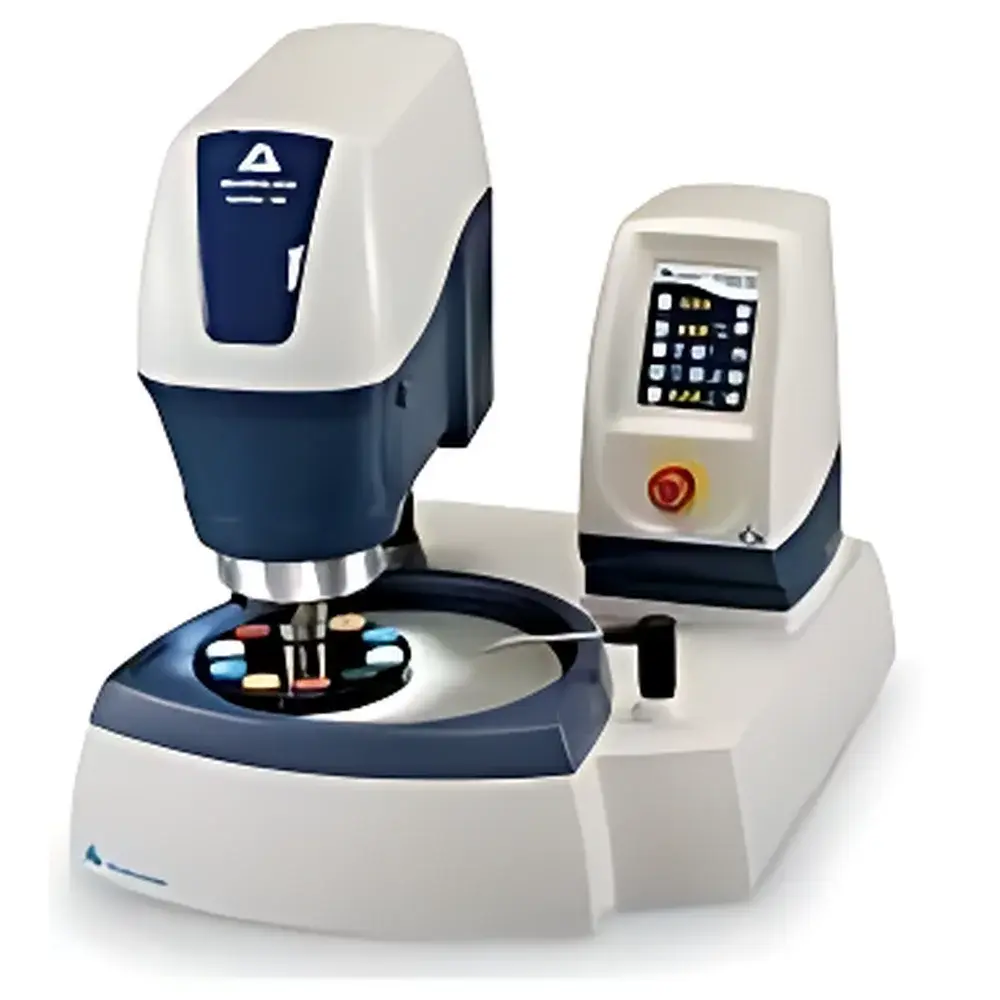
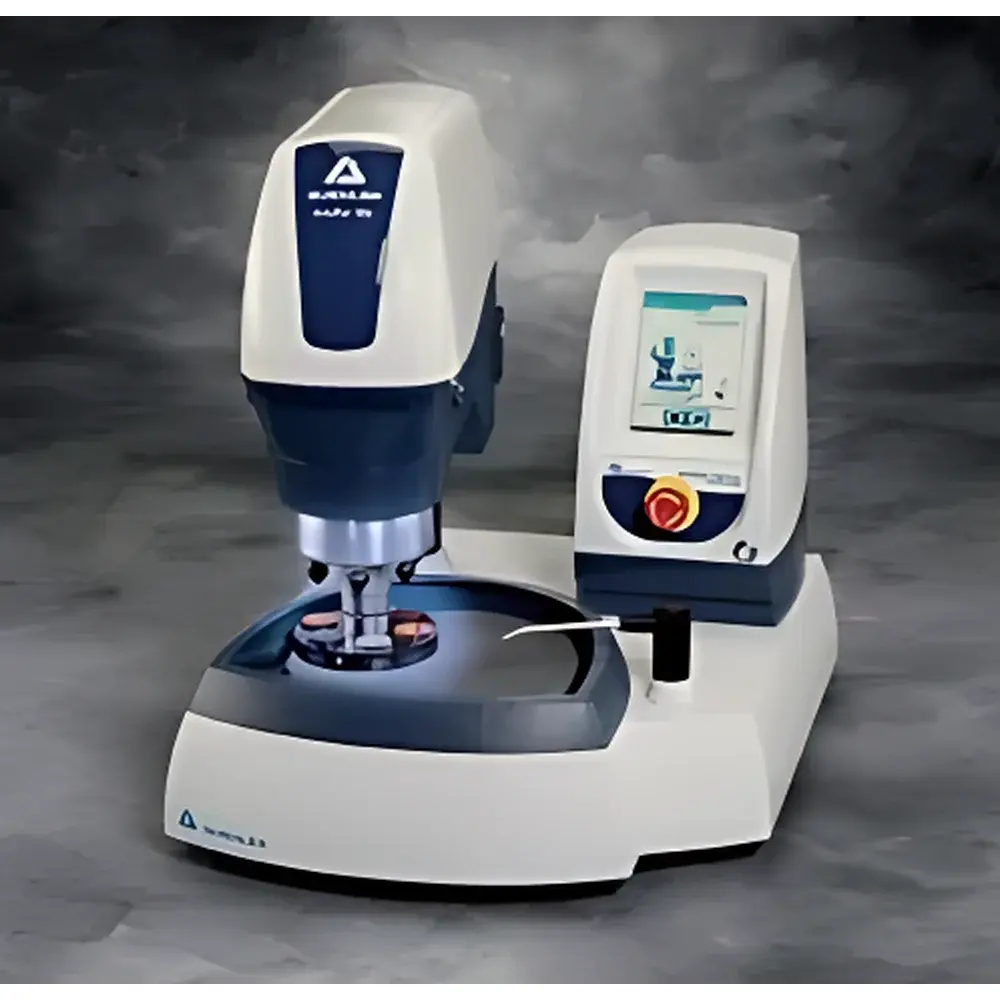
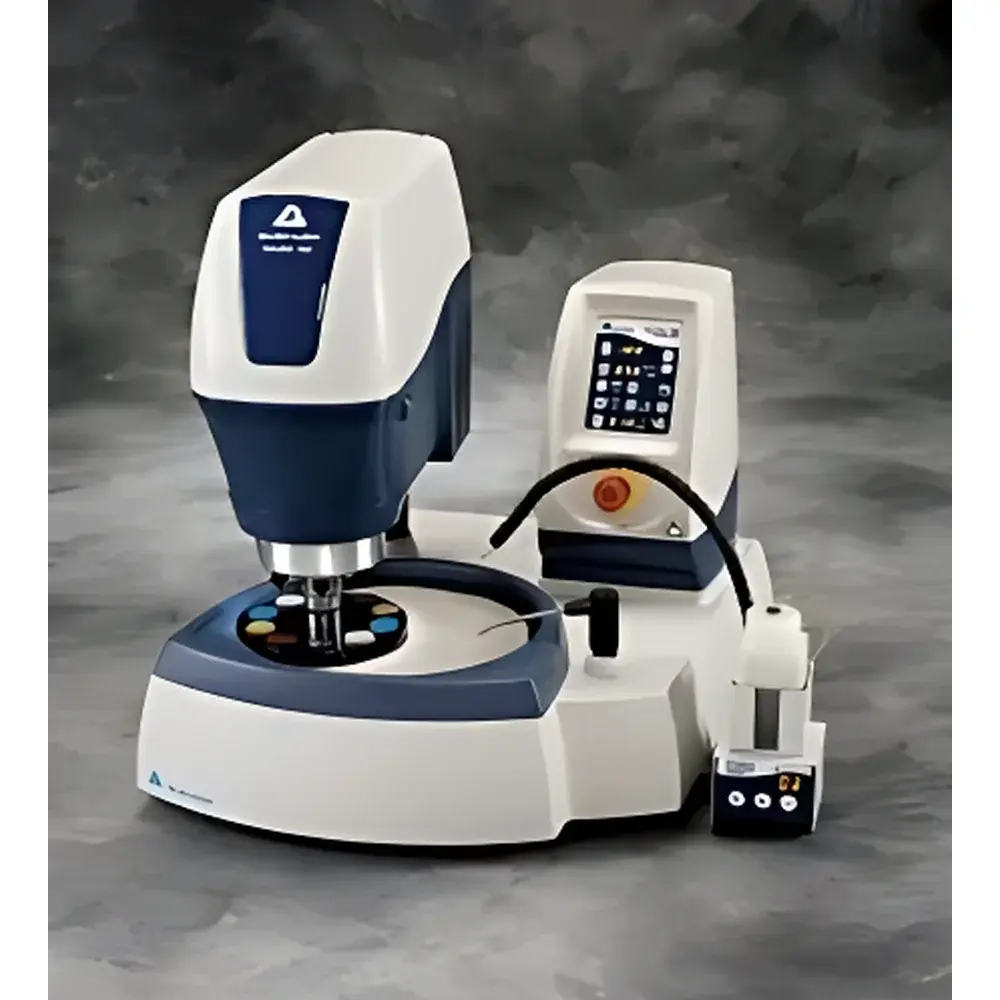
Buehler ECOMET 250 & AUTOMET 250 Automated Grinding and Polishing System
| Brand | Buehler |
|---|---|
| Origin | USA |
| Model | ECOMET 250 & AUTOMET 250 |
| Sample Holder Capacity | 1–6 (single-force loading), 3–10 (center-force loading) |
| Sample Diameter Range | 25–50 mm (mounted) |
| Platen Speed | 10–500 rpm, reversible |
| Autohead Speed | 30–60 rpm, reversible |
| Force Range | 5–45 N (single-point), 20–260 N (center-force) |
| Motor Power | 750 W (platen), 166 W (autohead), 1630 W (system total) |
| Platen Sizes | 205 mm (8″), 254 mm (10″), 305 mm (12″) |
| Control Interface | Waterproof LED touchscreen |
| Drive Type | Belt-driven, low-noise |
| Final Surface Finish | ≤0.02 µm or ≤0.05 µm (oxide polishing) |
Overview
The Buehler ECOMET 250 and AUTOMET 250 are fully automated grinding and polishing systems engineered for high-precision sample preparation in metallurgical, geological, electronic, and materials science laboratories. These instruments operate on the principle of controlled mechanical abrasion—applying precisely regulated normal force, rotational speed, and time to progressively reduce surface topography and eliminate deformation-induced artifacts. Designed to meet the stringent requirements of microstructural analysis—including optical microscopy, scanning electron microscopy (SEM), electron backscatter diffraction (EBSD), and energy-dispersive X-ray spectroscopy (EDS)—the system ensures reproducible, artifact-free surfaces with sub-micron flatness and minimal subsurface damage. Its dual-mode force application architecture (single-point pneumatic and center-force electro-hydraulic) enables consistent material removal across heterogeneous or multi-phase specimens while maintaining strict compliance with ASTM E3, ISO 14577, and ASTM E1558 standards for metallographic specimen preparation.
Key Features
- Two independent, continuously variable speed drives: platen (10–500 rpm) and autohead (30–60 rpm), both with reversible rotation to optimize abrasive action and minimize directional bias.
- Dual-force loading architecture: single-point pneumatic loading (5–45 N) for small or delicate samples; center-force electro-hydraulic vertical drive (20–260 N) for high-stability, uniform pressure distribution across multi-sample holders.
- Robust cast-aluminum frame with corrosion- and stain-resistant coated enclosure, ensuring long-term dimensional stability and resistance to abrasive slurry exposure.
- D-shaped platen design facilitates rapid, tool-free platen and consumable更换—reducing downtime and improving workflow continuity.
- Integrated LED task lighting within the working chamber provides shadow-free illumination for real-time visual monitoring of sample surface evolution.
- Self-cleaning features include a built-in platen rinse nozzle, flexible high-flow coolant hose with ergonomic handle, and drain-channel liner to prevent clogging and simplify maintenance.
- Emergency stop button and blue-backlit power switch provide immediate, unambiguous operational safety controls compliant with IEC 61000-6-2 and UL 61010-1.
- Low-noise belt-driven platen transmission ensures stable torque delivery and minimizes vibration-induced surface artifacts during fine polishing stages.
Sample Compatibility & Compliance
The ECOMET 250/AUTOMET 250 accommodates mounted specimens from 25 mm to 50 mm in diameter, with optional holders supporting unmounted wafers, brittle ceramics, soft polymers, and irregularly shaped components. The system supports standard metallographic consumables—including silicon carbide papers, diamond suspensions (15–0.25 µm), and colloidal silica (0.02–0.05 µm)—and is validated for use with Buehler’s proprietary MetaDi™ and MasterMet® series. All force, speed, and time parameters are digitally logged and traceable, supporting GLP/GMP workflows and FDA 21 CFR Part 11-compliant audit trails when integrated with Buehler’s OmniMet™ software suite. The system meets CE marking requirements and conforms to ISO/IEC 17025 calibration traceability protocols for laboratory accreditation.
Software & Data Management
Control is executed via an IP65-rated waterproof LED touchscreen interface with intuitive graphical navigation. Each method—including grinding, rough polishing, intermediate polishing, and final oxide polishing—is programmable with up to 10 sequential steps per protocol. Parameters such as dwell time, rotational direction, force ramping profiles, coolant flow activation, and autohead descent cutoff position are stored and recalled with version-controlled naming. Method files can be exported/imported via USB or network connection. When paired with OmniMet™ software (optional), full digital archiving, statistical process control (SPC) charting, and remote diagnostics become available—enabling cross-site method harmonization and quality assurance documentation per ISO 9001 and AS9100 requirements.
Applications
- Metallurgy: Preparation of ferrous/non-ferrous alloys, weld zones, heat-affected regions, and additive-manufactured metals for grain structure, phase distribution, and inclusion analysis.
- Geoscience: Thin-section and polished section preparation of rocks, ores, and extraterrestrial samples for petrographic and mineralogical characterization.
- Electronics: Cross-sectional polishing of solder joints, die attach layers, PCB laminates, and semiconductor packaging for failure analysis (FA) and reliability assessment.
- Advanced Materials: Artifact-free surface generation for ceramic matrix composites (CMCs), refractory metals, and biomedical implants prior to nanoindentation or TEM lamella extraction.
- Quality Control: High-throughput sample prep in ISO/IEC 17025-accredited labs performing routine hardness testing, coating thickness verification, and porosity evaluation.
FAQ
What types of samples can be prepared using the ECOMET 250/AUTOMET 250?
Mounted metallic, ceramic, or polymer specimens ranging from 25 mm to 50 mm in diameter; unmounted wafers and irregular geometries are supported with optional holders.
Is the system compatible with ASTM E3 and ISO 14577 standard methods?
Yes—the dual-force architecture, programmable dwell times, and traceable parameter logging ensure full alignment with these standards for metallographic preparation.
Can final polishing achieve ≤0.02 µm surface roughness?
When used with certified colloidal silica suspensions and optimized oxide polishing protocols, the system consistently delivers Ra ≤0.02 µm on appropriate substrates.
Does the system support GMP/GLP documentation requirements?
With OmniMet™ software integration, it provides electronic signatures, audit trails, and method versioning compliant with FDA 21 CFR Part 11 and EU Annex 11.
What maintenance intervals are recommended for long-term reliability?
Daily rinsing of the platen chamber and weekly inspection of belt tension and coolant lines are advised; annual calibration of load cells and speed encoders is recommended for accredited labs.



