
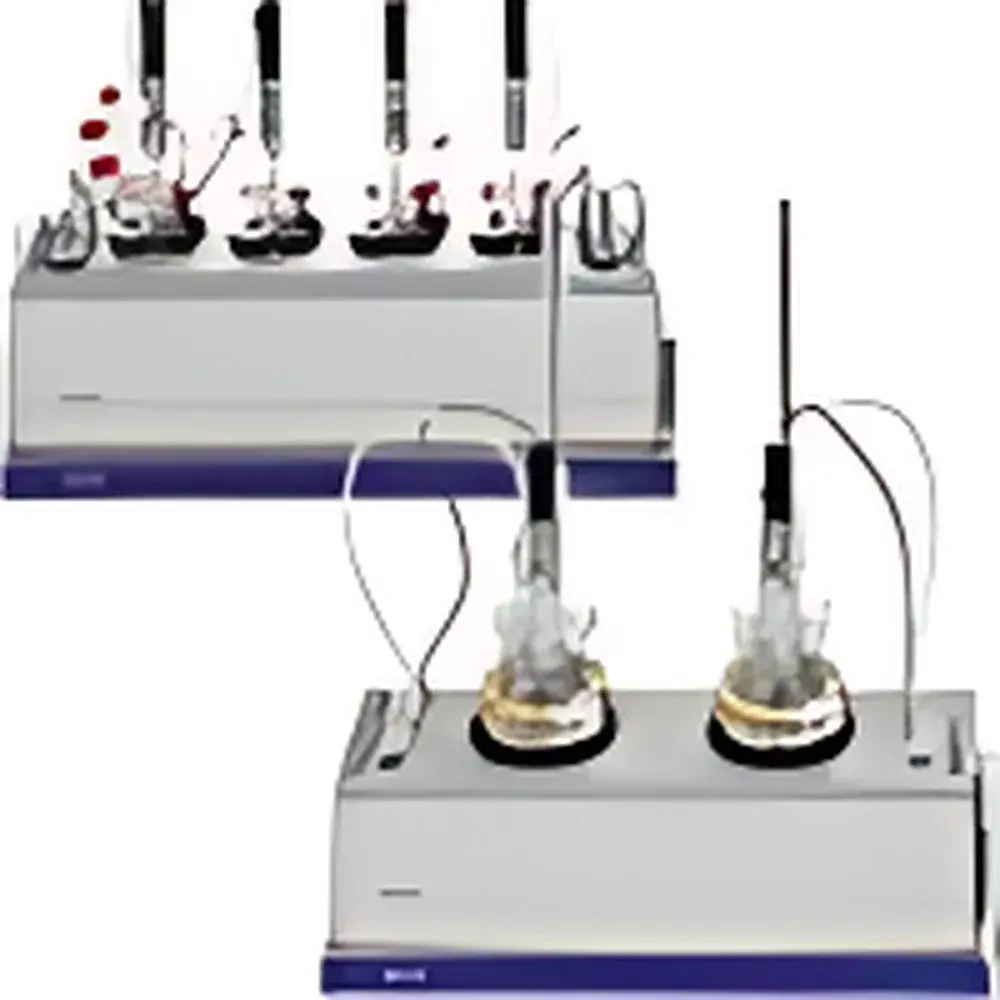
METTLER TOLEDO MultiMax™ Reaction Calorimeter
| Brand | METTLER TOLEDO |
|---|---|
| Origin | Switzerland |
| Model | MultiMax |
| Type | Reaction Calorimeter (Heat Flow Calorimetry System) |
| Configuration | Modular Parallel Reactor Platform with Independent Temperature, Agitation & Dosing Control |
| Thermal Measurement Principle | Heat Flow Calorimetry (HFC) |
| Compliance | Designed for GLP/GMP-aligned process development environments |
| Software Integration | iC Safety & iC DataCenter (21 CFR Part 11 compliant audit trail, electronic signatures) |
Overview
The METTLER TOLEDO MultiMax™ Reaction Calorimeter is a modular, high-precision heat flow calorimetry system engineered for quantitative thermal characterization of chemical reactions under controlled laboratory and pilot-scale conditions. Unlike infrared thermal imaging cameras—which measure surface radiation emission—the MultiMax operates on the fundamental principle of heat flow calorimetry: it quantifies reaction enthalpy (ΔHr), transient heat release profiles, maximum heat flow rates (qmax), heat transfer coefficients (U·A), and accumulated thermal energy by continuously monitoring the temperature differential across a calibrated heat exchanger jacket. This enables direct, model-free determination of thermodynamic and kinetic parameters without assumptions about reaction stoichiometry or heat capacity estimation. The system is purpose-built for process safety assessment, reaction mechanism elucidation, and scalable process development—serving as a critical bridge between discovery chemistry and manufacturing readiness.
Key Features
- Modular parallel reactor architecture supporting up to four independently controlled 50 mL reactors (Reactor Box 04-50) or two 250 mL reactors (Reactor Box 02-250), each with dedicated temperature control, overhead stirring, and automated reagent dosing.
- High-fidelity heat flow measurement with traceable calibration against electrical heating standards; supports detection limits down to ±0.1 W with reproducibility better than ±2% RSD over extended run times.
- Integrated real-time control of critical process variables: jacket temperature (±0.1 °C), impeller speed (0–1000 rpm, torque-sensing), and liquid addition (peristaltic or syringe pumps with volumetric accuracy <±0.5%).
- Interchangeable reactor boxes compatible with both standalone operation and integration into the MultiMaxART™ robotic platform or MultiMaxIR™ base station for unattended multi-day experimentation.
- Rugged stainless-steel construction with pressure-rated vessels (up to 10 bar g), corrosion-resistant wetted materials (Hastelloy C-276, glass-lined options), and explosion-proof motor drives meeting ATEX/IECEx Category 2G requirements.
Sample Compatibility & Compliance
The MultiMax accommodates a broad range of chemistries—including exothermic oxidations, hydrogenations, nitrations, Grignard additions, and polymerizations—across solvent systems (aqueous, chlorinated, ethereal, and highly viscous media). All reactor configurations comply with ISO 11358 (polymer thermal analysis), ASTM E698 (kinetic evaluation of decomposition), and ICH Q5C (stability testing of biologics). Data acquisition and reporting meet FDA 21 CFR Part 11 requirements via iC Safety software, including role-based access control, full electronic audit trails, and immutable data archiving. System validation documentation (IQ/OQ/PQ protocols) is provided per GAMP 5 guidelines for regulated pharmaceutical and fine chemical environments.
Software & Data Management
Operation and analysis are fully managed through METTLER TOLEDO’s iC Suite: iC Safety (for calorimetric interpretation and thermal hazard assessment) and iC DataCenter (for centralized data aggregation, trend analysis, and report generation). Raw heat flow, temperature, agitation, and dosing data are time-synchronized at 10 Hz resolution and stored in vendor-neutral HDF5 format. Batch-level metadata (operator ID, SOP version, raw material lot numbers) is embedded directly into datasets. Export options include CSV, PDF analytical reports, and direct integration with LIMS and MES platforms via OPC UA or RESTful API.
Applications
- Early-stage process safety screening: determination of adiabatic temperature rise (ΔTad), time-to-maximum-rate (TMRad), and criticality classification per CCPS guidelines.
- Reaction optimization: identification of optimal addition profiles, endpoint detection via heat flow inflection, and residence time distribution modeling.
- Kinetic parameter extraction: Arrhenius activation energy (Ea) and pre-exponential factor (A) derived from multiple isothermal and non-isothermal runs.
- Scale-up support: correlation of lab-scale heat transfer performance (U·A) with pilot plant jacket designs using dimensionless scaling numbers (e.g., Reynolds, Nusselt).
- Quality-by-Design (QbD) implementation: establishment of design space boundaries for temperature, dosing rate, and agitation intensity based on thermal response surfaces.
FAQ
How does MultiMax differ from traditional jacketed calorimeters like RC1?**
MultiMax extends RC1’s single-vessel heat flow methodology into a parallel, multi-reactor configuration—enabling statistically robust experimental design (DoE) without sequential run dependencies.
Can MultiMax perform adiabatic calorimetry?**
No—it is a heat flow calorimeter operating under near-isothermal conditions; for true adiabatic measurements, complementary use of ARC or Phi-TEC II is recommended.
Is reactor volume limited to 50 mL and 250 mL?**
Standard configurations are fixed, but custom reactor boxes (e.g., 10 mL micro-reactors or 500 mL vessels) can be validated upon request under engineering review.
Does the system support PAT integration?**
Yes—via analog/digital I/O and Modbus TCP, enabling synchronization with inline FTIR, Raman, or FBRM probes for multimodal reaction monitoring.
What training and support services are available?**
METTLER TOLEDO provides on-site installation qualification, operator certification courses, and application-specific workshops delivered by certified process safety engineers.





