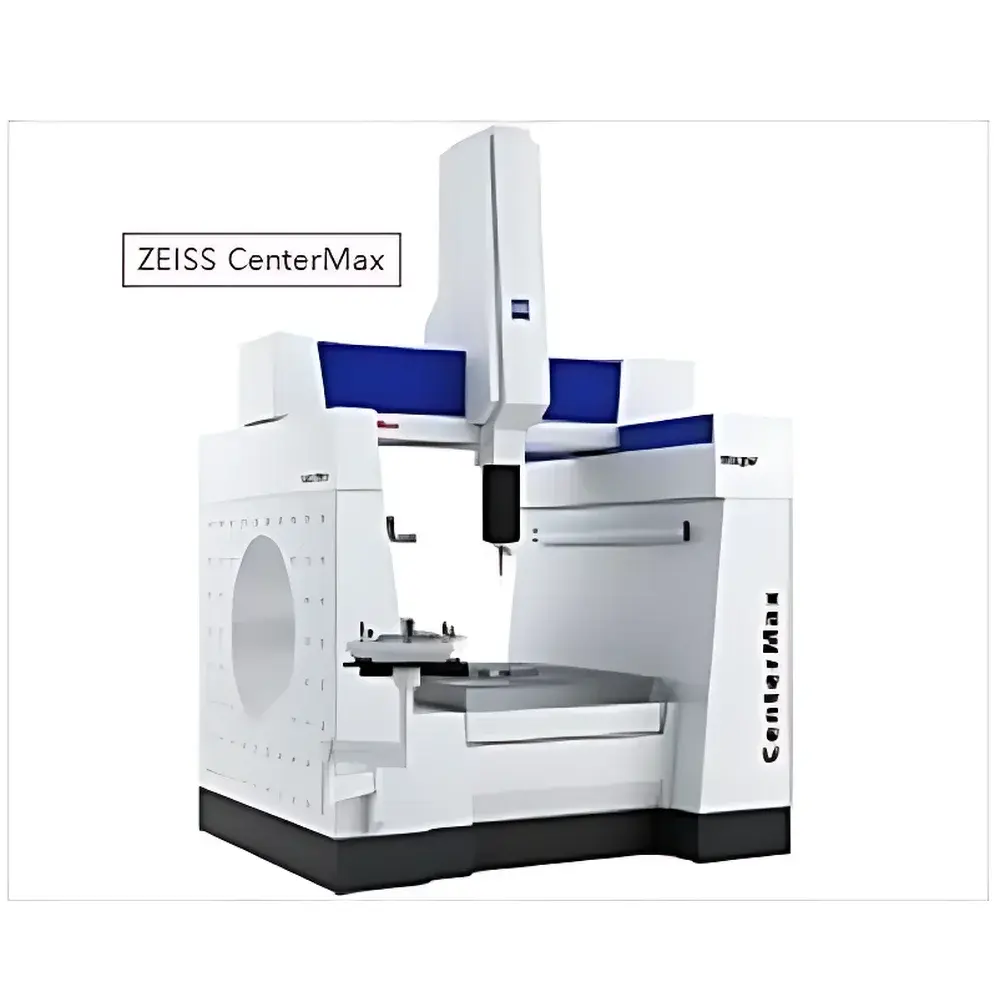
ZEISS CenterMax Coordinate Measuring Machine (CMM)
| Brand | ZEISS |
|---|---|
| Origin | Germany |
| Configuration | Bridge-Type CMM |
| Operation Mode | Fully Automated |
| Orientation | Vertical |
| Measurement Volume | 1100 × 1200 × 700 mm to 1100 × 1200 × 900 mm |
| Length Measurement Error (E₀) | Starting from 1.2 + L/280 µm |
| Standard Operating Temperature Range | 16–26 °C |
| Maximum Workpiece Weight Capacity | 1000 kg |
| Base Material | Granite or Cast Stone |
| Bearing System | Air-bearing Guideways |
| Vibration Isolation | Active Damping System |
| Environmental Resilience | Optimized for Production Floor Deployment |
Overview
The ZEISS CenterMax is a high-performance, bridge-type coordinate measuring machine engineered for precision geometric metrology in demanding production environments. Designed and manufactured in Germany by Carl Zeiss AG, the CenterMax integrates metrological rigor with industrial robustness—enabling direct integration into automated manufacturing lines without compromising measurement traceability or repeatability. Its core measurement principle relies on high-resolution tactile probing (compatible with scanning and single-point touch-trigger sensors), supported by a thermally stable granite or cast-stone base structure and air-bearing linear axes. The system complies with ISO 10360-2 (CMM acceptance and reverification tests) and meets the dimensional accuracy requirements defined in ISO 15530-3 for calibrated artifact-based uncertainty evaluation. Unlike traditional lab-grade CMMs, the CenterMax is explicitly engineered for shop-floor deployment: it maintains certified volumetric accuracy even under ambient temperature fluctuations (16–26 °C), floor-borne vibrations, and variable thermal gradients typical of metalworking or automotive assembly facilities.
Key Features
- Thermally adaptive cast-stone or granite base architecture providing exceptional resistance to thermal drift and long-term structural stability.
- High-precision air-bearing guideways on all three orthogonal axes—ensuring minimal friction, zero mechanical wear, and immunity to particulate contamination common in production settings.
- Integrated active vibration cancellation system that continuously monitors and counteracts low-frequency floor vibrations (typically 5–100 Hz), preserving sub-micron measurement fidelity.
- Modular open-frame design permitting three-sided part loading/unloading—ideal for integration with robotic material handling systems and automated gantry loaders.
- Third-generation high-speed scanning capability supporting continuous path acquisition at up to 500 mm/s, delivering dense point-cloud datasets suitable for GD&T analysis, surface deviation mapping, and statistical process control (SPC).
- Computer-aided kinematic error compensation (CAKE) applied in real time during motion, correcting for axis misalignment, squareness deviations, and Abbe errors based on laser interferometer calibration data.
Sample Compatibility & Compliance
The ZEISS CenterMax accommodates workpieces up to 1000 kg and within volumetric envelopes of 1100 × 1200 × 900 mm, making it suitable for large-scale components such as engine blocks, transmission housings, aerospace structural frames, and die-cast chassis modules. Its tactile probe compatibility includes both standard analog scanning heads (e.g., ZEISS VAST XT) and optical add-ons (e.g., ZEISS OptoScan for edge detection). The system supports full compliance with ISO/IEC 17025 metrological management requirements when operated under documented calibration intervals and environmental monitoring protocols. It is routinely deployed in industries requiring adherence to IATF 16949, AS9100, and FDA 21 CFR Part 820 quality systems—particularly where measurement uncertainty budgets must be formally declared per ISO/IEC Guide 98-3 (GUM).
Software & Data Management
The CenterMax operates exclusively with ZEISS CALYPSO software—a modular, audit-ready metrology platform compliant with FDA 21 CFR Part 11 for electronic records and signatures. CALYPSO provides full GD&T evaluation per ASME Y14.5 and ISO 1101, automated reporting with customizable templates, and native integration with enterprise MES and PLM systems via OPC UA and RESTful APIs. All measurement programs include embedded uncertainty estimation, traceable calibration history, and full revision-controlled documentation. Audit trails log operator actions, parameter changes, and probe calibration events with timestamped, non-erasable entries—meeting GLP/GMP data integrity requirements.
Applications
- First-article inspection and PPAP validation in Tier-1 automotive supply chains.
- In-process verification of machined features on CNC-milled aluminum and cast-iron components.
- Dimensional release testing of welded assemblies prior to painting or final assembly.
- Tooling and fixture verification across mold, die, and jig manufacturing workflows.
- Reverse engineering support for legacy part digitization and tolerance revalidation.
- Statistical analysis of geometric variation trends using multivariate SPC dashboards.
FAQ
What environmental conditions are required for optimal performance?
The CenterMax is rated for operation between 16 °C and 26 °C, with humidity ≤60% RH non-condensing. Its cast-stone base and active thermal compensation enable stable performance across ±2 °C/h ambient drift.
Is the system compatible with automated factory infrastructure?
Yes—it supports Ethernet/IP, PROFINET, and OPC UA connectivity for seamless integration with PLCs, SCADA systems, and digital twin platforms.
How often does the machine require recalibration?
Annual volumetric verification against certified step gauges or ball bars is recommended; interim checks using artifact-based reference parts can be scheduled per ISO 10360-6.
Can optical sensors be added post-purchase?
Yes—optical modules including fringe projection scanners and telecentric vision probes are field-installable via standardized mechanical and electrical interfaces.
Does ZEISS provide GMP-compliant documentation packages?
Yes—validated IQ/OQ documentation, URS alignment reports, and 21 CFR Part 11 configuration files are available upon request for regulated industries.