
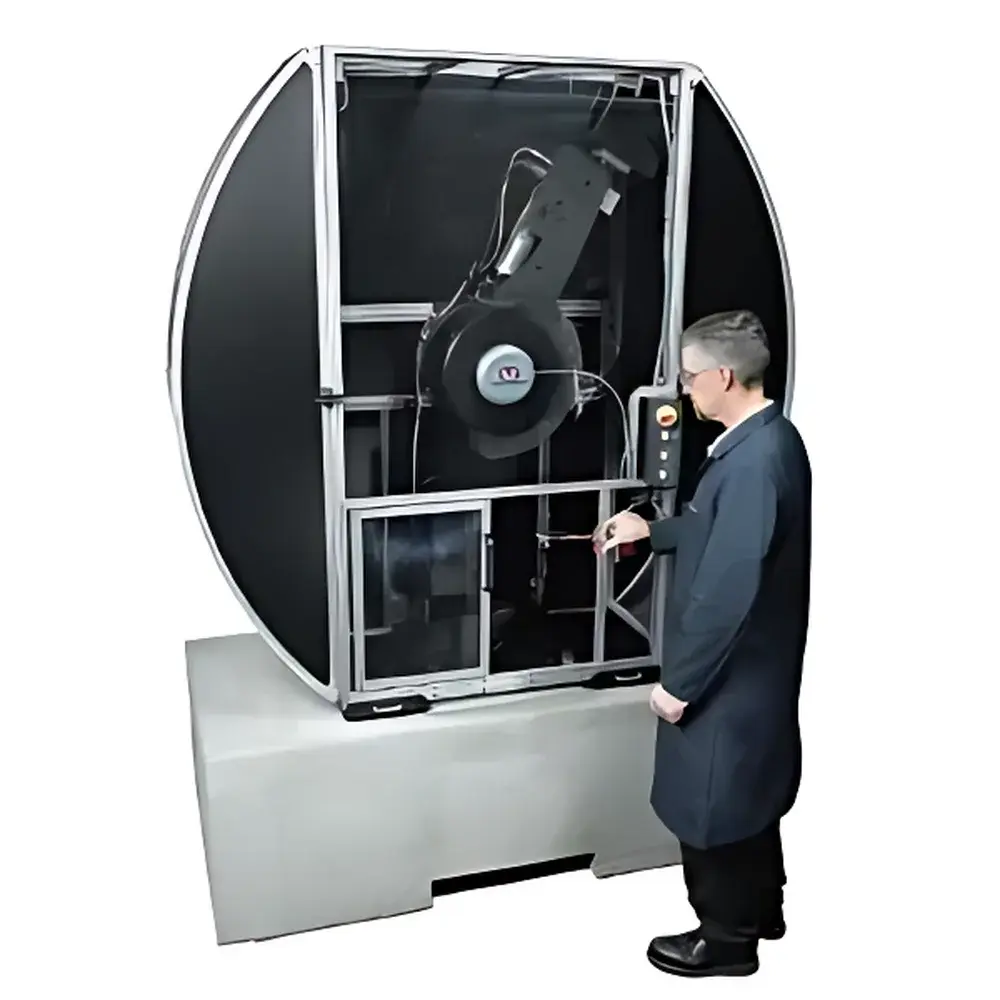
INSTRON MPX Series Pendulum Impact Testing Machine
| Brand | INSTRON |
|---|---|
| Origin | USA |
| Model | MPX |
| Impact Energy Range | 300–900 J |
| Impact Velocity | 5.3 m/s |
| Maximum Pendulum Lift Height | 762 mm |
| Test Types | Charpy (simply supported beam) and Izod (cantilever beam) impact testing |
| Compliance | ASTM E23, EN 10045, ISO 148, GOST 9454 |
Overview
The INSTRON MPX Series Pendulum Impact Testing Machine is a precision-engineered mechanical impact tester designed for standardized Charpy and Izod impact testing of metallic and polymeric materials under controlled conditions. Based on the classical pendulum principle—where gravitational potential energy is converted into kinetic energy upon release—the MPX delivers repeatable, traceable impact energy to standardized notched specimens. Its robust cast-iron frame, rigid anvil assembly, and calibrated pendulum system ensure high reproducibility across the full 300–900 J energy range. The machine operates in strict accordance with internationally recognized test standards—including ASTM E23 for metallic materials, ISO 148 for Charpy testing, EN 10045 for European compliance, and GOST 9454 for low-, ambient-, and elevated-temperature applications—making it suitable for quality control laboratories, metallurgical R&D centers, and third-party certification facilities requiring audit-ready test documentation.
Key Features
- Motor-driven pendulum lift mechanism with automatic return after each test cycle—reducing operator intervention and improving throughput in high-volume environments.
- Electromagnetic brake/clutch system enabling controlled, fail-safe pendulum descent; eliminates uncontrolled free-fall and ensures consistent impact dynamics.
- Dual mechanical locking system prevents accidental pendulum release during specimen loading or maintenance—enhancing operator safety per ISO 13857 and ANSI B11.1 requirements.
- Interlocked safety enclosure: All access doors are equipped with positive-break limit switches that immediately halt pendulum motion and disable release if opened mid-cycle.
- Adjustable pendulum height lock for low-energy or low-velocity testing protocols—enabling precise energy calibration down to sub-300 J levels when required by specialized material specifications.
- Modular anvil and striker configuration compliant with ISO 148 geometry tolerances; interchangeable anvils and hammers support both Charpy V-notch and Izod notch geometries, including custom configurations for non-standard specimens.
Sample Compatibility & Compliance
The MPX accommodates standard Charpy (10 × 10 × 55 mm) and Izod (63.5 × 12.7 × 3.2 mm) specimens as defined in ASTM E23 and ISO 148. Optional auxiliary steel base plates and support templates enable reliable testing of miniaturized or nonstandard samples—including thin-sheet metals, weldments, and additively manufactured coupons—while maintaining alignment accuracy within ±0.1 mm tolerance. All critical mechanical components—including the pendulum shaft, bearing housing, and striker radius—are manufactured to ISO 148-1 dimensional and surface finish specifications. The system is CE-marked and fully compliant with the Machinery Directive 2006/42/EC, incorporating risk assessment per EN ISO 12100 and safeguarding per EN ISO 13857. It supports GLP/GMP-aligned workflows through optional audit-trail-capable software integration.
Software & Data Management
While the base MPX operates as a standalone mechanical tester, it is fully compatible with INSTRON’s Dynatup® pulse data acquisition software for instrumented impact testing. When paired with an instrumented Charpy striker (optional), the system captures full force–time and displacement–time histories at up to 1 MHz sampling rate, enabling fracture energy partitioning (e.g., plastic deformation energy, crack initiation energy, total absorbed energy). Data export complies with ASTM E23 Annex A3 and ISO 148-2 reporting requirements—including peak load, time-to-peak, and energy integral calculations. All raw and processed datasets are timestamped, user-logged, and exportable in CSV, XML, or PDF formats for regulatory submission. Optional 21 CFR Part 11-compliant software modules provide electronic signatures, role-based access control, and immutable audit trails for FDA-regulated environments.
Applications
The MPX is routinely deployed in metallurgical laboratories for evaluating ductile-to-brittle transition temperatures (DBTT) in structural steels, aluminum alloys, and nickel-based superalloys. It supports qualification testing of weld joints per AWS D1.1 and ASME Section IX, where absorbed energy thresholds directly inform acceptance criteria. In polymer development, it characterizes impact resistance of engineering thermoplastics (e.g., PC, PEEK, PA66) under varying humidity and thermal conditioning. Automotive and aerospace suppliers use the MPX for supplier qualification against OEM-specific material specifications (e.g., GMW14124, Boeing BMS 7-27). Its reliability and standardization make it a preferred platform for inter-laboratory round-robin studies and proficiency testing programs accredited to ISO/IEC 17025.
FAQ
What standards does the MPX Series comply with?
The MPX meets ASTM E23, ISO 148-1/-2, EN 10045, and GOST 9454 for Charpy and Izod impact testing. It is CE-certified and conforms to EU Machinery Directive 2006/42/EC.
Can the MPX perform instrumented impact testing?
Yes—when equipped with an instrumented Charpy striker and Dynatup® software, it delivers full waveform capture and energy partitioning analysis per ISO 148-2.
Is temperature-controlled testing supported?
The MPX frame is compatible with external environmental chambers (e.g., liquid nitrogen cryo-cooling or heated enclosures) to conduct tests from –196 °C to +200 °C, provided specimen handling and alignment meet ISO 148-1 thermal stability requirements.
What safety certifications apply to the MPX?
It incorporates dual mechanical locks, electromagnetic braking, interlocked guarding, and emergency stop circuitry compliant with EN ISO 13850 and EN 60204-1.
How is calibration verified and maintained?
Calibration follows ISO 17025 procedures using NIST-traceable reference specimens and certified energy verification kits; annual recalibration is recommended, with documented traceability to national metrology institutes.



