
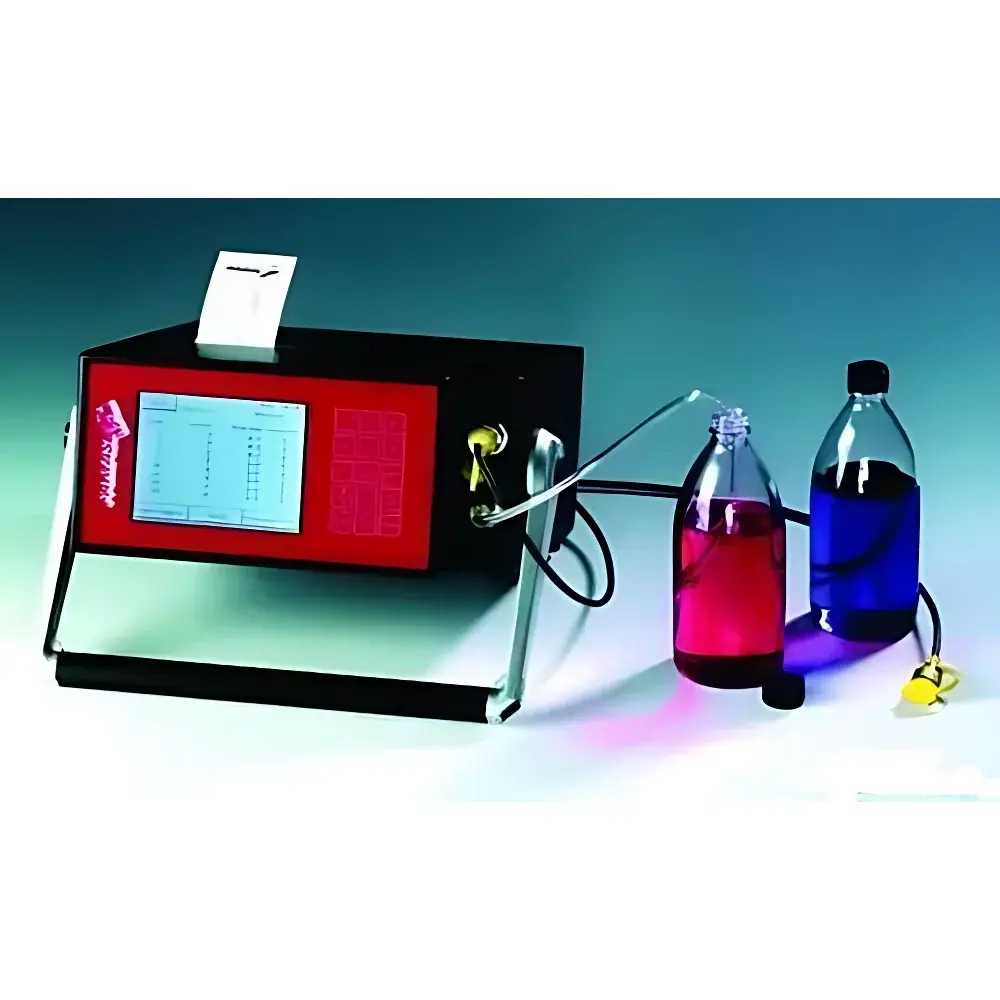
PAMAS S40 Portable Optical Particle Counter
| Brand | PAMAS |
|---|---|
| Origin | Germany |
| Model | S40 |
| Instrument Type | Optical Particle Counter |
| Measurement Principle | Light Obscuration (LO) |
| Particle Size Channels | 8 user-configurable thresholds |
| Compliance Standards | ISO 4406:1987 / ISO 4406:1999 / SAE AS4059D / NAS1638 |
| Power Supply | 90–230 V AC, 50 Hz |
| Weight | ~9 kg |
| Dimensions | 300 × 140 × 300 mm |
| Display | Backlit touchscreen LCD |
| Data Interface | RS-232C (ASCII 8-bit) |
| Internal Storage | 500 measurement records |
| Sampling Pressure Range | 0–420 bar |
| Viscosity Limit | ≤200 cSt (unpressurized), ≤350 cSt (pressurized), ≤1000 cSt (lubricating oil systems) |
Overview
The PAMAS S40 Portable Optical Particle Counter is a field-deployable, microprocessor-controlled instrument engineered for in-situ and laboratory-based assessment of solid particulate contamination in liquid media—primarily hydraulic fluids, turbine oils, lubricants, and aviation fuels. It operates on the well-established light obscuration (LO) principle: as particles suspended in a liquid stream pass through a precisely calibrated optical sensing zone, they interrupt a collimated light beam; the magnitude of signal attenuation is directly correlated to particle cross-sectional area, enabling size-resolved detection and counting. The S40 integrates a high-stability piston pump capable of delivering consistent flow rates across both ambient-pressure and high-pressure (up to 420 bar) sampling conditions—eliminating flow variability that compromises count accuracy in dynamic systems. Its sensor cell is manufactured to stringent optical tolerances using fused silica windows and optimized illumination geometry, ensuring minimal signal noise and high repeatability in particle sizing across its eight programmable threshold channels (e.g., ≥4 µm, ≥6 µm, ≥14 µm, ≥21 µm, ≥38 µm, ≥70 µm, ≥100 µm, ≥150 µm). This architecture supports traceable, quantitative compliance with international cleanliness standards including ISO 4406 (1987 & 1999 editions), SAE AS4059D, and NAS1638.
Key Features
- Integrated high-pressure piston pump (0–420 bar) enabling direct sampling from pressurized hydraulic circuits, gearboxes, and lube oil manifolds without external pressure regulation.
- Backlit capacitive touchscreen interface with intuitive menu navigation, real-time particle histogram visualization, and on-device configuration of size thresholds and reporting formats.
- Onboard thermal printer (32-character line width) producing hard-copy reports containing differential and cumulative counts per channel, calculated ISO codes, and timestamped metadata.
- Embedded 32-bit CPU with non-volatile memory storing up to 500 complete measurement datasets—including raw count data, calibration identifiers, operator ID, and sampling parameters.
- DIN 2353 standardized quick-connect fluid interface for rapid, leak-free coupling to industrial sampling ports—compatible with standard hydraulic test points and offline filtration monitoring stations.
- Multi-level password protection supporting role-based access control (e.g., operator, technician, administrator) to ensure data integrity and audit readiness under GLP/GMP frameworks.
- Viscosity compensation algorithm validated for fluids up to 200 cSt at ambient pressure and extended to 350 cSt under pressurized sampling; lubricating oil applications supported up to 1000 cSt via optional flow conditioning.
Sample Compatibility & Compliance
The S40 is validated for use with mineral oils, synthetic lubricants, phosphate esters, water-glycol fluids, and hydrocarbon-based fuels meeting ASTM D6792 and ISO 11171 reference material requirements. Its optical design minimizes refractive index dependency and mitigates Mie scattering artifacts common in low-refractive-index fluids. All reported cleanliness classifications are traceable to NIST-traceable calibration standards. The device complies with electromagnetic compatibility (EMC) directives per EN 61326-1 and carries CE marking for operation within EU industrial environments. While not FDA 21 CFR Part 11–certified out-of-the-box, its ASCII data export protocol and immutable internal logging support integration into validated LIMS or ELN platforms requiring electronic record retention and audit trails.
Software & Data Management
Raw count data and metadata are exportable via RS-232C serial interface using standard ASCII 8-bit framing (no proprietary drivers required). A Windows-compatible PC application—supplied with each unit—enables batch download, statistical trending (e.g., ISO code delta over time), overlay comparison of multiple samples, and automated report generation compliant with internal QA templates. Export formats include CSV and PDF. The firmware supports firmware updates via serial connection, and all stored measurements retain full parameter context (flow rate, temperature flag, sensor status, calibration date), facilitating retrospective root-cause analysis during reliability investigations or failure forensics.
Applications
- Condition monitoring of critical rotating equipment (turbines, compressors, servo-valve systems) per ISO 12192 and ISO 16232.
- Pre-commissioning verification of hydraulic system cleanliness prior to startup (per ISO 4406 acceptance limits).
- Filter performance validation—including beta-ratio testing per ISO 16889—using upstream/downstream paired measurements.
- Root-cause analysis of wear debris patterns in oil analysis laboratories, correlating particle counts with ferrographic or elemental spectroscopy results.
- Field verification of fluid cleanliness during maintenance interventions on offshore platforms, mobile construction machinery, and naval propulsion systems.
FAQ
What particle size ranges does the S40 resolve?
The S40 provides eight user-definable size thresholds, typically configured between 4 µm and 150 µm (c) based on application-specific standards; exact resolution depends on optical alignment and fluid refractive index.
Can the S40 measure particles in water-based fluids?
Yes—provided the fluid’s conductivity and refractive index fall within specified operational envelopes; deionized water requires dilution or surfactant addition to prevent electrostatic agglomeration artifacts.
Is calibration traceable to national standards?
Calibration uses ISO 11171–compliant latex sphere suspensions; certificates list NIST-traceable reference materials and uncertainty budgets per ISO/IEC 17025 guidelines.
How is sample flow rate controlled during high-pressure sampling?
The integrated piston pump maintains constant volumetric displacement regardless of inlet pressure; flow rate is set digitally (e.g., 20 mL/min) and verified by internal flow sensor feedback.
Does the S40 support automatic ISO code calculation?
Yes—firmware computes and displays ISO 4406:1999 codes (e.g., 18/16/13) in real time, with configurable rounding logic per customer-defined reporting protocols.



