
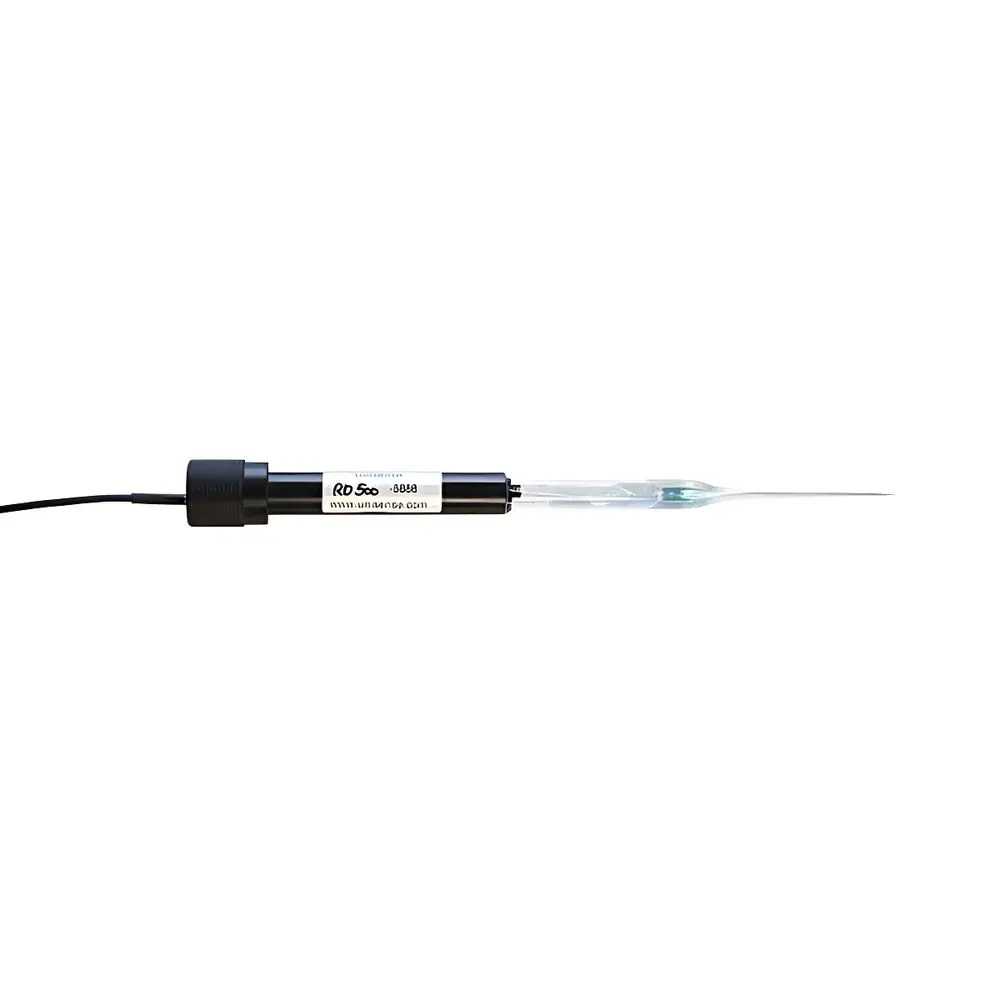
Unisense N₂O Microsensor System (N2O25 / N2O100 / N2O500)
| Brand | Unisense |
|---|---|
| Origin | Denmark |
| Model | N2O25, N2O100, N2O500 |
| Tip Diameter | 25 µm, 100 µm, 500 µm (customizable) |
| Measurement Principle | Amperometric, Clark-type polarographic microelectrode |
| Output Signal | nA-level current proportional to aqueous N₂O concentration |
| Temperature Range | 0–40 °C |
| Operating Pressure | Ambient to 2 bar |
| Calibration | Two-point (zero N₂O and saturated N₂O solution) |
| Compatible With | Unisense MicroRespiration, OXY-Micro, H₂S-Micro, and other sensor-based profiling systems |
Overview
The Unisense N₂O Microsensor System is a high-precision, amperometric microelectrode platform engineered for quantitative, spatially resolved measurement of dissolved nitrous oxide (N₂O) in heterogeneous, low-conductivity, or biologically active matrices. Based on the Clark-type polarographic principle, each sensor integrates a gas-permeable polymer membrane (typically silicone or Teflon), a thin electrolyte layer, and a noble metal working electrode (Pt or Au) held at a fixed reduction potential. Upon diffusion of N₂O through the membrane, electrochemical reduction occurs at the cathode surface (N₂O + 2H⁺ + 2e⁻ → N₂ + H₂O), generating a current linearly proportional to the aqueous N₂O concentration (detection limit < 10 nM; typical resolution ~1–5 nM). Unlike bulk gas-phase analyzers, this system enables direct, real-time, in situ quantification of N₂O gradients at micrometer-scale spatial resolution—critical for resolving biogeochemical hotspots in complex environmental and physiological microenvironments.
Key Features
- Micrometer-scale tip diameters (25 µm, 100 µm, 500 µm) minimize tissue or sediment disturbance during insertion, preserving structural integrity and local chemical equilibrium.
- Robust, shielded coaxial cable design ensures stable signal transmission under variable ionic strength (0.01–1.0 S/m) and mechanical stress (e.g., sediment profiling, tissue penetration).
- Integrated temperature compensation via embedded thermistor enables accurate concentration conversion across 0–40 °C without external recalibration.
- Compatible with motorized micromanipulators (e.g., Unisense MMS, PatchStar) for automated depth profiling with sub-micron positional repeatability.
- No stirring artifact: Signal remains stable under laminar flow or static conditions—ideal for measuring N₂O fluxes across unstirred boundary layers (e.g., biofilm–water interface, root cortex, coral mucus layer).
- Modular architecture allows co-deployment with O₂, pH, H₂S, NO, or H₂ microsensors on shared profiling rigs for multi-parameter biogeochemical mapping.
Sample Compatibility & Compliance
The N₂O microsensor is validated for use in diverse sample classes requiring minimal invasiveness and high spatial fidelity: soft biological tissues (cerebral cortex, liver parenchyma, tumor spheroids, intestinal mucosa), intact sediment cores, soil porewater, microbial aggregates (granules, flocs, marine snow), plant roots/stems/fruit pericarp, agar-embedded cultures, dental plaque, cheese matrices, and suspended or adherent mammalian cells. It complies with ISO 15681-2 (water quality — determination of orthophosphate — part 2: continuous flow analysis) methodology principles for microscale electrochemical detection, and supports GLP-compliant experimental workflows when used with Unisense’s audit-trail-enabled software (see Software section). Sensor fabrication adheres to ISO 9001-certified cleanroom protocols; all membranes and electrolytes are trace-metal-free and certified non-cytotoxic per ISO 10993-5.
Software & Data Management
Data acquisition and analysis are performed using Unisense SensorTrace Profiling v7.x, a Windows-based application supporting real-time signal visualization, automated depth calibration (via integrated encoder feedback), gradient calculation (dC/dz), and volumetric production/consumption rate derivation (using Fick’s first law). The software enforces ALCOA+ data integrity standards: all measurements include embedded timestamps, user ID, sensor ID, calibration metadata, and environmental parameters (T, salinity, pressure). Audit trails are immutable and exportable as CSV or HDF5. For regulated environments (e.g., wastewater treatment R&D under EPA Method 1694), optional 21 CFR Part 11 compliance modules provide electronic signatures, role-based access control, and full change history logging.
Applications
- Quantifying N₂O production and consumption zones in wastewater biofilms and activated sludge flocs to optimize denitrification efficiency.
- Mapping N₂O concentration profiles across wetland soil–water interfaces and rice paddy rhizospheres to constrain isotopic N₂O source partitioning models.
- Measuring N₂O dynamics in coral holobionts and benthic phototrophic mats under controlled light/dark and O₂/NH₄⁺ perturbations.
- Assessing mitochondrial N₂O generation in hypoxic tumor spheroids and ischemic brain slices—supporting mechanistic studies of nitric oxide synthase (NOS) side-reactions.
- Validating N₂O emission models in agricultural soils by correlating in situ microprofiles with bulk chamber fluxes and isotopic signatures (δ¹⁵N, δ¹⁸O).
- Characterizing N₂O transport limitations in food matrices (e.g., cheese ripening) and pharmaceutical hydrogels where gas diffusivity governs product stability.
FAQ
What is the minimum detectable N₂O concentration?
The detection limit is instrument- and configuration-dependent but typically ranges from 5 to 15 nM in deoxygenated freshwater at 20 °C.
Can the sensor be used in seawater or high-salinity media?
Yes—calibration and signal stability have been verified in salinities up to 35 psu; minor drift correction may be applied using conductivity-compensated calibration curves.
How often does the sensor require recalibration?
Two-point calibration (zero and saturated N₂O) is recommended before each experimental session or after >24 h of continuous use; membrane replacement is required every 3–6 months depending on usage intensity and matrix fouling.
Is sterilization possible for repeated use in cell culture or tissue experiments?
Ethanol immersion (70%, 5 min) and UV-C exposure (254 nm, 15 min) are validated for surface decontamination; autoclaving or chemical oxidants (e.g., bleach) will damage the membrane and electrolyte.
Does sensor orientation affect measurement accuracy?
No—amperometric response is isotropic; however, consistent orientation improves reproducibility during profiling due to uniform membrane exposure and reduced drag-induced bending.




