
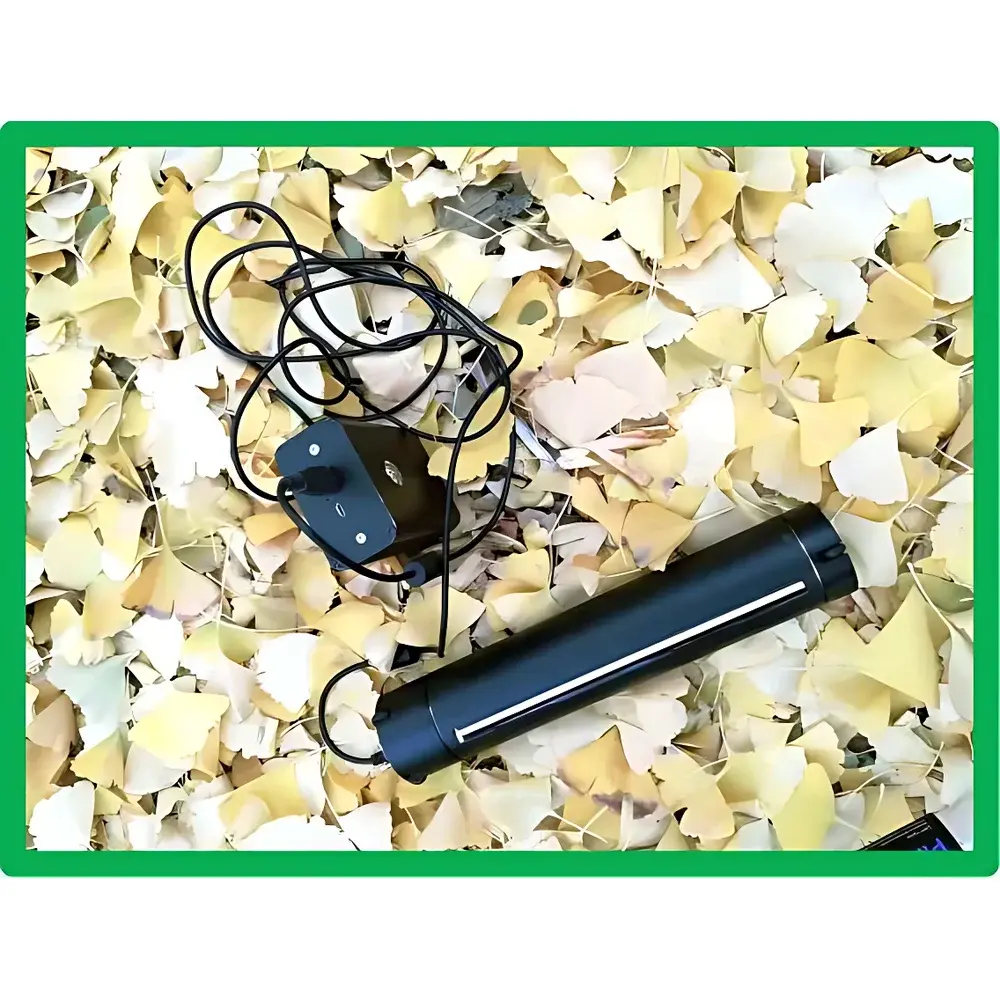
PMT-Root800 In Situ Root Growth Monitoring System
| Brand | PM-Tech |
|---|---|
| Origin | Germany |
| Model | Root800 |
| Resolution Options | 300/600/1200 DPI |
| Scan Time (max res) | ≤10 s |
| Operating Temperature | 0–50 °C |
| Relative Humidity | 0–100% RH (non-condensing) |
| Power Supply | 5 V DC (USB-powered) |
| Data Storage | Local on Windows host device |
| Integrated Sensors | 12-bit temperature sensor (−50 to +85 °C), water immersion detection with auto-shutdown |
| Software | Plant Phenotyping Software (Root Edition) with Pregizer/Topology/Custom topology modes, RHS/UCL color mapping, XY-resolution calibration, background subtraction, multi-document comparison, Excel/Matlab/SPSS export |
| Language Support | English, Simplified Chinese, Traditional Chinese |
Overview
The PMT-Root800 In Situ Root Growth Monitoring System is an engineered solution for non-destructive, high-resolution longitudinal observation of root architecture and developmental dynamics in both field and controlled-environment settings. Based on digital optical scanning within transparent minirhizotron tubes (1 m length, included), the system captures cross-sectional root images directly from undisturbed soil profiles using a precision linear actuator and CMOS imaging module. Its dual-control architecture—comprising a ruggedized handheld controller for field deployment and a USB-connected laptop interface for lab-based analysis—enables consistent data acquisition across ecological gradients and experimental conditions. Unlike destructive excavation or time-lapse X-ray microtomography, the Root800 delivers quantitative phenotypic data without perturbing rhizosphere integrity, making it suitable for long-term studies of root plasticity under abiotic stress (e.g., drought, salinity, nutrient heterogeneity), genotype-by-environment interactions, and root-microbe associations.
Key Features
- True in situ operation: Scans roots inside standard 60 mm OD acrylic minirhizotron tubes with minimal soil disturbance.
- Dual operational modes: Field-ready handheld controller (no external power or intermediate hardware required) and high-throughput laptop mode via direct USB 2.0 connection.
- Three selectable resolution modes (300 / 600 / 1200 DPI) optimized for balance between image fidelity and scan duration; full-frame 1200 DPI scan completes in ≤10 seconds.
- Integrated environmental monitoring: Onboard 12-bit temperature sensor (−50 to +85 °C) and water immersion detector with automatic circuit shutdown to prevent short-circuit damage.
- Real-time image preprocessing: Hardware-accelerated contrast enhancement, XY-directional resolution correction, and dynamic background subtraction to isolate root structures from soil matrix.
- Modular software architecture: Supports reproducible workflows compliant with FAIR data principles (Findable, Accessible, Interoperable, Reusable).
Sample Compatibility & Compliance
The Root800 accommodates standard minirhizotron tube diameters (50–70 mm OD) and supports vertical insertion depths up to 1.5 m using optional extension rods. It is compatible with monocot and dicot species—including cereals, legumes, trees, and model plants such as Arabidopsis thaliana and Zea mays—across diverse soil textures (sand to clay loam). The system meets IP65-rated ingress protection for outdoor use and operates reliably under ambient humidity up to 100% RH (non-condensing). All firmware and software components are validated for traceability in GLP-aligned research environments. While not certified under ISO/IEC 17025, the instrument’s measurement repeatability and sensor calibration protocols align with ASTM D5242 (Standard Practice for Minirhizotron-Based Root Observation) and support documentation required for USDA-NRCS and EU Horizon-funded plant phenotyping consortia.
Software & Data Management
The bundled Plant Phenotyping Software (Root Edition) provides a validated analytical framework for root morphometric quantification. It implements three topological analysis modes—Pregizer (for primary root dominance assessment), Topology (for branching hierarchy reconstruction), and Custom (user-defined node definitions)—alongside dual-color mapping (RHS hue-saturation-value and UCL uniform chromaticity scale) for spectral differentiation of root age classes or physiological status. Image processing includes mouse-driven region-of-interest selection, rubber-band cropping, pixel-level erasure for artifact removal, and magnifier-assisted manual calibration using embedded reference markers. Quantitative outputs include horizontal/vertical biomass distribution, estimated total root length, mean root diameter, angular orientation statistics, surface-to-volume ratios, and directional parameter trends (e.g., width vs. depth, angle gradient along axis). All results export natively to CSV, Excel-compatible formats, and MATLAB .mat files; metadata fields (time stamp, GPS-derived location tag, operator ID, treatment code) are embeddable and editable per image. Audit trails record user actions, parameter modifications, and version-controlled software updates—supporting compliance with FDA 21 CFR Part 11 requirements when deployed in regulated agricultural biotechnology workflows.
Applications
- Long-term root phenotyping trials evaluating drought tolerance, nitrogen-use efficiency, or aluminum resistance across breeding populations.
- Rhizosphere process studies integrating root growth dynamics with concurrent soil moisture, temperature, and redox potential logging.
- Evaluation of cover crop root architecture for soil carbon sequestration potential and erosion control efficacy.
- Validation of root system architecture (RSA) models against empirical in situ data.
- Ecophysiological monitoring of perennial species (e.g., grapevine, apple rootstock) across seasonal cycles.
- Support for MIAPPE-compliant phenotypic data submission to international repositories such as EURoot or PhenoFront.
FAQ
Is the Root800 compatible with third-party minirhizotron tubes?
Yes—the system interfaces with industry-standard acrylic or quartz tubes (50–70 mm outer diameter) using its adjustable mounting collar and depth-locking mechanism.
Can scan data be synchronized with external environmental sensors?
While the Root800 does not feature built-in wireless telemetry, timestamped image metadata can be aligned post-hoc with external sensor networks (e.g., Campbell Scientific CR1000X, Decagon EM50) via shared NTP-synchronized clocks.
Does the software support batch processing of multiple scans?
Yes—automated batch analysis is available for sequences acquired from the same tube over time, enabling temporal change detection and growth rate modeling.
What is the warranty coverage and service support structure?
PM-Tech provides a 24-month limited hardware warranty and remote software support through authorized European service centers; on-site technical assistance is available under extended service agreements.
Are software updates provided free of charge during ownership?
Minor version updates (bug fixes, compatibility patches) are delivered at no cost; major releases (v2.x, v3.x) may require a nominal maintenance subscription for priority access and validation reports.




