
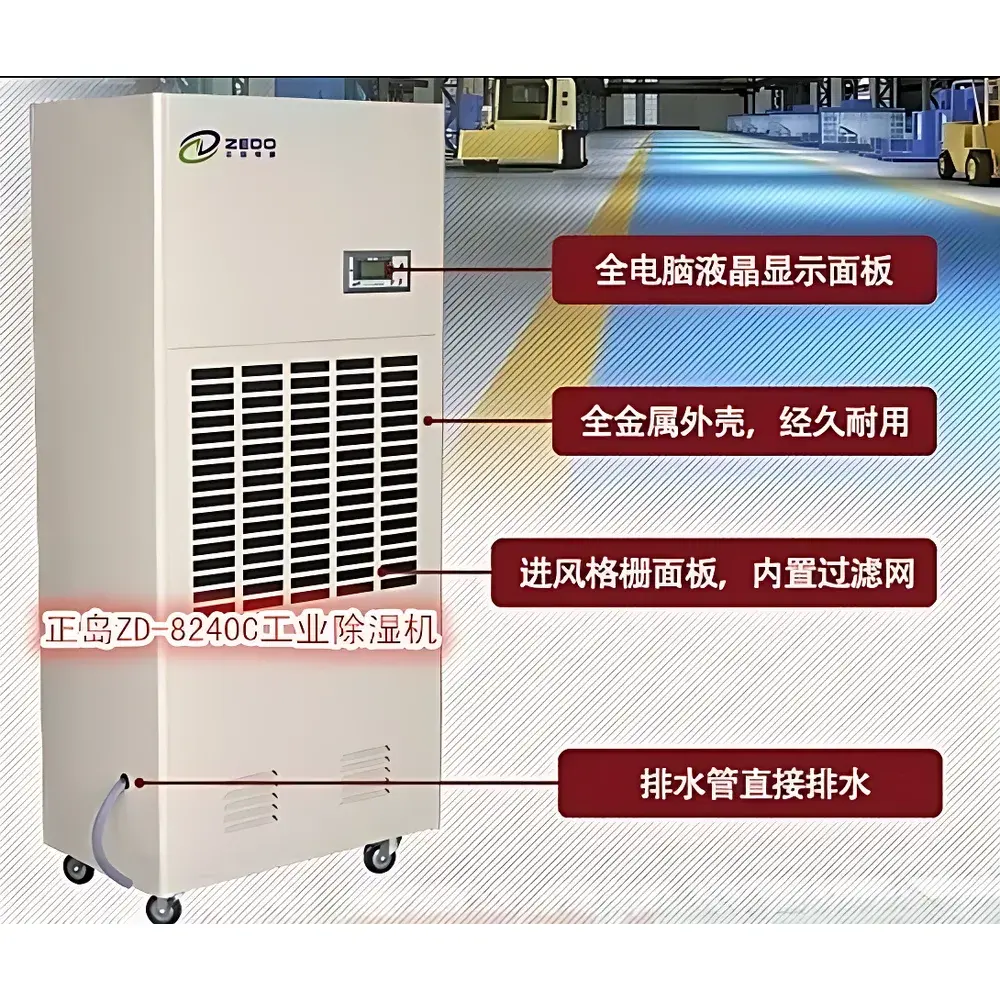
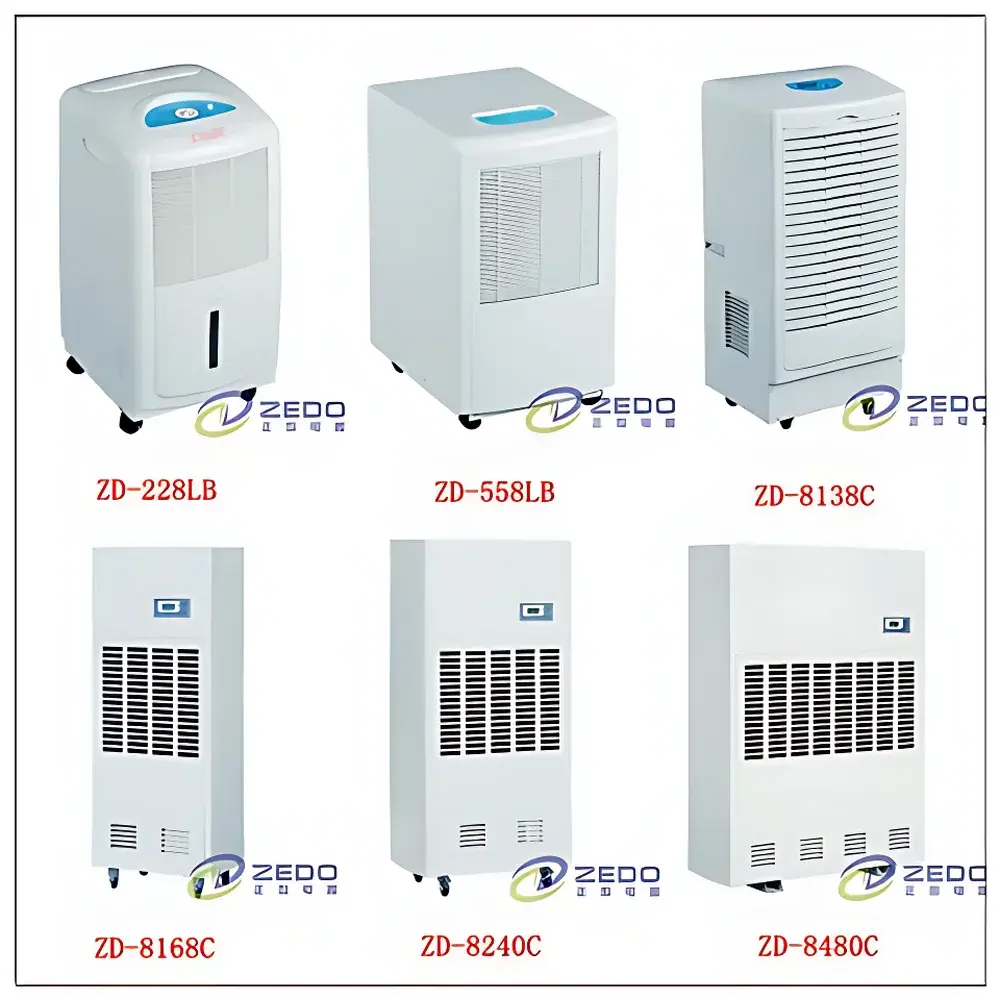
ZEDO ZD-8240C Industrial Dehumidifier
| Brand | ZEDO |
|---|---|
| Origin | Zhejiang, China |
| Manufacturer Type | Direct Manufacturer |
| Product Category | Domestic (China-made) |
| Model | ZD-8240C |
| Type | Compressor-based Industrial Dehumidifier |
| Dehumidification Capacity | 240 L/day |
| Power Input | 4900 W |
| Voltage/Frequency | 380 V~50 Hz |
| Operating Temperature Range | 5–38 °C |
| Noise Level | 52 dB(A) |
| Dimensions (W×D×H) | 770 × 470 × 1650 mm |
| Net Weight | 160 kg |
| Drainage Method | Continuous via PVC hose |
| Control System | Microprocessor-based with high-precision Japanese SHINYO humidity sensor |
| Safety Protections | High/low pressure cut-off, overload, undervoltage, reverse-phase protection |
| Filtration | Standard activated carbon filter |
| Airflow Design | Dual-centrifugal impeller, external rotor industrial fan |
| Heat Exchanger | Enhanced finned-tube copper coil with hydrophilic aluminum fins |
| Compressor | International-brand scroll compressor |
| Refrigerant | Eco-friendly R-410A |
| Application Area | 180–240 m² (at 2.6–2.8 m ceiling height, sealed environment) |
Overview
The ZEDO ZD-8240C Industrial Dehumidifier is a heavy-duty, compressor-driven moisture control system engineered for continuous operation in demanding production and storage environments. It operates on the principle of refrigerant-based condensation—drawing ambient air across a cooled evaporator coil where water vapor condenses into liquid form, which is then collected or drained continuously. This thermodynamic process delivers stable, predictable dehumidification performance under variable load conditions typical of industrial settings—including fluctuating ambient temperature (5–38 °C), high latent loads from personnel ingress, material handling, or ventilation infiltration. Unlike desiccant-based systems, the ZD-8240C achieves high volumetric moisture removal efficiency (240 L/day) without requiring consumable media or regeneration energy, making it optimal for applications where long-term operational economy and low maintenance overhead are critical.
Key Features
- Industrial-grade scroll compressor from a globally recognized manufacturer, delivering high volumetric efficiency, low mechanical wear, and extended service life under 24/7 duty cycles.
- Optimized heat exchanger assembly featuring internally grooved copper tubing paired with hydrophilic aluminum fins—maximizing surface contact area and thermal transfer coefficient while minimizing airflow resistance and frost accumulation.
- Dual centrifugal impeller air handling system with external rotor industrial fan—ensuring uniform static pressure distribution, high air volume delivery (>2,800 m³/h), and acoustic performance compliant with ISO 3744 noise measurement standards (≤52 dB[A] at 1 m).
- Microprocessor-based control unit integrated with SHINYO high-accuracy capacitive humidity sensor (±3% RH accuracy, 0–99% RH range), enabling precise setpoint regulation (1% RH increments) and real-time environmental feedback.
- Comprehensive electrical safety architecture: UL-listed contactors, Class B thermal overload relays, three-phase voltage monitoring, phase reversal detection, and automatic 3-minute compressor restart delay to prevent short-cycling damage.
- Structural modularity—refrigeration and airflow subsystems are physically isolated within the chassis—facilitating field service, component-level diagnostics, and compliance with ISO 5170-2 maintenance accessibility requirements.
Sample Compatibility & Compliance
The ZD-8240C is designed for use in non-hazardous, non-explosive indoor environments classified per IEC 60079-0 as Zone 22 (dust) and Group IIIA (combustible dust). It complies with CE marking directives (2014/35/EU Low Voltage Directive, 2014/30/EU EMC Directive) and meets GB/T 19411–2003 (Chinese National Standard for Industrial Dehumidifiers). While not intrinsically safe, its construction satisfies IP20 ingress protection and conforms to ISO 14644-1 Class 8 cleanroom support requirements when deployed in conjunction with HEPA filtration upgrades. The unit is routinely deployed in GMP-aligned facilities—including pharmaceutical storage vaults, medical device packaging lines, and precision instrument calibration labs—where humidity stability (±5% RH) directly impacts product shelf life, dimensional stability of hygroscopic materials, and electrochemical reliability of PCB assemblies.
Software & Data Management
The embedded controller supports local parameter configuration via intuitive membrane keypad interface with LCD status display (humidity setpoint, real-time RH%, fault codes, runtime hours). Optional RS-485 Modbus RTU communication port enables integration into facility-wide Building Management Systems (BMS) for centralized logging, alarm forwarding, and trend analysis. All operational events—including compressor cycle count, sensor calibration timestamps, and safety lockout triggers—are stored in non-volatile memory with audit-trail capability meeting FDA 21 CFR Part 11 electronic record requirements when paired with validated BMS software. Remote monitoring via optional Ethernet gateway (sold separately) supports SNMP v2c traps and HTTP-based status polling for predictive maintenance scheduling.
Applications
This dehumidifier serves mission-critical roles across regulated and high-value industrial sectors. In food manufacturing plants, it maintains ≤60% RH in dry-mix blending rooms to prevent caking and microbial proliferation in starches, powders, and dairy derivatives. Within electronics assembly facilities, it sustains ≤40% RH in SMT reflow zones to inhibit solder paste slump and mitigate electrostatic discharge (ESD) risks per ANSI/ESD S20.20. In archival repositories and library conservation centers, it stabilizes RH between 45–55% to inhibit cellulose hydrolysis in paper-based media and silver halide degradation in photographic negatives. Additional validated deployments include MRI equipment rooms (preventing cryostat dew-point excursions), aerospace composite layup bays (controlling resin viscosity), and semiconductor wafer fab tooling enclosures (limiting airborne molecular contamination).
FAQ
What is the recommended ambient temperature range for continuous operation?
The unit is rated for uninterrupted service between 5 °C and 38 °C ambient. Below 5 °C, frost formation on the evaporator may impair capacity; above 38 °C, condenser subcooling margin diminishes, potentially triggering high-pressure cutout.
Can this unit be integrated into an existing HVAC control network?
Yes—via optional RS-485 Modbus RTU interface (standard on firmware v2.3+), supporting read/write access to 22 operational registers including humidity setpoint, actual RH, compressor status, and fault history.
Is continuous drainage supported, and what are the hose specifications?
Continuous gravity-fed drainage is standard using 16 mm ID PVC hose (supplied); maximum vertical lift: 1.2 m; max horizontal run: 15 m with ≥1% slope.
Does the unit comply with energy efficiency regulations such as EU Ecodesign Directive?
It meets China’s GB 19576–2019 minimum seasonal energy efficiency ratio (SEER) requirement of 2.6 for industrial dehumidifiers >150 L/day capacity. CE-marked units shipped to EU markets include EN 12102-compliant test reports.
What maintenance intervals are recommended for sustained performance?
Condenser coil cleaning every 3 months in dusty environments; annual refrigerant charge verification and sensor recalibration (traceable to NIST standards); biannual inspection of electrical terminations and safety relay functionality per ISO 55001 asset management guidelines.



