
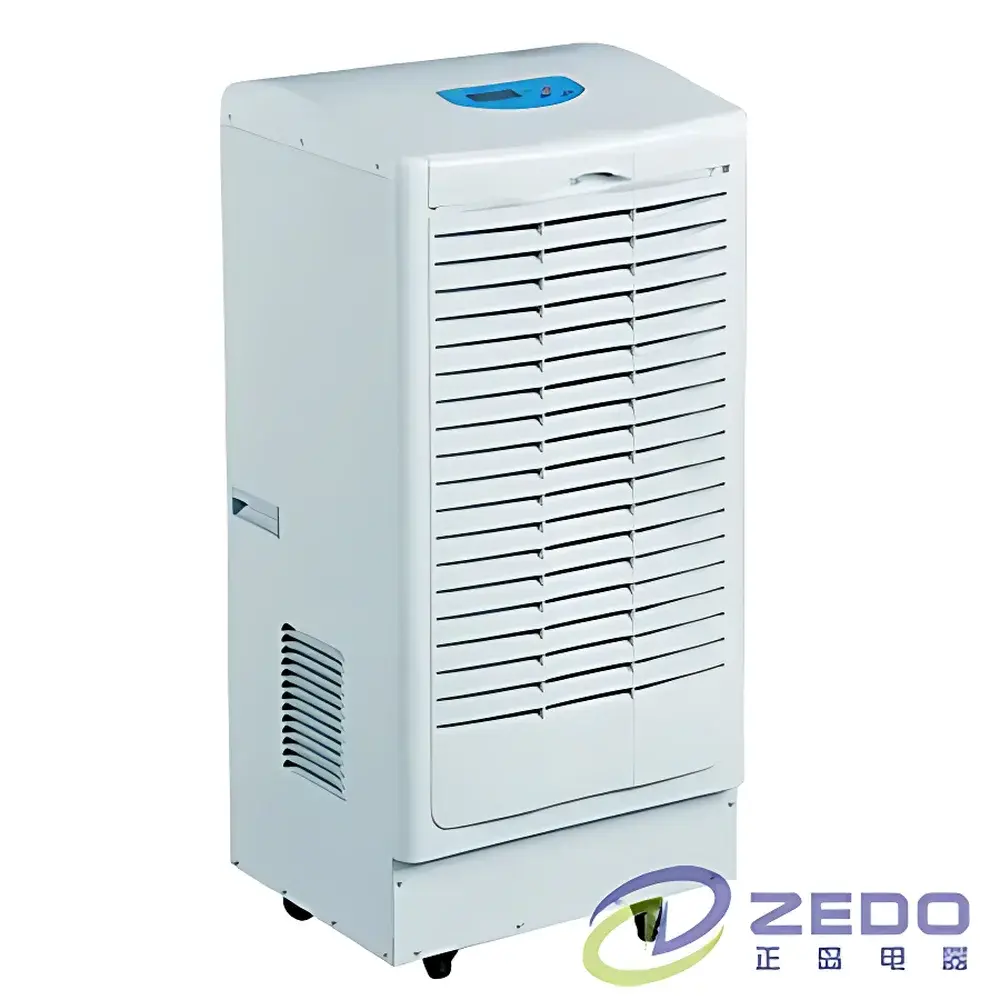
ZEDO ZD-8138C Industrial Dehumidifier for Printing Facilities
| Brand | ZEDO |
|---|---|
| Origin | Zhejiang, China |
| Manufacturer Type | Direct Manufacturer |
| Region of Origin | Domestic (China) |
| Model | ZD-8138C |
| Instrument Type | Compressor-Based Dehumidifier |
| Dehumidification Capacity | 138 L/day |
| Control Method | Intelligent Humidity Setpoint Control |
| Drainage | Continuous via PVC Drain Hose |
| Power Supply | 220 V~50 Hz |
| Input Power | 2000 W |
| Operating Temperature Range | 5–38 °C |
| Noise Level | 50 dB(A) |
| Dimensions (W×D×H) | 480 × 430 × 1100 mm |
| Net Weight | 58 kg |
| Airflow System | Dual-centrifugal impeller with external rotor industrial fan |
| Refrigeration System | Scroll compressor with eco-friendly refrigerant R410A |
| Heat Exchanger | Hydrophilic aluminum fin-tube coil with internal-thread copper tubing |
| Safety Protections | High/Low pressure switch, overcurrent/under-voltage/phase-reversal protection, 3-minute compressor delay start |
| Sensor | Japan Shinko high-precision capacitive humidity & temperature sensor |
| Filtration | Standard activated carbon pre-filter |
| Smart Diagnostics | Real-time fault detection with LED status indication |
Overview
The ZEDO ZD-8138C Industrial Dehumidifier is engineered specifically for precision humidity control in printing facilities, where ambient moisture directly compromises substrate integrity, ink transfer dynamics, and registration accuracy. Utilizing refrigerant-based condensation dehumidification—where moist air is drawn across a sub-zero evaporator coil (typically operating at ≤5 °C dew point), causing water vapor to condense and drain as liquid—the unit delivers stable, repeatable dry-air output. Unlike desiccant systems, this compressor-driven architecture ensures consistent performance across the 5–38 °C operational envelope typical of production environments, without requiring regeneration cycles or consumable media. Its design targets ISO 12647-2 recommended relative humidity (RH) bands of 40–60 % RH—proven optimal for minimizing paper dimensional instability, static charge accumulation, and ink drying variability in offset, flexographic, and digital print workflows.
Key Features
- High-capacity refrigeration system featuring an imported scroll compressor and R410A refrigerant—optimized for energy efficiency, low vibration, and extended service life under continuous operation.
- Dual-centrifugal air circulation system with external rotor industrial fans—engineered for uniform airflow distribution across large floor areas (100–150 m²) while maintaining acoustic performance ≤50 dB(A) at 1 m distance.
- Hydrophilic aluminum fin-tube heat exchanger with internally grooved copper tubing—maximizing latent heat exchange surface area and condensate shedding efficiency to sustain rated dehumidification capacity even at marginal inlet conditions.
- Microprocessor-based controller integrated with Shinko capacitive humidity/temperature sensors—enabling ±3 % RH accuracy, programmable setpoints (30–80 % RH), hysteresis adjustment, and real-time diagnostics via LED interface.
- Comprehensive electrical safety architecture—including high/low pressure cutouts, phase reversal detection, thermal overload relays, and 3-minute anti-short-cycle compressor delay—to ensure compliance with IEC 60335-1 general safety requirements for industrial appliances.
- Modular mechanical layout separating refrigeration and airflow subsystems—facilitating field-accessible maintenance without refrigerant recovery, reducing downtime during routine filter replacement or coil cleaning.
Sample Compatibility & Compliance
The ZD-8138C is designed for integration into controlled manufacturing environments where hygroscopic materials (e.g., cellulose-based papers, coated substrates, water-based inks) are processed. It meets structural and electrical safety benchmarks aligned with GB 4706.32 (Chinese national standard for dehumidifiers) and incorporates design elements compatible with broader facility-level compliance frameworks—including ISO 9001 quality management systems (QMS) and ISO 14001 environmental management protocols. While not certified to UL/CSA or CE for direct export use without regional adaptation, its component-level specifications (e.g., Class H insulation, IP20 enclosure rating, RoHS-compliant PCBs) support third-party validation for GMP-aligned printing operations handling pharmaceutical packaging or regulated documentation.
Software & Data Management
The unit operates via embedded firmware with no external software dependency. All operational parameters—including current RH%, setpoint, runtime hours, and active fault codes—are accessible through the front-panel LCD interface. The controller logs cumulative runtime and stores up to 10 recent fault events with timestamps—supporting preventive maintenance scheduling per ISO 55001 asset management guidelines. Though it lacks native Ethernet/Wi-Fi connectivity or cloud API integration, analog 4–20 mA output (optional accessory) enables connection to building management systems (BMS) or SCADA platforms for centralized environmental monitoring. Audit trail functionality satisfies basic GLP documentation needs when paired with manual logbook entries referencing displayed operational states.
Applications
Primary deployment contexts include pre-press paper acclimatization zones, pressroom climate buffers, post-print finishing areas, and archival-grade storage vaults for printed security documents. Secondary applications span laboratories handling moisture-sensitive reference standards (e.g., NIST-traceable calibration papers), cleanrooms supporting electronic label printing, and humidity-critical QC testing chambers where ASTM D644 (moisture content of paper) or TAPPI T402 (standard conditioning) protocols mandate strict RH adherence. The unit’s robust construction and continuous drainage capability also support long-duration unattended operation in bank vaults, museum conservation labs, and medical records repositories where mold inhibition is governed by ASHRAE Guideline 12-2020.
FAQ
What is the recommended RH setpoint for offset printing environments?
For optimal dimensional stability of wood-pulp papers and predictable ink film formation, maintain 45–55 % RH at 20–25 °C—per ISO 12647-2 Annex A.
Can this unit operate continuously in a 38 °C ambient environment?
Yes—the refrigeration circuit is thermally rated for inlet air up to 38 °C; however, dehumidification capacity decreases approximately 12 % per 5 °C rise above 25 °C ambient.
Is condensate disposal limited to gravity drainage?
No—continuous pump-assisted drainage (optional accessory) supports vertical lift up to 5 meters, enabling installation below floor level or remote tank placement.
Does the activated carbon filter remove VOCs from printing solvent vapors?
It captures low-molecular-weight organic compounds (e.g., ethanol, isopropanol) at trace concentrations but is not rated for high-concentration solvent exhaust streams; dedicated fume extraction remains mandatory.
How frequently should the evaporator coil be cleaned in a high-dust printing facility?
Inspect quarterly; clean with non-corrosive coil cleaner if dust loading exceeds visible accumulation—excessive buildup reduces latent capacity and may trigger frost protection shutdowns.



