
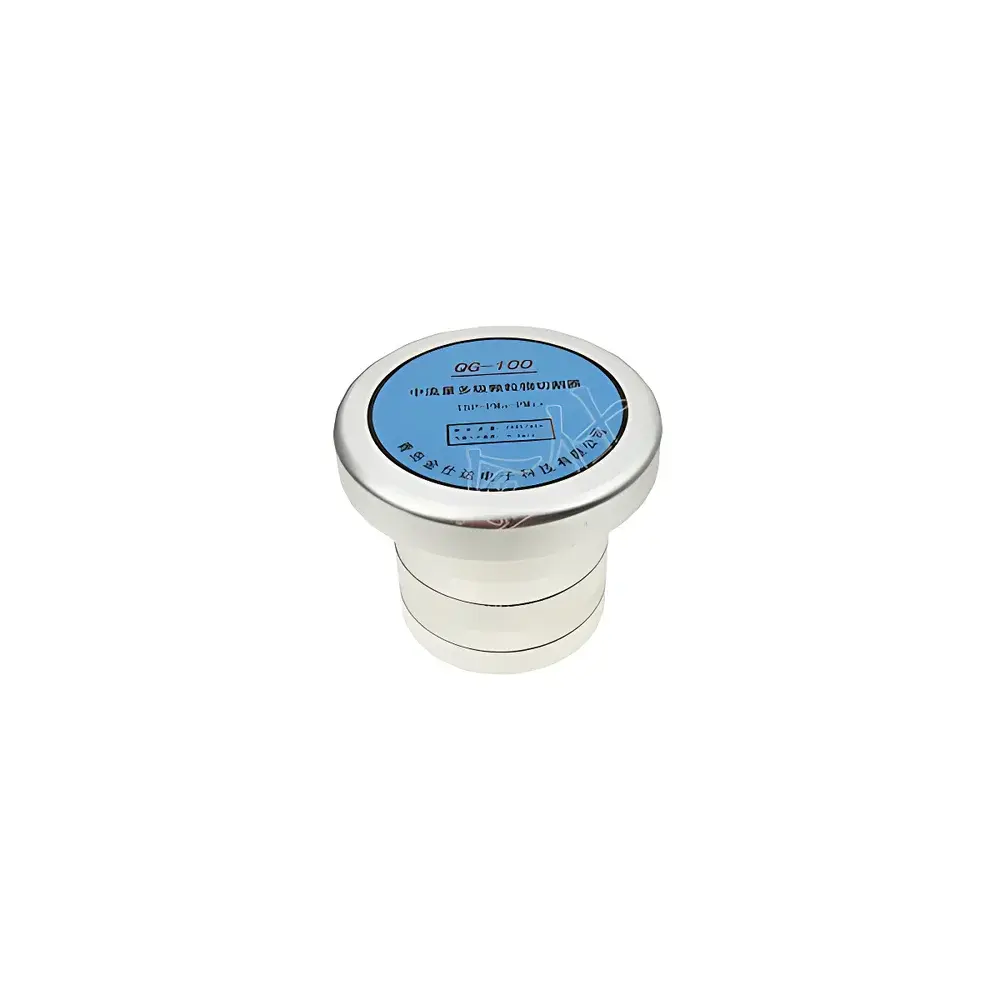
Genetec QG-100 Five-Stage Ambient Air Particulate Size-Selective Inlet (TSP/PM10/PM5/PM2.5/PM1)
| Brand | Genetec |
|---|---|
| Origin | Shandong, China |
| Manufacturer Type | OEM/ODM Producer |
| Product Category | Domestic |
| Model | QG-100 |
| Pricing | Upon Request |
| Flow Rate | 100 L/min |
| Effective Filter Area | Ø80 mm |
| PM10 Cut-Point | Da₅₀ = (10 ± 0.5) µm, σg = (1.5 ± 0.1) |
| PM2.5 Cut-Point | Da₅₀ = (2.5 ± 0.2) µm, σg = (1.2 ± 0.1) |
| PM1 Cut-Point | Da₅₀ = (1.0 ± 0.2) µm |
| Compliance | HJ 618–2011, HJ/T 93–2003 |
Overview
The Genetec QG-100 is a five-stage, size-selective ambient air particulate inlet engineered for precise physical fractionation of airborne particulate matter based on inertial impaction principles. It is designed to operate in tandem with medium-flow (100 L/min) gravimetric samplers for regulatory-compliant collection of total suspended particles (TSP) and aerodynamically defined fractions—PM10, PM5, PM2.5, and PM1—on individual filter substrates. Each stage comprises a precision-machined impactor plate and a corresponding collection substrate; stage-specific orifice geometry (number, diameter, and spacing) exploits differences in particle inertia to achieve sharp, reproducible aerodynamic cut-points. The QG-100 does not perform real-time measurement but serves as a critical front-end conditioning device enabling subsequent laboratory-based mass concentration determination via gravimetric analysis per HJ 618–2011.
Key Features
- Five-tier cascade impactor architecture supporting simultaneous TSP, PM10, PM5, PM2.5, and PM1 fractionation at a nominal flow rate of 100 L/min
- Aluminum alloy housing with anodized surface finish—eliminates electrostatic particle adhesion artifacts common in polymer-based inlets, ensuring gravimetric integrity
- Stage-specific orifice plates calibrated to meet Chinese environmental standard performance criteria: PM10 Da₅₀ = (10 ± 0.5) µm, σg = (1.5 ± 0.1); PM2.5 Da₅₀ = (2.5 ± 0.2) µm, σg = (1.2 ± 0.1); PM1 Da₅₀ = (1.0 ± 0.2) µm
- Standardized Ø80 mm filter support across all stages—compatible with quartz fiber, PTFE, and cellulose ester filters used in certified gravimetric protocols
- Modular mechanical design facilitating field maintenance, cleaning validation, and traceable recalibration under laboratory-controlled conditions
Sample Compatibility & Compliance
The QG-100 is validated for use with medium-flow sampling systems conforming to HJ/T 93–2003 technical specifications. Its performance parameters—including cut-point accuracy, geometric standard deviation (σg), and wall loss characteristics—are verified by the Chinese Center for Disease Control and Prevention (China CDC), Institute of Environmental Health and Related Product Safety. While developed for domestic regulatory frameworks, its aerodynamic behavior aligns with internationally recognized impactor theory (e.g., ISO 7708:1995 for particle size-selective sampling). When integrated into a full sampling train—including certified flow controllers, temperature/pressure sensors, and conditioned filter handling procedures—the system supports data submission for national air quality monitoring networks and research-grade epidemiological studies requiring speciated PM mass budgets.
Software & Data Management
As a passive mechanical inlet, the QG-100 requires no embedded firmware, power supply, or software interface. All operational parameters—including flow calibration logs, filter lot traceability, blank correction records, and environmental metadata (temperature, pressure, relative humidity)—must be documented manually or via external data acquisition systems compliant with GLP practices. Laboratories utilizing the QG-100 in regulated environments are advised to implement electronic lab notebooks (ELNs) with audit trails and 21 CFR Part 11–compliant electronic signatures when recording gravimetric results derived from its fractions. No proprietary software is associated with this device.
Applications
- Regulatory ambient air monitoring programs requiring concurrent quantification of PM1, PM2.5, PM5, PM10, and TSP mass concentrations
- Source apportionment studies where chemical speciation (e.g., EC/OC, water-soluble ions, metals) is performed separately on each size fraction
- Health effects research investigating differential deposition patterns of ultrafine (PM1) versus fine (PM2.5) and coarse (PM10) particles in respiratory tract models
- Method development and inter-laboratory comparison exercises targeting improved cut-point reproducibility and low-concentration recovery efficiency
- Educational use in environmental engineering and atmospheric science curricula for demonstrating inertial separation physics and aerosol dynamics
FAQ
Is the QG-100 suitable for continuous unattended operation?
No—it is intended for discrete, time-integrated sampling campaigns (e.g., 24-hr or 48-hr exposures) requiring manual filter exchange and strict environmental controls during handling.
Does it include flow control or require an external flow meter?
It requires integration with a calibrated medium-flow sampler capable of maintaining stable 100 L/min airflow; no internal flow regulation is provided.
Can it be used with high-volume samplers (>1 m³/min)?
No—its orifice geometry and pressure drop profile are optimized exclusively for 100 L/min systems; use with higher flows invalidates cut-point performance.
Are replacement impactor plates available with NIST-traceable certification?
Yes—Genetec provides factory-calibrated spare plates with individual test reports referencing HJ/T 93–2003 verification procedures.
What filter types are recommended for PM1 collection to minimize volatilization losses?
Quartz fiber filters pre-baked at 550°C (for organic carbon analysis) or polyurethane foam (PUF) substrates with backup quartz filters are commonly employed in PM1 gravimetric protocols per method guidance in HJ 618–2011 Annex B.







