
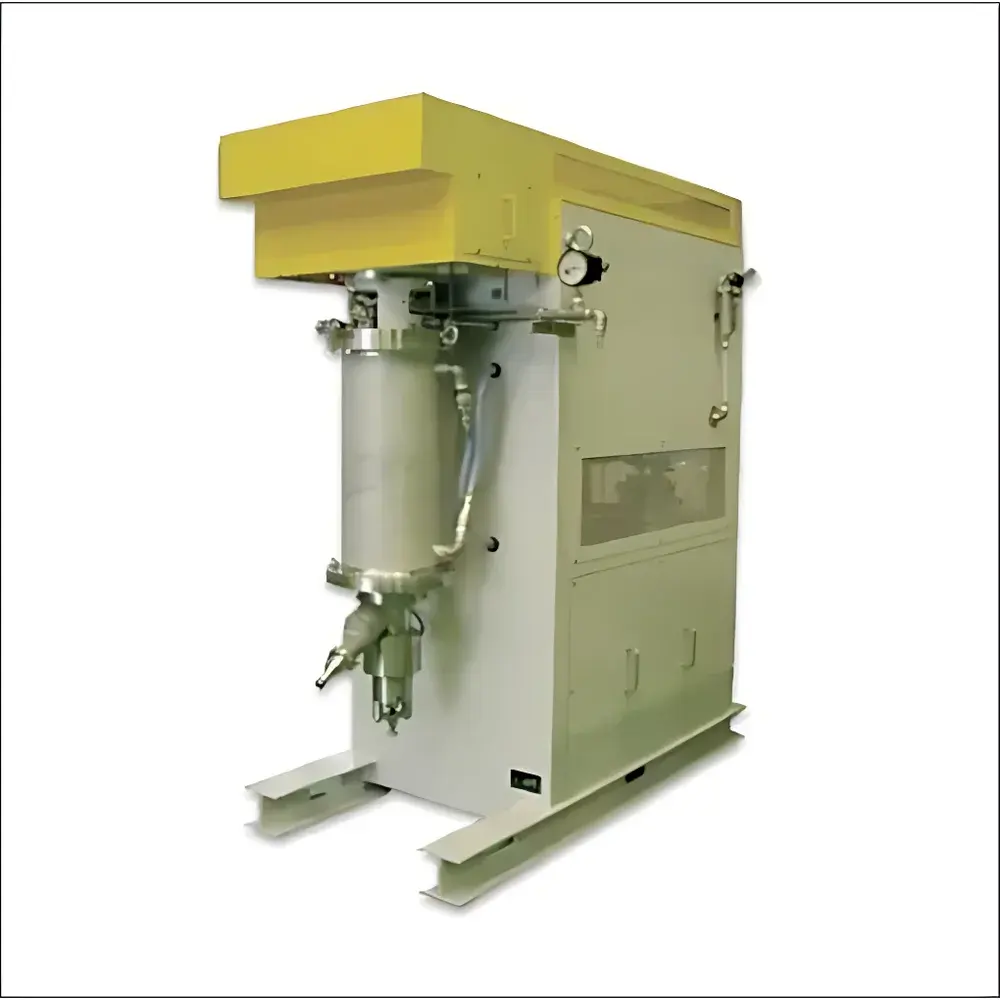
HM&M Apex Mill Vertical Bead Mill
| Brand | HM&M |
|---|---|
| Origin | Japan |
| Model | Apex Mill |
| Type | Wet Bead Mill (Vertical) |
| Sample Applicability | Hard, Brittle, and Agglomerated Materials |
| Feed Particle Size | >10 µm |
| Final Particle Size | <10 µm (down to 150 nm) |
| Batch Volume | 60 mL |
| Bead Size Range | Φ0.3 mm – Φ5 mm |
| Max. Slurry Viscosity | 30,000 mPa·s |
| Stirrer Tip Speed | 5–12 m/s |
| Cooling Jacket | Integrated |
| Bead Separation | Adjustable Conical Slit Separator with Pressure-Responsive Gap Control |
Overview
The HM&M Apex Mill is a precision-engineered vertical wet bead mill designed for high-efficiency, scalable particle size reduction of hard, brittle, and agglomerated materials in slurry form. Operating on the principle of shear and impact attrition between grinding media (beads) and suspended particles under controlled hydrodynamic conditions, the Apex Mill delivers reproducible submicron and nanoscale particle distributions—typically 150 nm to several micrometers—with exceptional process stability. Its vertical orientation ensures gravity-assisted downward slurry flow, promoting uniform bead distribution in the primary grinding zone and minimizing bead stratification or channeling—even at viscosities up to 30,000 mPa·s. The integrated cooling jacket maintains thermal stability during extended operation, critical for heat-sensitive formulations such as pharmaceutical actives, functional food ingredients, and nano-ceramic dispersions. Unlike horizontal mills, the Apex Mill’s compact columnar architecture reduces footprint while enabling rapid disassembly and full product recovery—key requirements for GMP-compliant R&D and pilot-scale development.
Key Features
- Pressure-responsive conical slit bead separator: Automatically adjusts gap width in response to backpressure rise, preventing clogging during high-viscosity or fine-bead (Φ0.3 mm) operation.
- Optimized stirrer geometry: Large internal mixing volume combined with tip speeds of 5–12 m/s ensures high energy transfer and consistent shear rate across batch volumes from 60 mL upward.
- Wide bead compatibility: Supports grinding media from Φ0.3 mm to Φ5 mm—enabling flexible selection based on target particle size, material hardness, and dispersion kinetics.
- Gravity-aligned slurry path: Downward flow design stabilizes bead positioning and eliminates lateral bead migration, ensuring uniform residence time and minimizing overgrinding or crystal damage.
- GMP-ready mechanical design: Minimal dead-legs, polished 316L stainless-steel wetted parts, sanitary seal configurations, and tool-free access to the grinding chamber facilitate CIP validation and residue clearance.
- Demonstrated low contamination profile: Validated in API milling applications with total metallic impurity levels <1 ppm—achievable via optimized bead load, speed, and residence time control.
Sample Compatibility & Compliance
The Apex Mill is validated for processing a broad spectrum of inorganic and organic solids, including metal oxides (e.g., TiO₂, BaTiO₃), conductive metals (Cu, Ag, Pd), ceramic precursors, pigments, agrochemical actives, food-grade suspensions (e.g., chocolate paste, spice emulsions), cosmetic suspensions (e.g., zinc oxide sunscreens), and nanoparticulate drug formulations. It complies with ISO 8573-1 (compressed air purity), meets FDA 21 CFR Part 11 requirements when paired with compliant data acquisition software, and supports GLP/GMP documentation through audit-trail-enabled process logging. All models conform to IEC 61000-6-2 (EMC immunity) and IEC 61000-6-4 (EMC emission) standards. For pharmaceutical use, equipment qualification (IQ/OQ/PQ) protocols are supported by HM&M’s technical documentation package—including material certificates, surface roughness reports (Ra ≤ 0.4 µm), and weld traceability records.
Software & Data Management
While the base Apex Mill operates via analog controls with calibrated speed and pressure monitoring, optional digital integration includes HM&M’s ApexControl™ module—a CE-certified PLC-based interface supporting real-time logging of stirrer RPM, inlet/outlet pressure differential, jacket coolant temperature, and total processing time. Data export is compatible with CSV and ASTM E2500-compliant formats. When deployed with validated LIMS or MES systems, the module enables electronic batch record generation, deviation flagging (e.g., pressure drift >±5% setpoint), and automated alarm escalation—fully aligned with Annex 11 and ALCOA+ data integrity principles. Audit trails are immutable and timestamped, satisfying FDA 21 CFR Part 11 electronic signature requirements.
Applications
- Nanomaterial synthesis: Production of stable colloidal dispersions of metal oxides and quantum dots for battery cathodes, catalysts, and optical coatings.
- Pharmaceutical nanomilling: Top-down comminution of BCS Class II/IV APIs into bioavailable nanosuspensions—validated for sterility-preserving aseptic transfer configurations.
- Electronics slurries: Precision dispersion of conductive pastes (Ag, Cu) and dielectric inks requiring narrow D90 <500 nm and minimal crystal lattice disruption.
- Food & nutraceuticals: Homogenization of lipid-based nutraceutical suspensions and pigment-stabilized sauces without thermal degradation.
- High-performance ceramics: Deagglomeration of submicron alumina, zirconia, and silicon carbide powders prior to sintering—maintaining stoichiometric integrity and phase purity.
FAQ
What is the smallest achievable particle size with the Apex Mill?
Typical final particle size distribution (PSD) reaches D90 values of 150–500 nm depending on material hardness, slurry rheology, bead size, and residence time—validated via laser diffraction (ISO 13320) and TEM cross-correlation.
Can the Apex Mill handle abrasive materials like silicon carbide or tungsten carbide?
Yes—when equipped with wear-resistant stirrer tips (e.g., SiC-coated or tungsten carbide inserts) and ceramic-lined grinding chambers; HM&M provides abrasion resistance test reports per ASTM G65 for specific material pairings.
Is cleaning validation support available for pharmaceutical applications?
Yes—HM&M supplies swab sampling point maps, residue limit calculations per ICH Q5C, and cleaning cycle development templates aligned with PDA TR29 and EU GMP Annex 15.
Does the Apex Mill support continuous operation?
The standard Apex Mill is batch-operated; however, the Wide Separator Apex Mill variant (not covered here) is engineered for semi-continuous flow-through mode with integrated feed/pump control and inline PSD monitoring.
How is bead wear monitored and managed over time?
Bead mass loss is tracked via periodic gravimetric analysis; HM&M recommends replacement intervals based on cumulative energy input (kWh/L) and post-milling elemental analysis of filtrate—protocols included in the Operator’s Manual.



