
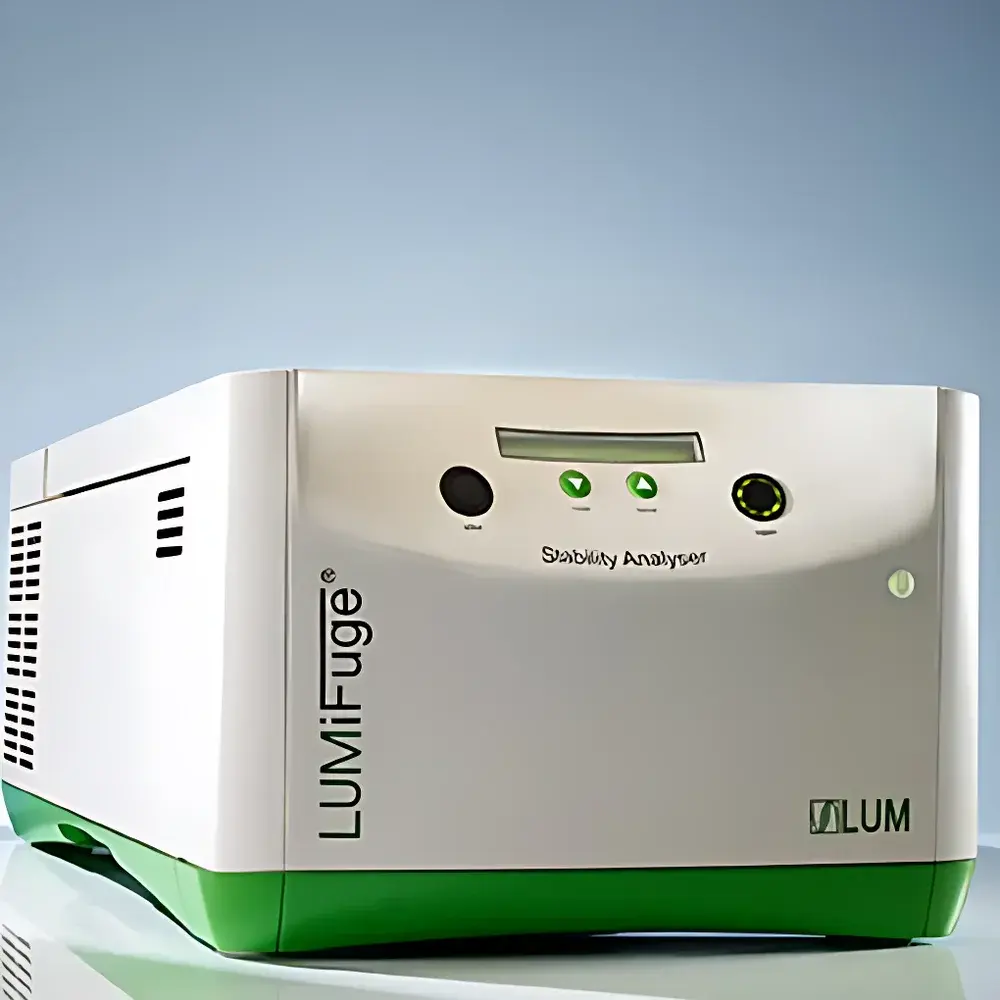
LUMiFuge Protein Stability Analyzer by LUM GmbH
| Brand | LUM GmbH |
|---|---|
| Origin | Germany |
| Model | LUMiFuge |
| Application | Protein Stability & Colloidal Dispersion Analysis |
| Technology | STEP™ (Spatial and Temporal Extinction Profiling) |
| Sample Capacity | 8 positions |
| Temperature Control | 4–60 °C (±0.5 K) |
| Acceleration Range | 6–2300 × g |
| Detection Time Resolution | 1 s–99 h |
| Sample Volume | 0.05–2.0 mL |
| Concentration Range | 0.00015–90 wt% |
| Density Limit | up to 22 g/cm³ |
| Viscosity Range | 0.8–10⁸ mPa·s |
| Light Source | NIR or customizable multi-wavelength LED array |
| Compliance | ISO/TR 13097, FDA 21 CFR Part 11 (software audit trail enabled), GLP-ready |
| Dimensions (W×H×D) | 37×27×60 cm |
| Weight | 40 kg |
Overview
The LUMiFuge Protein Stability Analyzer is a high-precision analytical centrifuge engineered for rapid, non-invasive assessment of colloidal and macromolecular stability—specifically optimized for therapeutic proteins, monoclonal antibodies, virus-like particles, and other biopharmaceutical formulations. At its core lies STEP™ (Spatial and Temporal Extinction Profiling) technology: a patented optical method that captures full-length extinction profiles across the entire sample cell in real time, without dilution, labeling, or prior knowledge of composition. Unlike conventional sedimentation assays relying on endpoint measurements or turbidity proxies, the LUMiFuge applies controlled centrifugal acceleration (6–2300 × g) while simultaneously recording spatially resolved light transmission data—enabling direct quantification of particle migration, phase separation kinetics, and structural evolution within heterogeneous dispersions. This physical acceleration approach compresses months of real-time storage stability into hours, delivering predictive insight into shelf-life-limiting mechanisms such as aggregation, sedimentation, creaming, flocculation, and coalescence.
Key Features
- Simultaneous analysis of up to 8 samples under identical, programmable conditions (temperature, acceleration, illumination)
- High-resolution optical detection system with NIR or multi-wavelength LED sources and linear CCD sensor array for sub-millimeter spatial resolution
- Precise temperature control from 4 °C to 60 °C (±0.5 K), enabling cold-chain simulation and accelerated thermal stress testing
- Compatibility with disposable quartz, glass, or polymer sample tubes—eliminating cross-contamination and cleaning validation burdens
- Direct measurement of sedimentation velocity, clarification rate, layer thickness, density gradients, and floc strength without calibration standards
- Integrated magnetic field module option for orthogonal or parallel field application—supporting characterization of magnetically responsive protein conjugates or iron oxide nanoparticle formulations
- Robust mechanical architecture designed for continuous operation in regulated GMP environments
Sample Compatibility & Compliance
The LUMiFuge accommodates undiluted, native-state protein solutions—including high-concentration mAb formulations (>150 mg/mL), PEGylated proteins, liposomal suspensions, and virus preparations—across viscosity ranges from 0.8 to 10⁸ mPa·s and densities up to 22 g/cm³. Its label-free, non-destructive methodology complies with ISO/TR 13097 for dispersion stability evaluation and supports regulatory submissions under ICH Q5C (stability of biotechnological/biological products). SEPView software is validated per FDA 21 CFR Part 11 requirements, featuring electronic signatures, full audit trails, role-based access control, and immutable raw data archiving—ensuring traceability and integrity for GLP and GMP audits.
Software & Data Management
SEPView is the dedicated acquisition and analysis platform for the LUMiFuge, delivered pre-installed and factory-calibrated. It provides automated workflow templates for stability ranking, kinetic modeling (e.g., DLS-equivalent size distribution via sedimentation coefficient mapping), and quantitative comparison of destabilization onset times. Raw extinction profiles are stored in vendor-neutral HDF5 format, supporting third-party integration with LIMS and statistical process control (SPC) systems. Batch reporting includes customizable PDF exports compliant with ALCOA+ principles (Attributable, Legible, Contemporaneous, Original, Accurate, Complete, Consistent, Enduring, Available).
Applications
- Accelerated stability screening of monoclonal antibodies, fusion proteins, and bispecifics during formulation development
- Comparative assessment of excipient effects on colloidal stability and aggregation propensity
- Characterization of freeze-thaw and shear-induced destabilization events
- Quantitative evaluation of surfactant efficacy in preventing interfacial denaturation
- Stability profiling of mRNA-LNP formulations and viral vector suspensions
- Batch-to-batch consistency monitoring for release testing
- Root-cause analysis of visible particle formation via spatial-temporal fingerprinting
- Supporting QbD initiatives through mechanistic understanding of destabilization pathways
FAQ
Can the LUMiFuge distinguish between reversible aggregation and irreversible precipitation?
Yes. By resolving spatial evolution of extinction profiles over time, the instrument differentiates transient opalescence (reversible scattering) from permanent sediment formation (irreversible phase separation) based on migration velocity, layer compaction, and interface sharpness.
Is sample preparation required before loading?
No. Native, undiluted samples are loaded directly into standardized tubes—no filtration, dilution, or labeling is necessary.
How does the LUMiFuge correlate with real-time storage studies?
Empirical correlation models built from historical data enable prediction of 24-month stability outcomes from 24-hour accelerated runs, validated against long-term ICH conditions (25 °C/60% RH and 40 °C/75% RH).
Does the system support IQ/OQ/PQ documentation?
Yes. Comprehensive qualification protocols—including installation, operational, and performance qualification templates—are provided with the instrument and align with ASTM E2500 and Annex 15 guidelines.
Can I export raw data for independent reanalysis?
Yes. All extinction profiles, metadata, and processing logs are exported in open HDF5 format with documented schema, ensuring full computational reproducibility.



