
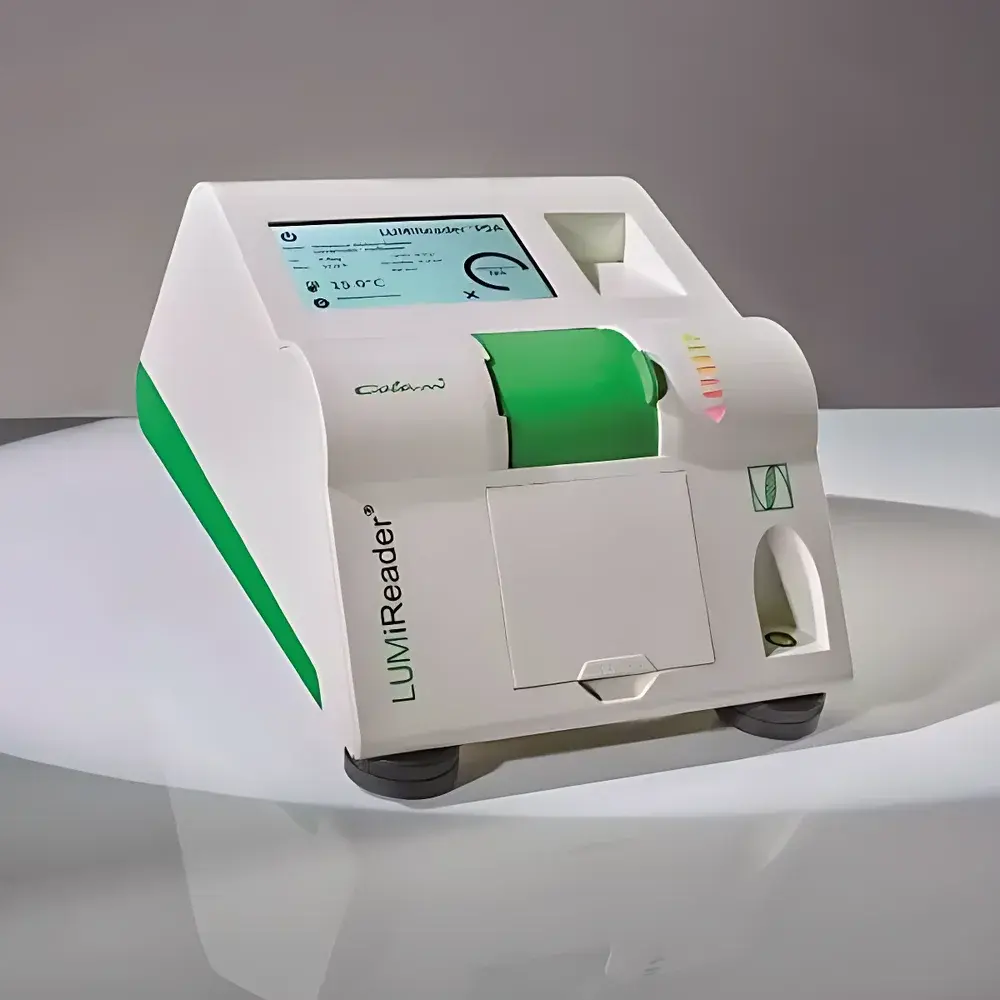
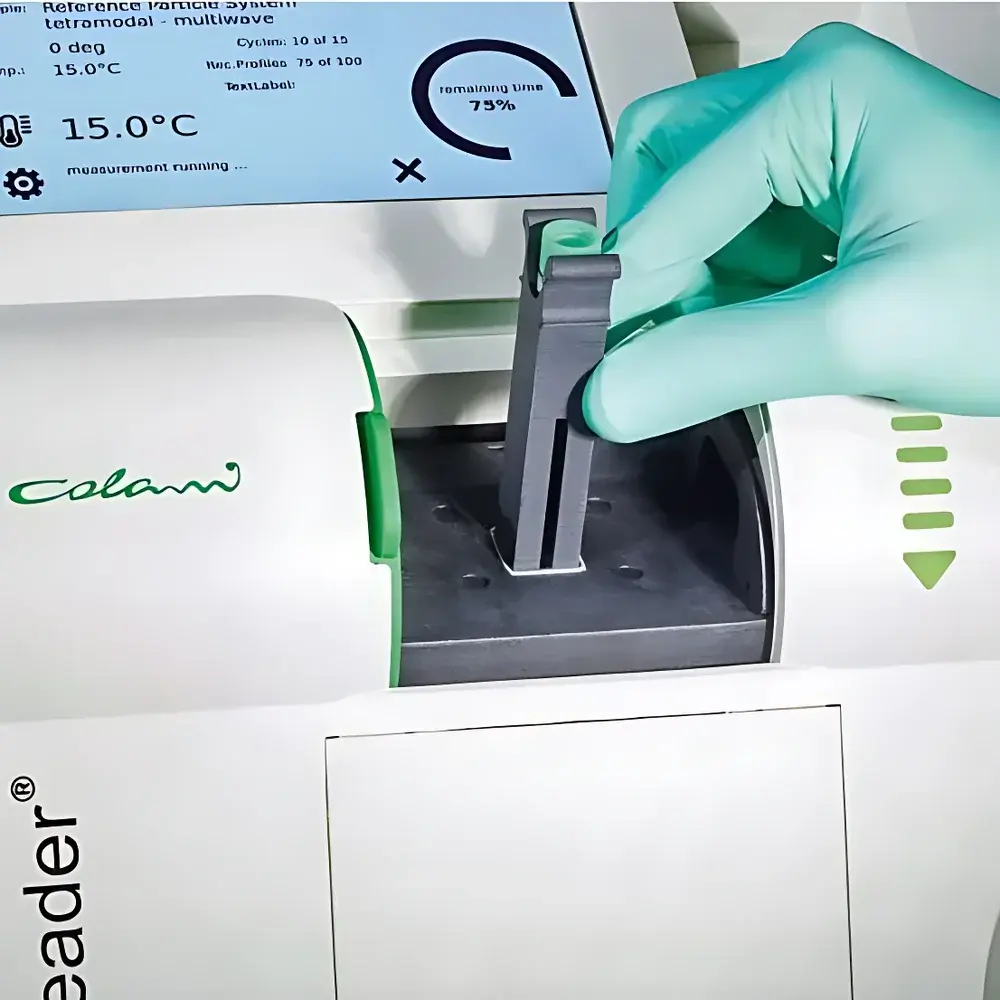
LUM GmbH LUMiReader PSA Sedimentation Particle Size Analyzer
| Brand | LUM GmbH |
|---|---|
| Origin | Germany |
| Model | LUMiReader PSA |
| Detection Principle | STEP Technology™ (Spatial and Temporal Extinction Profiling) |
| Measurement Range | 500 nm – 300 µm (particle size), 200 nm – 2000 µm (stability analysis) |
| Sample Volume | 0.5–4.0 mL |
| Acceleration | Up to 10× g via controlled tilt (0°–30°) |
| Temperature Control | Ambient +3°C to 60°C (±1 K) |
| Detection Frequency | Up to 250 measurements per second |
| Optical Resolution | >9000 high-sensitivity photodetectors per channel |
| Compliance | ISO/TR 13097, ISO 13317, ASTM D7827, FDA 21 CFR Part 11 (audit trail & electronic signature ready) |
| Power Supply | 24 V DC (100–240 V AC input) |
| Dimensions (W×H×D) | 29 × 24 × 44 cm |
| Weight | 11 kg |
Overview
The LUM GmbH LUMiReader PSA is a state-of-the-art sedimentation particle size analyzer engineered for direct, label-free, and quantitative characterization of colloidal and heterogeneous dispersions under native conditions. At its core lies the proprietary STEP Technology™ (Spatial and Temporal Extinction Profiling), a non-invasive optical method that captures real-time extinction profiles across the entire sample height—simultaneously in space and time—using multi-wavelength illumination and high-resolution photodetection. Unlike conventional centrifugal or laser diffraction techniques, the LUMiReader PSA operates at natural gravitational acceleration (1× g) or accelerated separation (up to 10× g) via precisely controlled sample tube tilting—eliminating mechanical rotation, shear artifacts, or calibration dependencies. This enables true measurement of particle migration velocity distributions (Qv(v)), intensity-weighted (qInt(x)) and volume-weighted (q3(x)) particle size distributions—without requiring prior knowledge of refractive index, particle shape, density, or viscosity. The system complies with ISO 13317 for volumetric particle size distribution determination and ISO/TR 13097 for dispersion stability assessment, making it suitable for regulatory-compliant R&D, QC, and process development in GMP/GLP environments.
Key Features
- STEP Technology™: Simultaneous acquisition of spatially resolved extinction profiles across full sample height (0.5–4.0 mL), enabling quantification of sedimentation, creaming, flocculation, coalescence, and phase separation kinetics.
- Multi-wavelength optical architecture: Eliminates reliance on single-wavelength assumptions; supports robust analysis of complex, polydisperse, or optically heterogeneous systems (e.g., pigmented emulsions, ceramic slurries, biopharmaceutical suspensions).
- Tilt-accelerated separation: Programmable inclination angles (0°–30°) provide controlled, reproducible enhancement of sedimentation rates—up to 10× g—without centrifugal force, preserving fragile structures and avoiding wall effects.
- Integrated precision temperature control: Maintains ±1 K stability from ambient +3°C up to 60°C, critical for thermally sensitive formulations (e.g., protein therapeutics, waxy crude oils, temperature-responsive polymers).
- No moving parts in optical path: Ensures long-term signal stability and minimal maintenance; 9000+ micro-resolution photodetectors per channel deliver sub-second temporal resolution (down to 0.5 s per profile) and high spatial fidelity.
- Factory-precalibrated and certified: Delivered with traceable calibration documentation compliant with ISO/IEC 17025 requirements; no user calibration required for routine operation.
Sample Compatibility & Compliance
The LUMiReader PSA accommodates a broad spectrum of industrial and research-grade dispersions—including concentrated suspensions (>75% w/w), low-concentration colloids (as low as 0.00015%), high-density systems (up to 22 g/cm³), and highly viscous media (up to 10⁸ mPa·s). It is validated for use with opaque, colored, or turbid samples where light scattering models fail—such as carbon black inks, asphalt emulsions, pharmaceutical nanosuspensions, food pastes, and mining tailings. Regulatory alignment includes full support for FDA 21 CFR Part 11 compliance (electronic records, audit trails, role-based access control), GLP/GMP data integrity protocols, and reporting templates aligned with ISO/TR 13097 stability classification (e.g., destabilization rate, separation onset time, interface velocity). All raw extinction data are stored in vendor-neutral .csv and .lum formats, ensuring long-term archival and third-party interoperability.
Software & Data Management
The instrument is operated via LUM’s proprietary SEPView® software—a Windows-based platform designed for scientific rigor and workflow efficiency. SEPView provides automated acquisition scheduling, real-time visualization of extinction profile evolution, and integrated mathematical modeling for deriving Qv(v), qInt(x), and q3(x) distributions using inverse Laplace transformation and constrained regularization algorithms. Data processing modules include stability ranking (based on ISO/TR 13097), shelf-life prediction (via Arrhenius modeling), flocculation strength quantification, and layer density profiling. All analyses generate PDF reports with embedded metadata (operator ID, timestamp, instrument serial number, environmental logs), digital signatures, and revision-controlled history—fully auditable for quality assurance departments and regulatory submissions.
Applications
The LUMiReader PSA serves as a primary analytical tool across industries where dispersion stability dictates product performance and shelf life. In pharmaceuticals, it characterizes injectable suspensions, topical emulsions, and mRNA-LNP formulations without dilution or labeling. In coatings and inks, it quantifies pigment settling behavior and rheological aging. In food science, it monitors phase separation in dairy creams, plant-based beverages, and starch gels. Energy applications include asphalt emulsion stability, lubricant degradation, and battery slurry homogeneity. Additional use cases span ceramics (slip casting stability), cosmetics (sunscreen particle aggregation), agrochemicals (suspension concentrate sedimentation), and wastewater treatment (floc settling kinetics). Its ability to operate on undiluted, unfiltered, and unstirred samples ensures physiologically and industrially relevant results.
FAQ
Does the LUMiReader PSA require refractive index or density input for particle size calculation?
No. STEP Technology™ derives particle size distributions directly from measured sedimentation velocity and extinction gradients, eliminating dependence on optical or material constants.
Can it analyze highly concentrated or opaque samples?
Yes. The multi-wavelength, high-dynamic-range detection system is specifically optimized for turbid, pigmented, and concentrated systems where traditional light-scattering methods fail.
Is the instrument compliant with FDA 21 CFR Part 11 for regulated environments?
Yes. SEPView software includes full electronic signature capability, audit trail logging, user access controls, and data integrity safeguards validated for pharmaceutical and medical device QA/QC.
What is the minimum detectable particle size and maximum concentration?
Stability analysis range: 200 nm – 2000 µm; particle sizing range: 500 nm – 300 µm; concentration range: 0.00015% – 75% w/w.
How does tilt-based acceleration differ from centrifugation?
Tilting induces a gravitational component parallel to the tube axis, accelerating sedimentation without introducing shear, convection, or boundary-layer artifacts—preserving native particle interactions and aggregate structure.



