
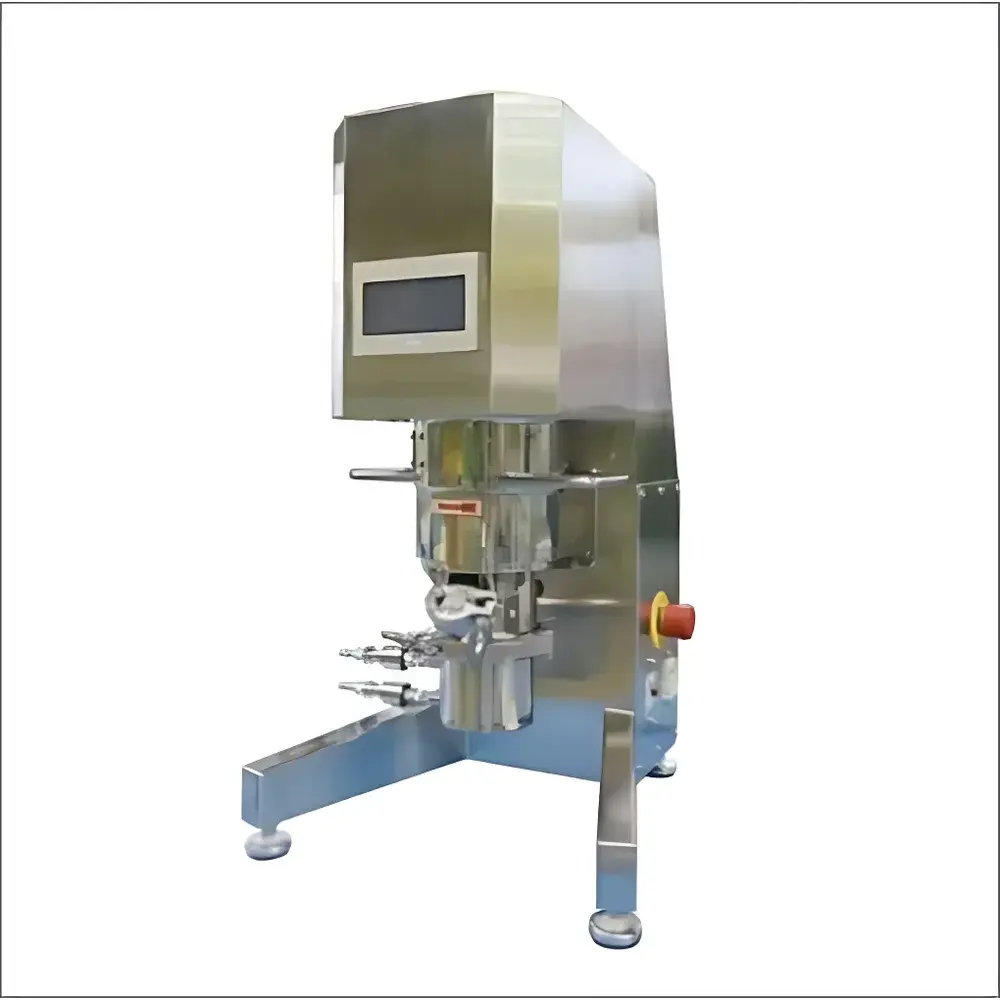
HM&M Apex LABO Benchtop Batch Bead Mill
| Brand | HM&M |
|---|---|
| Origin | Japan |
| Model | Apex LABO |
| Type | Laboratory-Scale Batch Bead Mill |
| Sample Capacity | 50–150 mL (standard 100 mL) |
| Bead Size Range | φ15 µm – φ1 mm |
| Inlet Particle Size | >10 µm |
| Outlet Particle Size | <10 µm (down to ≤100 nm achievable under optimized conditions) |
| Peripheral Speed | 1.5–12 m/s |
| Motor Power | 0.75 kW |
| Voltage | AC 100 V (100–110 V compatible) |
| Dimensions (L×W×H) | 460 × 370 × 654 mm |
| Weight | 69 kg |
| Compliance | Designed for GLP-compliant lab environments |
Overview
The HM&M Apex LABO is a precision-engineered, benchtop batch bead mill designed for laboratory-scale wet grinding, dispersion, and deagglomeration of suspensions and pastes. Operating on the principle of high-shear attrition between grinding media (beads) and suspended particles in a confined chamber, it delivers consistent sub-micron and nanoscale particle size reduction—ideal for R&D validation prior to scale-up. Its compact footprint and modular container system support rapid method development for formulations involving pigments, ceramics, battery cathode/anode slurries, pharmaceutical nanosuspensions, and advanced functional materials. Unlike continuous mills, the Apex LABO’s batch architecture enables strict control over residence time, energy input, and thermal management—critical for heat-sensitive or shear-labile samples.
Key Features
- Benchtop design with low-voltage (AC 100 V) operation—compatible with standard Japanese and North American lab power outlets without step-down transformers.
- Interchangeable grinding chambers: 50 mL, 100 mL (standard), and 150 mL volumes—enabling direct comparison across dosage levels and slurry viscosities.
- Wide bead diameter compatibility: supports grinding media from φ15 µm (ultra-fine nano-beads) up to φ1 mm—allowing systematic optimization of impact energy vs. surface-area-driven dispersion.
- Adjustable rotor peripheral speed (1.5–12 m/s) via variable-frequency drive—providing precise control over specific energy input (kWh/kg) and shear rate profile.
- Sealed, solvent-compatible chamber assembly—designed for safe operation with organic solvents (e.g., NMP, DMF, acetone); optional remote control unit enables placement of mill head inside fume hoods while retaining full operational interface outside.
- Robust stainless-steel construction (SUS316 contact parts) with ceramic shaft seal—ensuring chemical resistance and long-term dimensional stability under abrasive conditions.
Sample Compatibility & Compliance
The Apex LABO handles hard, brittle, and moderately ductile materials—including metal oxides (TiO₂, Al₂O₃), lithium-ion battery active materials (NMC, LFP), quantum dots, polymer nanoparticles, and crystalline APIs. It accommodates inlet feed sizes >10 µm and routinely achieves D₉₀ < 10 µm; with optimized bead selection (e.g., φ50–100 µm zirconia) and extended milling cycles, sub-100 nm distributions are reproducibly attainable. The system complies with core laboratory safety and documentation standards: all operational parameters (speed, time, temperature) are manually logged per GLP requirements; audit trails can be integrated into LIMS via external data capture. While not certified for FDA 21 CFR Part 11 out-of-the-box, its deterministic process logic and parameter lockout capability support validation under GMP-aligned SOPs for early-phase manufacturing.
Software & Data Management
The Apex LABO operates via manual analog controls—intentionally omitting embedded microprocessors to maximize reliability, minimize electromagnetic interference in sensitive lab environments, and simplify qualification (IQ/OQ). All critical process variables—including run duration, rotational speed setting, and chamber cooling status—are recorded externally using calibrated timers and tachometers traceable to NIST standards. For digital integration, optional RS-232 or 4–20 mA analog outputs allow connection to SCADA or LabVIEW-based monitoring systems. HM&M provides comprehensive technical documentation—including bead wear rate charts, torque vs. viscosity curves, and validated cleaning procedures—for inclusion in equipment master files and regulatory submissions.
Applications
- R&D of nanoparticle dispersions for inkjet inks, conductive pastes, and anti-reflective coatings.
- Process development for pharmaceutical nanosuspensions requiring narrow PDI (<0.2) and crystal integrity preservation.
- Slurry homogenization in solid-state battery electrode formulation—particularly for sulfide-based electrolytes where mechanical degradation must be minimized.
- Validation of scalable milling parameters: results generated on the Apex LABO demonstrate strong linear correlation with HM&M’s UAM-015 continuous mill and industrial Ultra Apex systems—reducing scale-up risk by >70% (per HM&M internal benchmarking study, 2022).
- Quality control testing of dispersant efficacy and surfactant selection under controlled energy input.
FAQ
What bead materials are recommended for sub-100 nm grinding?
Zirconia (Y-TZP) beads with diameters of φ50–150 µm are most effective for balancing attrition efficiency and minimal contamination. For ultra-fine applications (<50 nm), φ15–30 µm silica or polymeric beads may be used—but require extended cycle times and rigorous temperature control.
Can the Apex LABO process high-viscosity slurries (>5,000 cP)?
Yes—within the 50–150 mL range and with bead loading ≥70% v/v. Optimal performance requires pre-dilution or use of low-viscosity co-solvents; chamber cooling is strongly advised above 3,000 cP.
Is cleaning validation supported?
Yes—HM&M supplies detailed swab-testing protocols and residue limits per ICH Q5C guidelines, along with ultrasonic cleaning fixtures and compatibility charts for common solvents (IPA, ethanol, aqueous NaOH).
How does it compare to rotor-stator homogenizers?
Unlike rotor-stator systems, bead mills apply mechanical energy directly to particles via media collision—delivering higher energy density, narrower PSD, and superior scalability for hard-to-disperse systems.
Does HM&M offer application support for method transfer?
Yes—HM&M’s Technical Service Group provides remote and on-site assistance for DOE-based parameter optimization, including bead size/speed/charge mapping and thermal profiling.



