
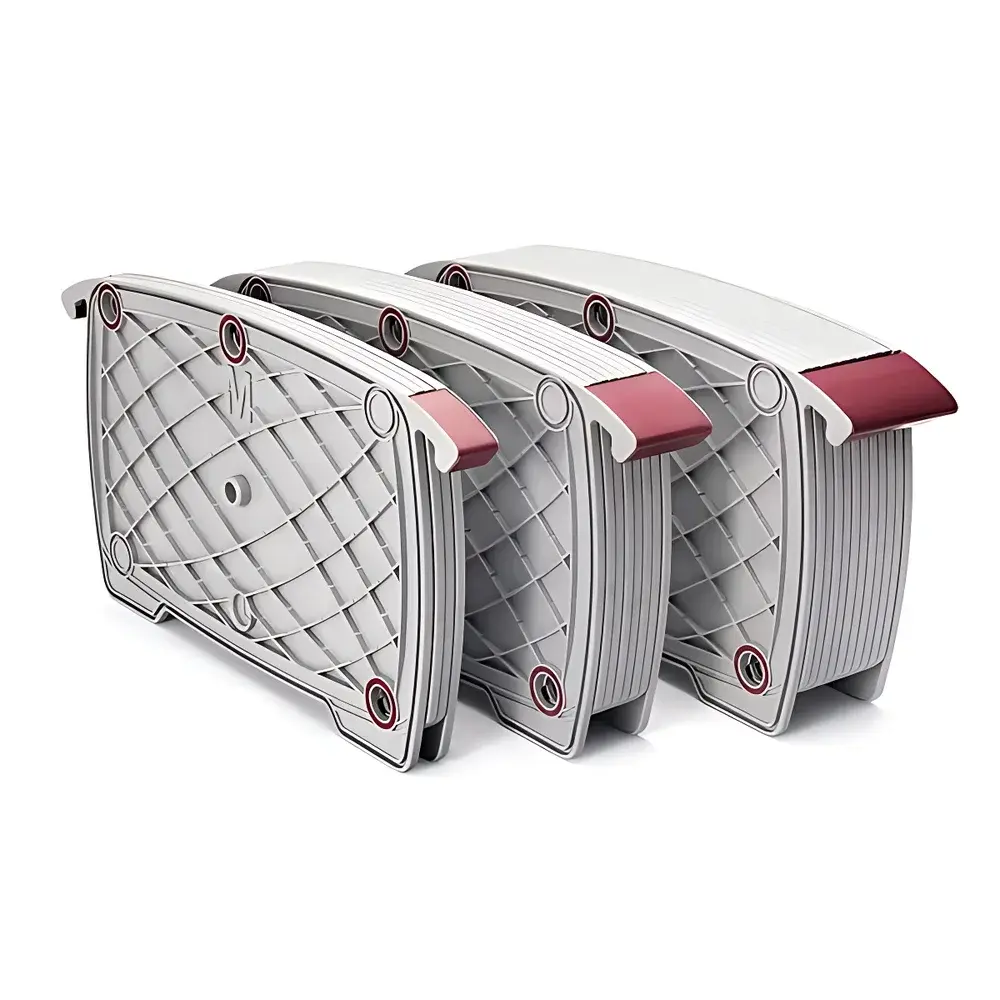
Millipore Clarisolve® Depth Filter Cartridge
| Brand | Millipore |
|---|---|
| Origin | USA |
| Model | Clarisolve® |
| Filter Structure | Density-Gradient Depth Media |
| Recommended Pre-treatment | Cationic Polymer Flocculation (e.g., pDADMAC) or pH Shift Precipitation |
| Typical Particle Size Handling Range | 10–60 µm |
| Format | Disposable Pod-Type Modular Cartridge |
| Compliance | Designed for cGMP Bioprocessing Environments |
| Regulatory Support | Compatible with FDA 21 CFR Part 11–compliant data management workflows when integrated with validated control systems |
Overview
The Millipore Clarisolve® Depth Filter Cartridge is an engineered solution for the primary clarification of high-cell-density (HCD) and high-titer monoclonal antibody (mAb) harvest streams. Unlike conventional depth filters optimized for sub-micron particulates from low-density cultures, Clarisolve® employs a proprietary density-gradient media architecture specifically designed to accommodate the broad, shifted particle size distribution (PSD) generated by modern pre-treatment strategies—particularly cationic polymer flocculation (e.g., poly(diallyldimethylammonium chloride), pDADMAC) and pH-based precipitation. This structural optimization enables efficient capture of large, fragile flocs (30–60 µm) while maintaining high flow rates, low pressure rise, and minimal product loss—critical attributes in continuous or semi-continuous bioprocessing platforms. The filter operates on the principle of depth filtration, where particles are retained not only on the surface but throughout the tortuous pore network via mechanisms including adsorption, interception, inertial impaction, and sedimentation—enhanced by graded density layers that progressively refine retention without premature blinding.
Key Features
- Density-gradient depth media architecture enables high throughput and extended service life under high-solids loading conditions typical of HCD mAb harvests (≥10 × 10⁶ cells/mL)
- Modular pod-type disposable format ensures scalability from lab-scale process development (e.g., 20MS for 10–20 µm flocs) to commercial manufacturing (e.g., 60 HX for 50–60 µm flocs)
- No centrifugation required—eliminates capital cost, footprint, and operational complexity associated with disc-stack or tubular bowl centrifuges
- Reduced buffer consumption and rinse volume compared to conventional depth filters, lowering overall process mass intensity (PMI)
- Validated extractables and leachables profile compliant with ICH Q5A(R2) and USP requirements for therapeutic protein manufacturing
- Pre-sterilized options available (gamma or E-beam), supporting closed-system, single-use bioprocessing architectures
Sample Compatibility & Compliance
Clarisolve® filters are qualified for use with clarified harvest streams from CHO, SP2/0, and HEK293 cell cultures expressing mAbs, Fc-fusion proteins, and bispecific antibodies. The system supports both batch and perfusion-derived harvests exhibiting viable cell densities up to 30 × 10⁶ cells/mL and viabilities ≥70%. It is compatible with common pre-treatment chemistries—including pDADMAC, PEI, chitosan, and acetic acid–mediated pH shift—and demonstrates robust performance across varying DNA, host cell protein (HCP), and total protein concentrations. All Clarisolve® cartridges are manufactured under ISO 13485-certified quality systems and meet ASTM F838-20 bacterial retention testing criteria. Documentation packages support regulatory filings per ICH M4Q(R2) and are aligned with EU Annex 1 and FDA Guidance for Industry: Process Validation – General Principles and Practices.
Software & Data Management
While the Clarisolve® cartridge itself is a passive, hardware-only component, its integration into automated clarification skids or single-use processing platforms enables full traceability and audit readiness. When paired with MilliporeSigma’s BioControl™ or third-party SCADA/DCS systems, real-time monitoring of differential pressure, flow rate, and total processed volume can be logged with time-stamped, user-authenticated entries. Such configurations support 21 CFR Part 11 compliance through electronic signatures, audit trails, and data integrity controls—including immutable record retention and role-based access management. Process parameter reports and filter usage logs may be exported in CSV or PDF formats for inclusion in batch records and regulatory submissions.
Applications
- Primary clarification of mAb harvests following cationic polymer flocculation (pDADMAC, PEI)
- pH-shift–mediated clarification of high-titer cell culture fluid (CCF) prior to Protein A chromatography
- Integrated clarification in continuous bioprocessing trains, including perfusion-to-PAC transitions
- Reduction of downstream burden on subsequent steps: decreased HCP/DNA load reduces resin fouling in affinity chromatography and improves polishing step capacity
- Scalable platform for clinical manufacturing (Phase I–III) and commercial launch, with identical filtration mechanism across scales
FAQ
What pre-treatment methods are most compatible with Clarisolve® filters?
Clarisolve® is optimized for use with cationic polymer flocculation (e.g., pDADMAC, PEI) and pH-shift precipitation. Particle size distribution post-treatment dictates model selection: 20MS for 10–20 µm flocs (pH shift), 40MS for 30–40 µm (moderate pDADMAC dosing), and 60 HX for 50–60 µm (high-dose flocculation).
Can Clarisolve® replace centrifugation entirely in a mAb purification train?
Yes—when combined with appropriate pre-treatment, Clarisolve® eliminates the need for centrifugation in most mAb processes, enabling fully single-use, closed-system clarification with reduced facility footprint and operational risk.
Is extractables and leachables data available for regulatory submission?
Yes—comprehensive E&L studies per USP and are included in the Technical Dossier, supporting IND, BLA, and MAA filings.
How is scalability ensured from benchtop to production?
The modular pod design maintains identical media composition, gradient structure, and fluid dynamics across sizes; scale-up is achieved via geometrically consistent area expansion—not media reformulation—ensuring predictable performance transfer.




