
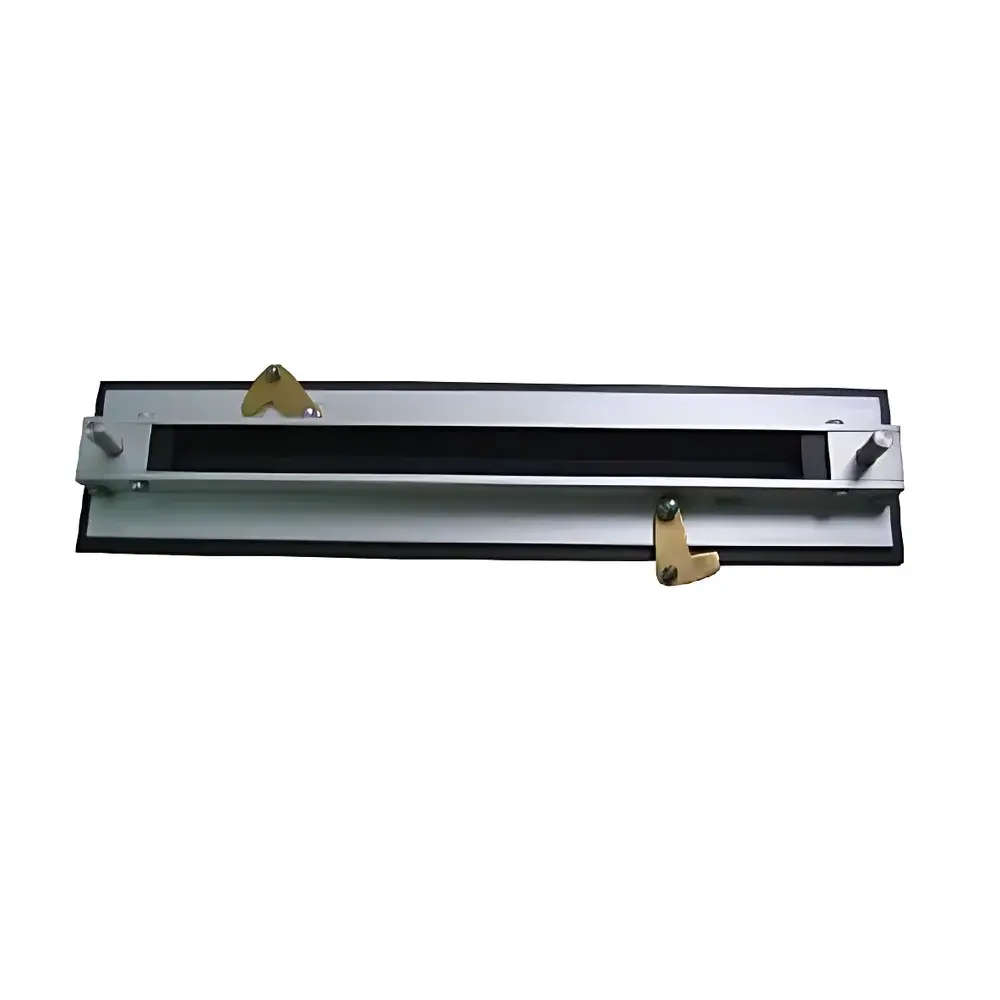
TESTech TTech-GBT21618 Solid Combustion Propagation Tester
| Brand | TESTech |
|---|---|
| Origin | Jiangsu, China |
| Manufacturer Type | Direct Manufacturer |
| Compliance | GB/T 21618 & UN Manual of Tests and Criteria, Part III, Subsection 33.2.1 |
| Sample Form | Powder, Granular or Paste-like Solids |
| Mold Dimensions | 250 mm length, triangular cross-section (10 mm height × 20 mm base) |
| Mold Material | Anodized Aluminum (heat-resistant, electrically insulating) |
| Confinement Plates | ±2 mm vertical overhang beyond mold profile |
| Ignition Source | Gas burner ≥1000 °C, flame diameter ≥5 mm |
| Test Substrate | Non-porous, non-combustible, low-thermal-conductivity quartz plate |
Overview
The TESTech TTech-GBT21618 Solid Combustion Propagation Tester is a precision-engineered instrument designed to quantify the linear combustion propagation behavior of solid combustible materials under standardized thermal ignition conditions. It operates on the principle of controlled flame front advancement along a geometrically defined sample geometry—specifically, a triangular prism-shaped specimen formed in a calibrated anodized aluminum mold. The device measures the time required for flame to traverse a fixed 250 mm length, from which the combustion propagation rate (mm/s) is derived. This metric serves as a critical input parameter in hazard classification frameworks for hazardous goods transport (UN TDG), safety data sheet (SDS) authoring, and process safety assessments—including dust explosion consequence modeling and thermal runaway screening in chemical manufacturing, battery material handling, and pharmaceutical powder processing environments.
Key Features
- Strictly compliant with GB/T 21618–2008 “Dangerous Goods – Test Method for Burning Rate of Flammable Solids” and aligned with UN Manual of Tests and Criteria, Part III, Section 33.2.1 (Test N.1), ensuring regulatory acceptability for domestic and international classification submissions.
- Triangular cross-section mold (250 mm × 10 mm × 20 mm) fabricated from anodized aluminum—offering dimensional stability up to 400 °C, electrical insulation, and resistance to oxidation during repeated high-temperature exposure.
- Integrated confinement plates extending 2 mm above the mold profile to minimize lateral heat loss and enforce quasi-one-dimensional flame propagation, thereby enhancing test reproducibility across operator teams and laboratories.
- High-temperature gas burner system delivering stable ignition at ≥1000 °C with a minimum 5 mm flame diameter—meeting the thermal flux requirements specified in both GB/T 21618 and UN protocols.
- Quartz test substrate platform: non-porous, non-combustible, and thermally inert (≤1.4 W/m·K conductivity), eliminating substrate-mediated ignition artifacts and enabling accurate assessment of intrinsic material flammability.
Sample Compatibility & Compliance
The TTech-GBT21618 accommodates heterogeneous solid-phase samples including fine powders (D50 < 500 µm), granules (0.5–3 mm), and semi-solid pastes with yield stress < 500 Pa. Sample loading follows strict volumetric packing procedures defined in Clause 6.2 of GB/T 21618 to ensure consistent density and interparticle contact. All test reports generated using this instrument support UN hazard class assignment (Class 4.1: Flammable Solids) and are admissible in regulatory filings with China’s Ministry of Emergency Management (MEM), the U.S. DOT, and the European Chemicals Agency (ECHA). The system architecture enables full traceability per GLP principles, with documented calibration records for burner temperature verification (via calibrated thermocouple), mold dimensional inspection (CMM-certified), and timing measurement (±0.01 s resolution stopwatch or synchronized video timestamping).
Software & Data Management
While the TTech-GBT21618 is a manually operated benchtop tester (no embedded microcontroller or proprietary software), it integrates seamlessly into laboratory quality management systems via standardized documentation workflows. TESTech provides a validated Excel-based calculation template (v2.1, revision-controlled) that auto-computes propagation rate, applies rounding per ISO/IEC 17025:2017 Clause 7.6.2, and generates audit-ready test reports with embedded metadata (operator ID, ambient T/RH, sample lot number, mold calibration certificate ID). Optional integration with LIMS platforms (e.g., LabWare, Thermo Fisher SampleManager) is supported through CSV export of raw timing data and image logs (when paired with external high-speed camera systems operating at ≥250 fps).
Applications
- Hazard classification of new chemical entities and intermediates under GHS/CLP and UN TDG frameworks.
- Comparative screening of flame-retardant additive efficacy in polymer composites and coated battery cathode powders.
- Validation of safe storage and pneumatic conveying parameters for organic pigment powders and metal hydride slurries.
- Input data generation for Computational Fluid Dynamics (CFD) models simulating deflagration pressure development in silos and reactors.
- Supporting due diligence in REACH registration dossiers where flammability endpoints are required under Annex VII–VIII.
FAQ
Does the TTech-GBT21618 meet ASTM E2021 or ISO 5660 requirements?
No—ASTM E2021 addresses piloted ignition of solids using radiant heat, while ISO 5660 is a cone calorimeter standard measuring heat release rate. The TTech-GBT21618 implements a distinct test principle (linear flame propagation in confined geometry) specified exclusively in GB/T 21618 and UN Test N.1.
Can the instrument be used for moisture-sensitive samples?
Yes—sample molding and ignition occur under ambient atmosphere, but optional desiccator-integrated sample conditioning modules (accessory kit TTech-DSC-01) allow pre-test equilibration at ≤10% RH per ISO 12156-1.
Is third-party calibration certification available?
Yes—TESTech partners with CNAS-accredited calibration labs (Certificate No. CNAS LXXXXX) offering annual verification of mold dimensions, burner temperature profile, and timing system accuracy, fully traceable to NIM (National Institute of Metrology, China).



