
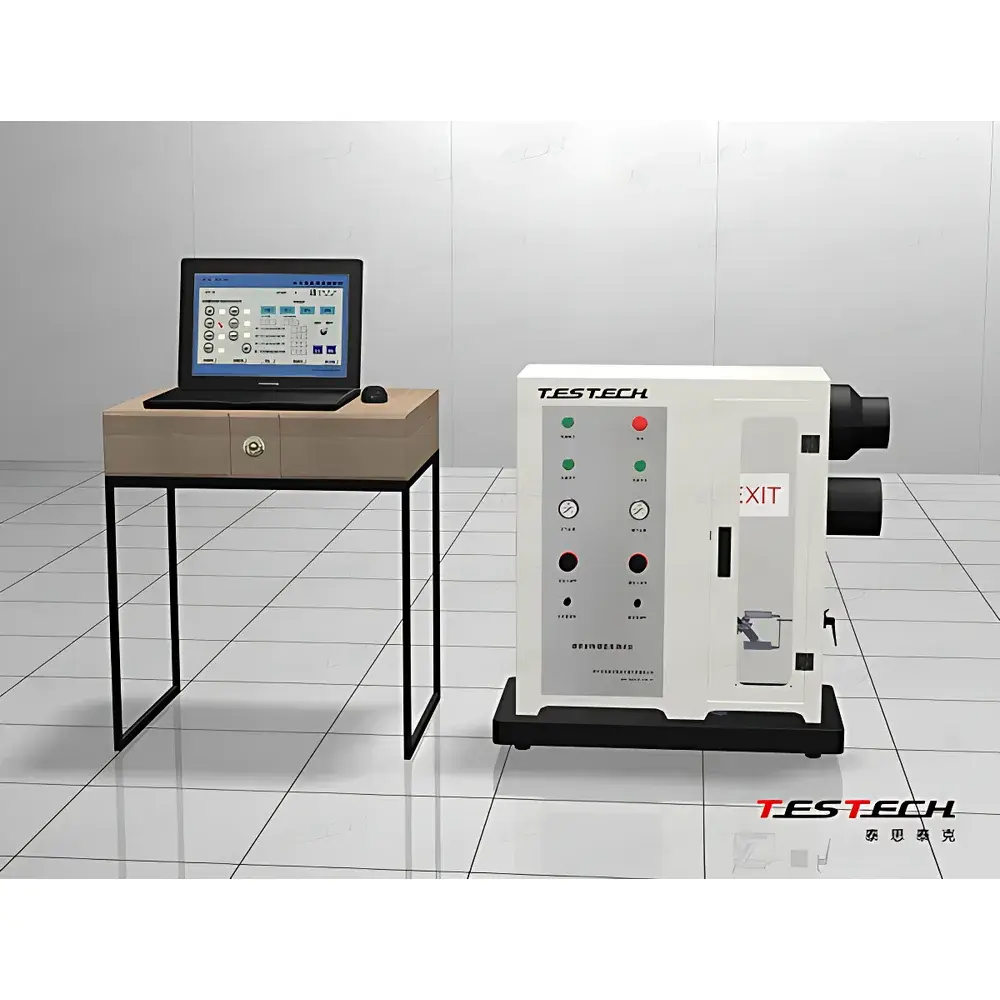
TESTech TTech-GBT8627 Smoke Density Chamber for Building Materials (Compliant with GB/T 8627-2007 and ASTM D2843)
| Brand | TESTech |
|---|---|
| Model | TTech-GBT8627 |
| Origin | Jiangsu, China |
| Manufacturer Type | Direct Manufacturer |
| Compliance | GB/T 8627-2007, ASTM D2843 |
| Optical Path Length | 300 mm |
| Light Source Height | 480 mm above base |
| Photometric Range | 0–100% transmittance (smoke density resolution: 0.1%) |
| Measurement Accuracy | ±3% |
| Exhaust Flow Rate | 1700 L/min |
| Power Supply | 220 VAC, 3 A, 50 Hz |
| Weight | 50 kg |
| Fuel | Commercial propane (≥85% purity) |
| Optical Sensor | Silicon photodiode module with integrated signal amplifier |
| Data Acquisition | National Instruments (NI) system, 1 s sampling interval |
| Control Software | LabVIEW-based custom application for automated timing, ignition, exhaust control, real-time transmittance calibration, and curve visualization |
Overview
The TESTech TTech-GBT8627 Smoke Density Chamber is a precision-engineered apparatus designed to quantify the specific optical density of smoke generated during the controlled combustion or thermal decomposition of building materials under standardized laboratory conditions. It operates on the principle of light attenuation—measuring the reduction in luminous transmittance across a defined 300 mm optical path as smoke accumulates within a calibrated test chamber. This method directly correlates to the obscuration potential of smoke, a critical parameter in fire safety engineering where visibility loss and toxic gas dispersion govern evacuation feasibility and hazard assessment. The instrument strictly conforms to the procedural and metrological requirements of GB/T 8627-2007 “Test Method for Smoke Density of Building Materials” and is functionally aligned with ASTM D2843 “Standard Test Method for Smoke Density of Materials in a Vertical Position.” Its design supports static smoke generation testing—where specimens are exposed to radiant heat and flame in a fixed orientation—enabling reproducible evaluation of material contribution to smoke load in early-stage fire scenarios.
Key Features
- Robust chamber construction with baked enamel finish for long-term corrosion resistance and structural stability under repeated thermal cycling.
- Front access via tempered transparent glass door, permitting unobstructed visual monitoring of flame behavior, smoke development, and specimen integrity throughout the test cycle.
- Stainless steel sample holder and precision-machined specimen template ensure consistent positioning, dimensional repeatability, and resistance to oxidation at elevated temperatures.
- High-fidelity optical train featuring a silicon photodiode sensor module with integrated low-noise signal amplification, delivering linear and stable transmittance response across the full 0–100% range.
- Calibrated 300 mm optical path aligned at 480 mm above the chamber base—matching the geometric specification mandated by GB/T 8627-2007 for uniform light beam geometry and scattering minimization.
- Dual combustion system comprising a primary burner for main specimen ignition and a secondary burner for supplementary heat input, enabling precise thermal flux control per test protocol requirements.
- Integrated high-capacity exhaust system (1700 L/min) with programmable post-test purge sequence, ensuring rapid and complete removal of residual smoke and combustion byproducts between trials.
Sample Compatibility & Compliance
The TTech-GBT8627 accommodates flat, rigid specimens up to 250 mm × 90 mm × 50 mm (L × W × H), compatible with common building material categories including rigid foam insulation, fiberboard, PVC cladding, coated gypsum board, and composite panels. Specimen mounting follows the vertical orientation requirement specified in both GB/T 8627-2007 and ASTM D2843. All mechanical, optical, and thermal subsystems are validated against the tolerance limits defined in Clause 5 (Apparatus) and Annex A (Verification Procedures) of GB/T 8627-2007. Instrument traceability is maintained through factory calibration of photometric response using neutral density filters certified to ISO/IEC 17025-accredited standards. The system supports documentation workflows compliant with GLP principles, including audit-ready test logs, operator identification, and environmental condition recording (ambient temperature/humidity).
Software & Data Management
Control and data acquisition are executed via a dedicated LabVIEW-based application running on an embedded industrial laptop. The software implements fully automated test sequencing—including pre-test zero-point calibration, automatic ignition timing, synchronized data capture at 1-second intervals, real-time transmittance normalization, and post-combustion exhaust activation. All raw photometric signals are timestamped and stored in binary and CSV formats, preserving full fidelity for retrospective analysis. The interface displays live transmittance (%) and derived smoke density (Ds = –log10(T/100)) curves overlaid with reference thresholds. Historical datasets are indexed by test ID, date, operator, and material batch, supporting version-controlled report generation in PDF format with embedded metadata. While not inherently 21 CFR Part 11-compliant, the architecture permits integration with external electronic lab notebook (ELN) systems for regulated environments requiring signature logging and change control.
Applications
This chamber serves as a core tool in fire performance laboratories conducting classification testing for non-load-bearing interior finishes, thermal insulation products, and façade components under national and regional fire codes (e.g., China’s GB 8624, EU CPR EN 13501-1). It supports R&D activities aimed at optimizing flame-retardant formulations, evaluating halogen-free alternatives, and benchmarking comparative smoke toxicity indices when coupled with FTIR or GC-MS off-gas analysis. Regulatory submission packages for building product certifications—particularly those requiring documented smoke production data for Class B1/C fire ratings—routinely include TTech-GBT8627 test reports. Academic researchers utilize its repeatable output to correlate polymer structure (e.g., char yield, decomposition onset) with observed smoke evolution profiles.
FAQ
What standards does the TTech-GBT8627 explicitly comply with?
It is engineered and verified to meet all apparatus, procedural, and reporting requirements of GB/T 8627-2007 and is functionally equivalent to ASTM D2843 for static smoke density measurement.
Is propane the only approved fuel source?
Yes—the system is calibrated and validated exclusively for commercial propane with ≥85% purity, as stipulated in both GB/T 8627-2007 and ASTM D2843; substitution with butane or natural gas invalidates compliance.
How is optical path contamination mitigated during repeated testing?
The fused silica optical windows are accessible for manual cleaning using lint-free wipes and spectroscopic-grade solvents; their horizontal orientation and smooth surface minimize particulate adhesion, and the 1700 L/min exhaust ensures minimal residue accumulation between runs.
Can the system be integrated into a larger fire test suite (e.g., cone calorimeter or LOI bench)?
While standalone by design, analog voltage outputs (0–10 V) for transmittance and digital I/O triggers enable synchronization with auxiliary equipment via TTL or relay interfaces for multi-instrument fire scenario replication.
Does the LabVIEW software support automated report generation for regulatory submissions?
Yes—it exports structured test reports containing raw data, calculated smoke density curves, pass/fail determinations per standard thresholds, and configurable header fields for accreditation body requirements.
Related Products



