
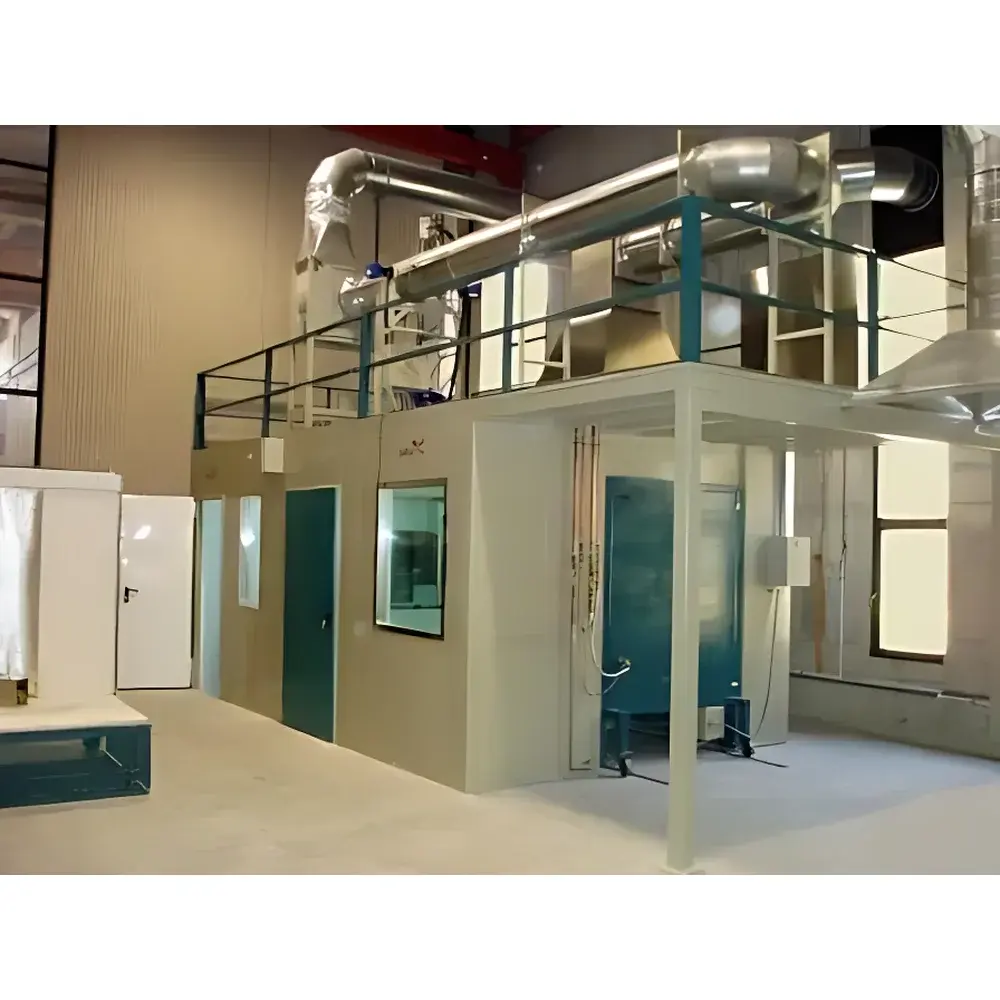
TESTech TTech-GBT25207 ISO 9705 Corner Burn Test Chamber for Full-Scale Room Fire Testing of Building Surface Products
| Brand | TESTech |
|---|---|
| Origin | Jiangsu, China |
| Manufacturer Type | Direct Manufacturer |
| Product Category | Domestic |
| Model | TTech-GBT25207 |
| Pricing | Upon Request |
Overview
The TESTech TTech-GBT25207 Corner Burn Test Chamber is a full-scale fire testing apparatus engineered in strict compliance with ISO 9705:1993 “Fire tests — Room corner test for surface products”, GB/T 25207–2010 “Test method for fire performance of surface products using full-scale room fire test”, and ASTM E 603–22 “Standard Guide for Room Fire Experiments”. It implements the corner fire configuration—a standardized, reproducible large-scale fire scenario where combustible surface materials are mounted on two adjacent interior walls (excluding ceiling), ignited by a propane-fueled burner at the floor-level corner. The test quantifies critical fire growth parameters including heat release rate (HRR), time to flashover, total heat release (THR), smoke production rate (SPR), CO/CO₂ yields, and gas-phase temperature profiles. Unlike bench-scale methods (e.g., cone calorimetry per ISO 5660 or SBI per EN 13823), the corner burn test preserves real-world installation geometry, boundary conditions, and flame spread dynamics—making it indispensable for regulatory evaluation, fire model validation, and performance certification of wall linings, claddings, insulation systems, and decorative finishes in commercial and residential buildings.
Key Features
- Structurally rigid test chamber constructed from A1-class non-combustible material (density ≥ 700 kg/m³) meeting EN 13501–1 requirements for reaction-to-fire classification.
- Internal chamber dimensions: 3.6 m (L) × 2.4 m (W) × 2.4 m (H); door aperture: 0.8 m (W) × 2.0 m (H) with fire-rated sealing.
- Propane sand-bed burner system with dual-stage gas flow control valves (mechanical + solenoid), integrated emergency shut-off, and 10 kV spark igniter with automatic flame supervision and safety cutoff.
- Dedicated exhaust ducting with adjustable-speed centrifugal fan (≥ 3.5 m³/s nominal capacity), stainless steel 3 m × 3 m canopy, and differential pressure-controlled flow measurement using bidirectional pitot tubes and calibrated transmitters (0–100 Pa range).
- Modular, mobile timing and data acquisition console with 19″ rack-mounted instrumentation interface for synchronized recording of thermal, optical, and gas-phase signals.
- Integrated staircase access for routine maintenance of exhaust ducts, sampling lines, and sensor arrays without chamber disassembly.
- Fire suppression and drainage system compliant with NFPA 101 and local industrial safety codes, including automatic water deluge activation and gravity-fed wastewater containment.
Sample Compatibility & Compliance
The TTech-GBT25207 accommodates full-size building surface products—including gypsum board assemblies, wood-based panels (per ISO 13784–1), polymer-coated metals, textile wallcoverings, and composite cladding systems—mounted in accordance with their intended field application. Sample mounting follows ISO 9705 Annex A protocols: vertical orientation on two intersecting walls, minimum exposed area ≥ 1.2 m² per wall, and substrate conditioning per ISO 139. The system supports multi-standard alignment: ISO 9705 (primary), GB/T 25207–2010 (Chinese national adoption), ASTM E 603 (guidance), ASTM E 1537 (for upholstered furniture when adapted), and ISO 13784–1 (plywood fire behavior). All hardware, calibration procedures, and uncertainty budgets conform to ISO/IEC 17025:2017 requirements for accredited fire testing laboratories. Data traceability meets GLP and FDA 21 CFR Part 11 criteria via audit-trail-enabled software logging.
Software & Data Management
Acquisition and analysis are managed through a deterministic real-time control platform running on Windows OS with deterministic I/O drivers. The system logs >200 channels at 10 Hz resolution—including thermocouple arrays (Type K, ±0.5 °C), oxygen concentration (paramagnetic analyzer, 0–25 % vol, ±0.1 %), CO/CO₂ (NDIR analyzers, 0–1 % CO, 0–10 % CO₂, ±2 % FS), smoke density (incandescent light extinction, CIE photopic response, <3 s 90 % rise time), and mass loss rate (load cell, ±0.1 kg). Raw data export is supported in CSV, HDF5, and ASTM E1366-compliant XML formats. Calibration certificates for all sensors are traceable to NIM (China) or NIST (USA) standards. Optional integration with FDS (Fire Dynamics Simulator) input templates enables direct model validation workflows.
Applications
- Regulatory submission for CE marking (EN 13501–1), CCC certification (China), and UL/ULC recognition of wall and ceiling finishes.
- Development and qualification of intumescent coatings, mineral wool composites, and fire-retardant-treated wood products.
- Validation of computational fire models used in performance-based design (e.g., under NFPA 101A or ISO/TR 16732–1).
- Comparative fire hazard assessment of alternative construction systems (e.g., cross-laminated timber vs. steel stud assemblies).
- Root-cause analysis of fire incidents involving façade systems, particularly in high-rise building investigations.
FAQ
What standards does the TTech-GBT25207 fully support?
ISO 9705:1993, GB/T 25207–2010, ASTM E 603–22, and supplementary alignment with ISO 13784–1 and ASTM E 1537 for adapted configurations.
Is the chamber suitable for testing ceiling-mounted materials?
No—the ISO 9705 protocol specifies wall-only mounting; ceiling exposure is excluded by design to replicate realistic corner fire development.
Can the system be configured for nitrogen-dilution or inert atmosphere testing?
Yes—gas supply infrastructure includes dedicated ports for N₂ and other calibration gases; optional purge modules enable controlled O₂ depletion experiments.
What is the maximum sample thickness the chamber accommodates?
Up to 200 mm, provided structural mounting integrity and thermal boundary conditions remain within ISO 9705 tolerances.
Does the system include built-in fire modeling output tools?
It exports time-resolved HRR, SPR, and gas composition data in formats directly ingestible by FDS, PyroSim, and SAFIR for post-test simulation refinement.



