
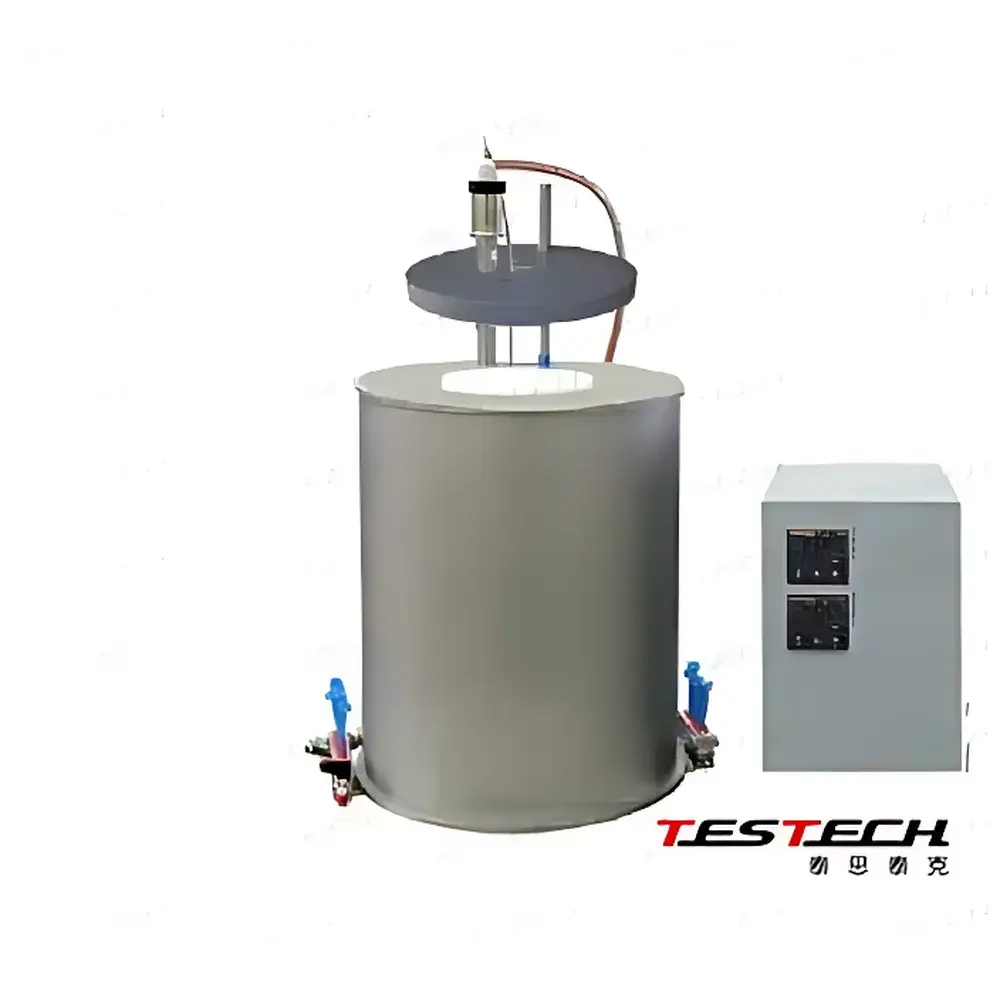
TTech-GBT16429 Godbert-Greenwald Dust Cloud Minimum Ignition Temperature (MIT) Tester
| Brand | TESTech |
|---|---|
| Model | TTech-GBT16429 |
| Test Principle | Godbert-Greenwald furnace method |
| Temperature Range | Ambient to 800 °C (short-term up to 1000 °C for chamber cleaning) |
| Temperature Accuracy | ±1% above 500 °C, ±3% below 300 °C |
| Air Pressure Reservoir | 0–1 bar |
| Pressure Control Accuracy | ±5% |
| Chamber | Vertical quartz tube, open-bottom configuration |
| Dimensions (W×D×H, incl. stand) | 500×300×450 mm |
| Power Supply | 230 V / 50 Hz or 110 V / 60 Hz |
Overview
The TTech-GBT16429 Godbert-Greenwald Dust Cloud Minimum Ignition Temperature (MIT) Tester is a precision-engineered apparatus designed to determine the lowest temperature at which a suspended cloud of combustible dust ignites spontaneously in heated air—without an external ignition source. This test follows the fundamental principles of thermal ignition theory and adheres to the methodology defined in GB/T 16429–2022 (equivalent to IEC 61241-2-1 and ASTM E1226), which specifies the Godbert-Greenwald furnace technique. The instrument employs a vertically oriented, open-bottom quartz tube furnace that enables controlled dispersion of dust into a preheated air column. As the dust cloud passes through the heated zone, thermal energy transfer initiates pyrolysis and subsequent exothermic oxidation when the ambient temperature exceeds the material’s critical autoignition threshold. The MIT value thus obtained serves as a critical parameter for hazard classification, process safety design, and compliance with ATEX, IECEx, NFPA 652, and OSHA Process Safety Management (PSM) requirements.
Key Features
- High-purity vertical quartz furnace tube (open-bottom design) ensures optical clarity for real-time observation and minimizes catalytic surface effects during testing.
- Programmable temperature control system with dual-range accuracy: ±1% deviation above 500 °C and ±3% below 300 °C—optimized for reproducible thermal profiling across the full operational range (ambient to 800 °C).
- Dedicated air pressure reservoir (0–1 bar) with ±5% pressure regulation enables consistent dust dispersion velocity and cloud density, directly influencing test repeatability per ISO/IEC 17025 validation protocols.
- Short-term thermal overcapacity (up to 1000 °C) supports in-situ cleaning cycles to eliminate residual char or condensed volatiles between tests—reducing cross-contamination risk and extending component service life.
- Universal power compatibility (230 V / 50 Hz or 110 V / 60 Hz) facilitates global deployment without hardware modification.
- Compact benchtop footprint (500 × 300 × 450 mm, including support frame) integrates seamlessly into standard laboratory fume hoods or dedicated explosion-proof testing enclosures.
Sample Compatibility & Compliance
The TTech-GBT16429 accommodates a broad spectrum of organic and inorganic particulates—including metal powders (e.g., aluminum, magnesium), agricultural dusts (e.g., flour, starch), pharmaceutical actives, polymer granules, and carbon-based materials—provided particle size distribution falls within the recommended range (typically D50 < 75 µm). All test procedures conform to national and international standards: GB/T 16429–2022 (China), IEC 61241-2-1:2004 (Electrical apparatus for use in combustible dust atmospheres), and ASTM E1226–23 (Standard Test Method for Explosibility of Dust Clouds). The system architecture supports GLP-compliant documentation workflows, including manual logbook integration and timestamped operator annotations required for regulatory audits under FDA 21 CFR Part 11 and EU Annex 11.
Software & Data Management
While the TTech-GBT16429 operates via hardware-integrated analog/digital temperature and pressure controllers (no embedded software stack), it is fully compatible with third-party data acquisition systems (e.g., National Instruments LabVIEW, Keysight PathWave) via 4–20 mA and RS-485 interfaces. Real-time furnace temperature, reservoir pressure, and event-triggered video capture (via optional high-speed camera mount) can be synchronized for post-test thermal history reconstruction. All raw parameter sets—including ramp rate, dwell time, observed ignition delay, and visual confirmation timestamps—are structured to align with ISO 17025 clause 7.5.2 on record retention and traceability. Calibration certificates for thermocouples (Type K, Class 1) and pressure transducers are provided with each unit and traceable to NIM (National Institute of Metrology, China) standards.
Applications
- Hazard identification and classification of bulk powders in chemical, pharmaceutical, food, and additive manufacturing facilities.
- Input data for Dust Explosion Severity (KSt) and Maximum Pressure (Pmax) modeling using empirical correlations such as those in NFPA 68 and EN 14034.
- Validation of inerting strategies (e.g., N2 or CO2 blanketing) by comparing MIT shifts under reduced-oxygen atmospheres.
- Supporting Layer of Protection Analysis (LOPA) and Quantitative Risk Assessment (QRA) for powder-handling unit operations (e.g., milling, pneumatic conveying, silo filling).
- Research into thermal decomposition kinetics and catalytic effects of additives or moisture content on dust ignition propensity.
FAQ
What standards does the TTech-GBT16429 comply with?
It is engineered and validated per GB/T 16429–2022, with methodological alignment to IEC 61241-2-1 and ASTM E1226.
Can the instrument test dusts with high moisture content?
Yes—though samples must be preconditioned per ISO 18852 to stabilize water activity; excessive moisture may suppress ignition or cause inconsistent cloud formation.
Is operator training included with purchase?
Comprehensive on-site or virtual commissioning and SOP development support is available upon request, covering safe handling, calibration verification, and test report generation.
How often does the quartz tube require replacement?
Under normal usage and proper cleaning protocols, the quartz tube typically maintains integrity for ≥500 test cycles; visual inspection for devitrification or microfractures is recommended after every 100 runs.
Does the system support automated dust dispersion?
The base configuration uses manual dispersion via calibrated air pulse; optional motorized disperser modules with programmable pulse width and frequency are available as accessories.



