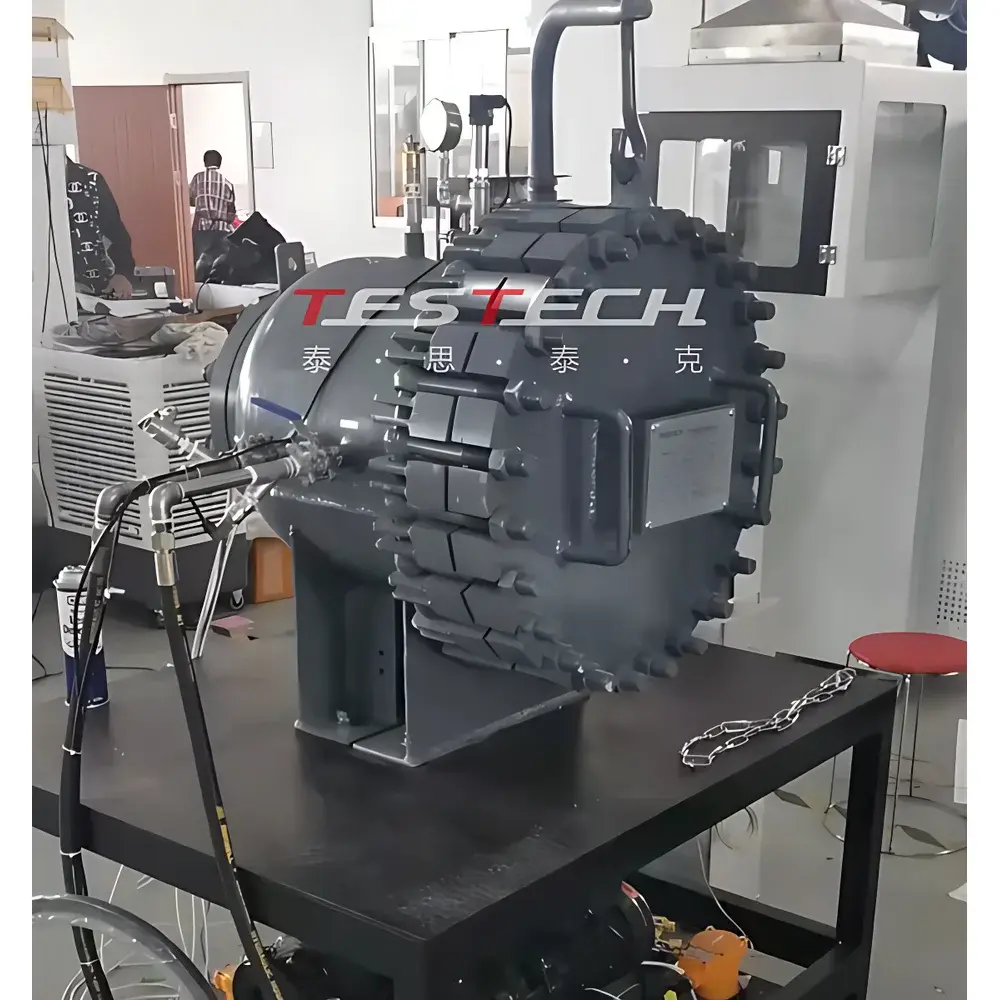
TESTech TTech-UL9540A Battery Thermal Runaway Fire Propagation Test System
| Brand | TESTech |
|---|---|
| Model | TTech-UL9540A |
| Origin | Jiangsu, China |
| Manufacturer Type | Direct Manufacturer |
| Compliance Standard | UL 9540A |
| Heating Plate Max Temp | 500 °C |
| Heating Power | 1 kW |
| Oxygen Analyzer | 0–25% vol, <1% linearity error, ≤6 s response time, resolution 100 ppm |
| CO₂ Analyzer | 0–10% vol, ±1% FS accuracy, <1% repeatability |
| CO Analyzer | 0–1% vol, ±1% FS accuracy, <1% repeatability |
| Smoke Density Detector | Photodetector wavelength 350–1100 nm, responsivity 0.65 A/W, max output current 100 mA, gain adjustment 70 dB, linearity ≥99.8%, drift <0.1% |
| Control Software | LabVIEW-based, modular architecture with calibration, real-time monitoring, data logging, and ASTM/ISO-compliant reporting modules |
Overview
The TESTech TTech-UL9540A Battery Thermal Runaway Fire Propagation Test System is a fully integrated, standards-aligned platform engineered for quantitative evaluation of thermal runaway propagation behavior in lithium-ion battery energy storage systems (ESS) under controlled fire exposure conditions. Designed explicitly to meet the test methodology requirements of UL 9540A — the industry benchmark for evaluating fire safety performance of grid-scale and residential ESS configurations — the system implements a calibrated, multi-sensor measurement architecture to capture critical fire dynamics parameters including heat release rate (HRR), gas composition evolution (O₂, CO, CO₂), smoke optical density (OD), and thermal feedback profiles. The core test configuration follows the UL 9540A Annex B “Module-Level Propagation Test” protocol: a single initiator cell is thermally stressed using a ceramic heating plate until thermal runaway initiates; subsequent flame spread, gas venting kinetics, and adjacent cell response are monitored via synchronized thermal, optical, and chemical sensing subsystems. All hardware components — from the 500 °C rated heating plate to the NIST-traceable gas analyzers — are selected and integrated to ensure metrological integrity across repeated test cycles.
Key Features
- Ceramic flat-panel heater with precise temperature control up to 500 °C and nominal 1 kW power delivery, enabling reproducible thermal ramping and sustained plateau conditions per UL 9540A Section 7.2.
- Remotely actuated ignition system positioned above the test cell, designed to trigger combustion of early-stage flammable electrolyte vapors released during venting, ensuring consistent fire initiation timing.
- Dual-path gas sampling train incorporating particulate filtration, chilled condensate removal (cold trap), desiccant drying, and mass-flow-controlled aspiration — optimized to preserve sample integrity for downstream analysis.
- Multi-gas analytical suite comprising certified paramagnetic O₂ analyzer (0–25% range, ≤6 s T₉₀), NDIR CO₂ analyzer (0–10% range, ±1% FS), and NDIR CO analyzer (0–1% range, ±1% FS), all meeting ASTM E800 and ISO 13571 traceability requirements.
- Smoke density measurement subsystem featuring U.S.-sourced photodetector with 350–1100 nm spectral response, 0.65 A/W peak responsivity, and <0.1% signal drift over 30-minute acquisition windows — compliant with ASTM E662 and ISO 5659-2 optical density protocols.
- LabVIEW-based control and acquisition software with modular architecture supporting instrument calibration (gas analyzers, photometric channel, thermocouple arrays), real-time parameter visualization, event-triggered data capture, and automated report generation aligned with UL 9540A Annex D documentation templates.
Sample Compatibility & Compliance
The TTech-UL9540A accommodates standard-format lithium-ion battery cells (prismatic, cylindrical, pouch) up to 200 mm in height and 150 mm in footprint, with configurable mounting fixtures for module-level testing per UL 9540A Section 8. All subsystems operate within defined environmental tolerances (23 ±2 °C ambient, 50 ±5% RH) to minimize extrinsic variability. The system satisfies functional equivalence requirements of UL 9540A Sections 5–9 and supports audit readiness for third-party certification bodies. Data acquisition and storage comply with GLP principles, including electronic signature support, audit trail logging, and version-controlled calibration records — facilitating alignment with FDA 21 CFR Part 11 and ISO/IEC 17025 laboratory accreditation frameworks.
Software & Data Management
The embedded LabVIEW application provides a deterministic, deterministic real-time control loop (100 Hz minimum update rate) for coordinated operation of heating, ignition, gas flow, and sensor acquisition. Calibration modules include zero/span verification routines for each gas analyzer, photometric baseline correction, and thermocouple cold-junction compensation validation. Raw time-series data (temperature, voltage, gas concentrations, optical density, pressure differentials) are stored in HDF5 format with embedded metadata (test ID, operator, calibration status, environmental logs). Export options include CSV, MATLAB .mat, and PDF reports containing annotated plots, pass/fail determinations per UL 9540A acceptance criteria (e.g., time-to-propagation, peak HRR, total smoke release), and traceable uncertainty budgets.
Applications
This system is deployed by battery manufacturers, independent safety laboratories, and national metrology institutes for: validating cell-level and module-level fire containment designs; comparative assessment of thermal barrier materials and fire suppression additives; development of physics-based propagation models requiring high-fidelity experimental boundary conditions; and generation of data required for UL 9540A certification submissions to AHJs (Authority Having Jurisdiction). It further supports research into vent gas composition kinetics, sooting tendency correlations, and smoke toxicity precursor formation pathways under standardized thermal runaway induction.
FAQ
Does the system support full UL 9540A Annex B testing?
Yes — all mechanical, thermal, and analytical subsystems conform to the dimensional, temporal, and metrological specifications outlined in UL 9540A Annex B for module-level propagation testing.
Can the software generate UL-compliant test reports?
Yes — the reporting module auto-populates tables and figures per UL 9540A Annex D, including propagation time, flame front velocity, and gas concentration integrals, with user-annotated deviations.
Is the gas analysis system calibrated to international standards?
All analyzers are supplied with NIST-traceable calibration certificates and support on-site span-gas verification using certified reference materials per ISO 6141.
What maintenance intervals are recommended for the smoke density optical path?
Optical windows require cleaning every 5 test cycles or after visible soot deposition; detector linearity verification is performed quarterly using neutral density filters per ASTM E1317.
Is remote operation supported for hazardous testing scenarios?
Yes — ignition, heating ramping, and emergency shutdown functions are accessible via isolated Ethernet interface with role-based access control and encrypted session logging.