
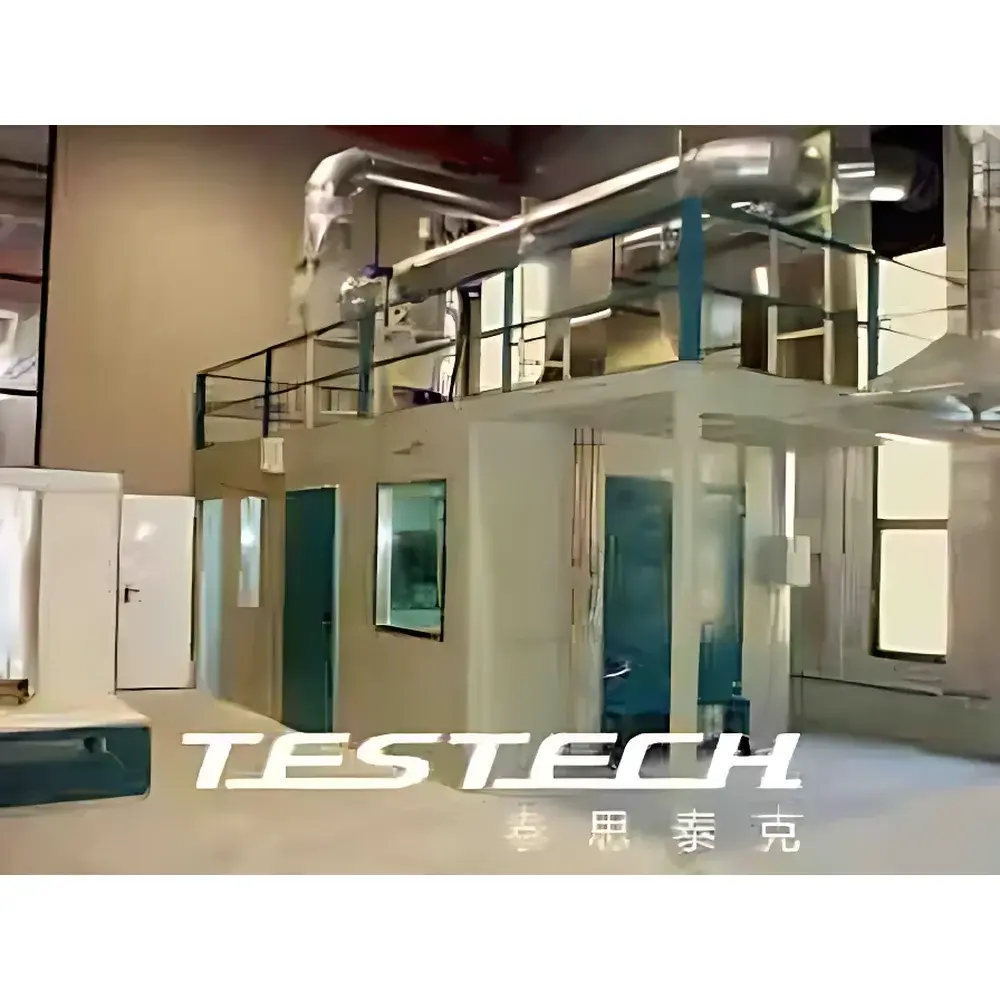
TESTech TTech-GBT20284 Single Burning Item (SBI) Fire Test Apparatus for Building Materials
| Brand | TESTech |
|---|---|
| Origin | Jiangsu, China |
| Manufacturer Type | Direct Manufacturer |
| Country of Origin | China |
| Model | TTech-GBT20284 |
| Price | USD 55,800 (FOB Jiangsu) |
| Compliance | GB/T 20284–2006, GB 8624–2012, BS EN 13823:2010+A1:2014 |
| Chamber Dimensions | 3.0 m × 3.0 m × 2.4 m |
| Exhaust Duct | Ø315 mm insulated stainless steel duct with 50 mm mineral wool insulation |
| Exhaust Flow Rate | 0.50–0.65 m³/s |
| Pressure Sensor Range | 0–100 Pa (±2 Pa accuracy, ≤1 s 90% response time) |
| Ignition | 10 kV spark igniter with mechanical auto-positioning and flame failure cutoff |
| Propane Mass Flow Control | 0–2.3 g/s (±1% reading accuracy) |
| Oxygen Analyzer | Paramagnetic, 0–25% O₂ (linearity deviation <1%) |
| CO₂ Analyzer | NDIR, 0–10% CO₂ (linearity deviation <±1%) |
| Smoke Measurement | White-light extinction system (color temperature 2900±100 K, current stability ±0.5%) |
| Thermocouples | K-type armored, 0.5 mm diameter |
| Data Acquisition | Embedded 10.2" touchscreen HMI + PLC-based control architecture with USB/RS232 interfaces |
| Output Metrics | Heat Release Rate (HRR), Peak HRR (up to 1 MW), FIGRA, SMOGRA, SPR, Total Heat Release (THR), Total Smoke Release (TSR), CO/CO₂ yields, O₂ consumption |
Overview
The TESTech TTech-GBT20284 Single Burning Item (SBI) Fire Test Apparatus is a fully integrated, standards-compliant combustion testing system engineered for the quantitative assessment of non-flooring building materials and products under controlled single-flame thermal exposure. It implements the internationally recognized cone calorimeter–adjacent methodology defined in BS EN 13823:2010+A1:2014 and aligned with national specifications GB/T 20284–2006 and GB 8624–2012. The apparatus subjects vertically mounted specimens (typically 495 mm × 1500 mm) to radiant and convective heat flux from a propane-fueled burner array positioned at the base of a sliding trolley. Combustion dynamics—including heat release rate (HRR), smoke production rate (SPR), oxygen depletion, and gas species evolution—are measured continuously via calibrated physical and optical sensors. The test chamber’s robust refractory construction—comprising firebrick, gypsum board, and calcium silicate panels—ensures thermal stability and repeatability across extended test cycles (up to 20 minutes). All critical parameters are acquired at ≥1 Hz sampling frequency and processed in real time to derive standardized fire performance indices including Fire Growth Rate Index (FIGRA), Smoke Growth Rate Index (SMOGRA), and peak HRR.
Key Features
- Human-centered control architecture featuring an embedded 10.2-inch industrial touchscreen HMI with intuitive parameter configuration, real-time curve visualization (HRR, O₂, CO₂, temperature), and fault diagnostics.
- PLC-driven automation for ignition sequence, propane mass flow regulation (via high-accuracy thermal mass flow meter), exhaust flow modulation (using VFD-controlled fan), and flame failure detection with immediate shutdown.
- Dual-stage exhaust system: insulated Ø315 mm stainless steel duct with 50 mm mineral wool cladding ensures stable draft conditions and minimizes thermal loss during measurement.
- High-fidelity gas analysis suite: paramagnetic O₂ sensor (0–25%, <1% linearity error), NDIR CO₂ analyzer (0–10%, ±1% full-scale deviation), and white-light extinction smoke densitometer (2900±100 K tungsten source, ±0.5% current regulation).
- Structurally optimized test trolley with dual propane burners arranged in an isosceles triangle (250 mm leg length); rear panel fabricated from calcium silicate board (density 800±150 kg/m³, thickness 12±3 mm).
- Comprehensive data traceability: timestamped raw datasets stored locally; exportable via USB to CSV or Excel; audit-ready metadata including operator ID, calibration timestamps, and environmental conditions (ambient T/RH).
Sample Compatibility & Compliance
The TTech-GBT20284 accommodates rigid and semi-rigid building products including wall claddings, insulation boards, sandwich panels, and decorative laminates—excluding floor coverings per EN 13823 scope limitations. Specimens are mounted vertically on the trolley using standardized fastening fixtures that preserve edge geometry and minimize thermal bridging. The system supports compliance verification against multiple regulatory frameworks: GB 8624–2012 (China’s classification standard for combustion performance), GB/T 20284–2006 (technical specification for SBI testing), and BS EN 13823 (harmonized European standard adopted by CE marking pathways). All sensor subsystems undergo quarterly functional verification per ISO/IEC 17025–recommended practices; pressure transducers and thermocouples are traceable to NIM (National Institute of Metrology, China) reference standards. The apparatus meets GLP requirements for fire test laboratories conducting third-party certification per CNAS-CL01:2018.
Software & Data Management
The embedded control software implements deterministic real-time acquisition synchronized across all analog and digital channels. Raw signals—including differential pressure across the exhaust duct, thermocouple voltages, O₂/CO₂ partial pressures, and photometric extinction ratios—are digitized at 16-bit resolution and filtered using Bessel-type low-pass algorithms to suppress high-frequency noise without phase lag. Calculated outputs (HRR, FIGRA, TSR, etc.) conform strictly to EN 13823 Annex B algorithms and are displayed alongside live trend plots. Historical test records include full metadata: specimen identification, pre-test conditioning (23°C/50% RH per ISO 291), ambient barometric pressure, and operator-entered notes. Exported datasets comply with ASTM E1354–22 data formatting conventions and support post-processing in MATLAB, Python (Pandas), or commercial fire modeling tools (e.g., FDS, PyroSim). Audit trails record every parameter change, user login/logout event, and calibration action—fully satisfying FDA 21 CFR Part 11 electronic record requirements when operated in validated laboratory environments.
Applications
This SBI apparatus serves as a primary qualification tool in fire safety engineering labs, material R&D centers, and national testing institutes. It enables comparative evaluation of flame-retardant additives in polymer composites, validation of intumescent coating efficacy on structural steel substrates, and regulatory submission support for CE marking of façade systems under Construction Products Regulation (EU No. 305/2011). In academic research, it supports fundamental studies on pyrolysis kinetics, char layer formation mechanisms, and smoke toxicity correlations (e.g., CO yield vs. FIGRA). Industrial users apply it for internal quality gate checks prior to large-scale production of insulation boards or curtain wall assemblies. Its reproducibility (inter-laboratory CV <8% for FIGRA on reference PMMA specimens) makes it suitable for round-robin intercomparison studies coordinated by ISO/TC 92/SC 1.
FAQ
What standards does the TTech-GBT20284 explicitly support?
It is designed and verified for GB/T 20284–2006, GB 8624–2012, and BS EN 13823:2010+A1:2014. Optional firmware modules can extend compatibility to ASTM E2058 (SBI adaptation) upon request.
Is the system compliant with GLP or ISO/IEC 17025 requirements?
Yes—the hardware architecture, calibration traceability, data audit trail functionality, and user access controls meet essential criteria for GLP compliance and ISO/IEC 17025 accreditation when implemented within a documented quality management system.
Can test data be exported for external fire modeling?
Yes. Time-series HRR, SPR, CO/CO₂, and O₂ consumption data are exportable in comma-separated values (CSV) format with SI-unit headers, directly ingestible by Fire Dynamics Simulator (FDS) and other CFD-based fire simulation platforms.
What maintenance intervals are recommended for sensor recalibration?
O₂ and CO₂ analyzers require biannual verification using certified gas mixtures; pressure transducers and thermocouples should be calibrated annually against NIST-traceable references. Full system performance verification is advised before each new certification campaign.
Does the apparatus support unattended operation?
Fully autonomous test execution is supported—including ignition, data acquisition, termination logic, and report generation—but operator presence is mandated per EN 13823 Clause 7.2 for safety observation and emergency intervention.



