
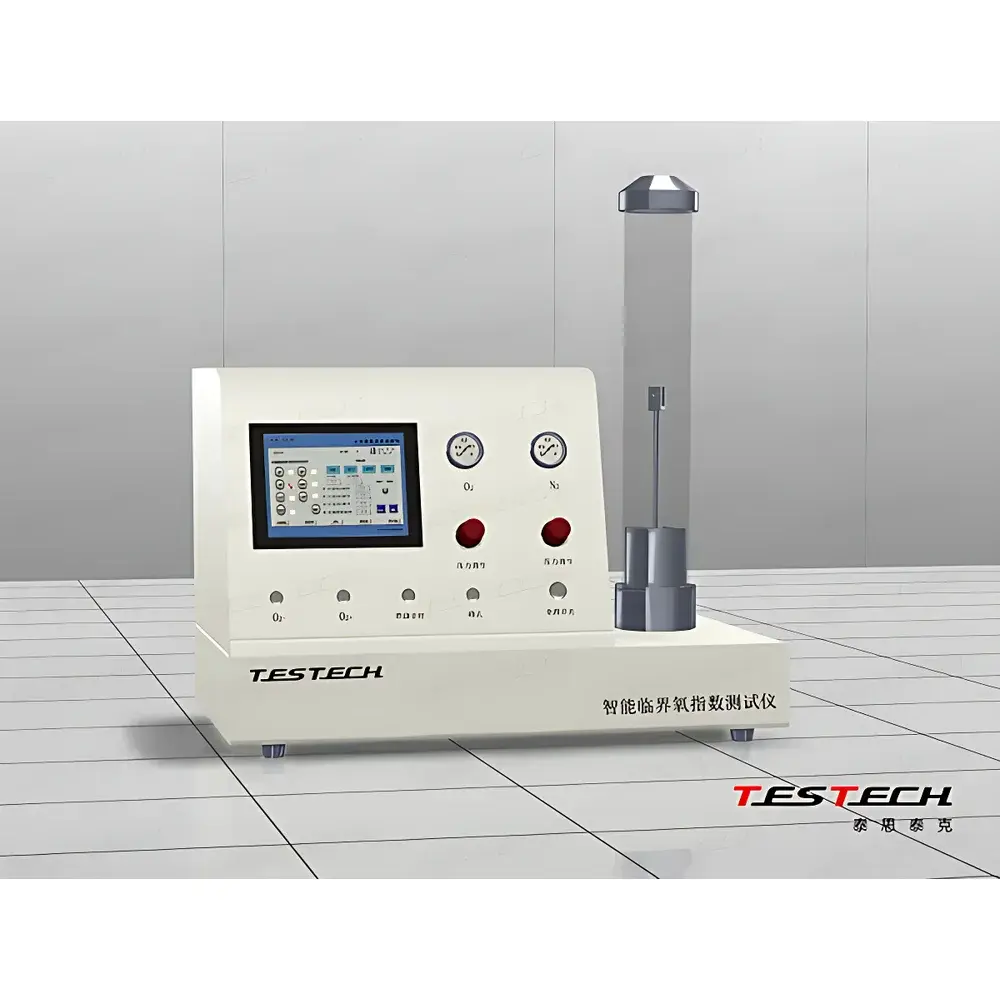
TESTech TTech-ISO4589 High-Temperature Oxygen Index Tester
| Brand | TESTech |
|---|---|
| Origin | Jiangsu, China |
| Manufacturer Type | Direct Manufacturer |
| Model | TTech-ISO4589 |
| Compliance | ISO 4589-3:1996 |
| Temperature Range | 25–150 °C |
| Temp. Control Accuracy | ±2 °C (≤125 °C), ±3 °C (>125 °C) |
| O₂ Concentration Range | 10–60 % (±0.1 %) |
| O₂/N₂ Flow Control Accuracy | ±0.01 L/min |
| Flow Resolution | 0.01 L/min |
| O₂ Step Resolution | 0.1 % |
| Ignition Time | 15 s ±1 s |
| Flame Height | 15–20 mm |
| Combustion Tube | Inner quartz tube (ID ≥75 mm, H ≥450 mm) |
Overview
The TESTech TTech-ISO4589 High-Temperature Oxygen Index Tester is a precision-engineered instrument designed to determine the limiting oxygen index (LOI) of polymeric materials under elevated thermal conditions, in strict accordance with ISO 4589-3:1996 — *Plastics — Determination of burning behaviour by oxygen index — Part 3: Elevated-temperature test*. Unlike standard ambient-temperature LOI testing, this system introduces controlled thermal preconditioning of the combustion environment to simulate real-world high-temperature ignition scenarios—particularly relevant for engineering thermoplastics, flame-retarded composites, and heat-resistant elastomers used in aerospace, rail, and electrical insulation applications. The instrument operates on the principle of vertical specimen orientation within a thermally stabilized quartz combustion column, where the oxygen concentration in a flowing O₂/N₂ mixture is precisely regulated until the specimen sustains flaming combustion for a defined duration (typically 3 min or 180 s). The minimum oxygen volume percentage at which sustained combustion occurs is reported as the high-temperature LOI value—a critical quantitative metric for comparative flammability assessment under thermal stress.
Key Features
- Integrated high-precision temperature-controlled combustion chamber with independent heating elements and preheater, enabling stable thermal environments from 25 °C to 150 °C.
- Microprocessor-based closed-loop control system that dynamically adjusts O₂/N₂ mass flow rates to maintain user-defined oxygen concentration within ±0.1 % accuracy, with 0.01 L/min resolution and step resolution down to 0.1 % O₂.
- Automated ignition sequence featuring a calibrated, height-adjustable (15–20 mm) butane flame source with fixed 15 s ±1 s application time—ensuring repeatable thermal initiation across test series.
- Real-time digital display of actual oxygen concentration, chamber temperature, gas flow rates, and elapsed combustion time during active testing.
- Dual-wall quartz combustion tube assembly: inner tube (≥75 mm ID, ≥450 mm height) surrounded by an outer tube maintaining a uniform 5–10 mm annular gap—optimized for laminar flow, thermal stability, and minimal draft interference.
- Comprehensive data acquisition and validation logic embedded in firmware, including automatic pass/fail evaluation per ISO 4589-3 criteria and statistical confidence assessment for triplicate test sets.
Sample Compatibility & Compliance
The TTech-ISO4589 accommodates vertically oriented, self-supporting specimens—including rigid bars (typically 150 mm × 10 mm × thickness ≤10.5 mm), thin sheets, foams, and flexible films—provided they meet dimensional and structural requirements specified in ISO 4589-3. Specimen conditioning follows ISO 291 ambient conditioning protocols prior to insertion. All operational parameters—including temperature ramp profiles, gas mixing ratios, and ignition timing—are traceable and configurable to support GLP-compliant laboratory workflows. The instrument’s firmware architecture supports audit-ready event logging, and its calibration procedures align with ISO/IEC 17025 metrological principles. While not certified to UL 94 or ASTM D2863 directly, its LOI outputs serve as foundational input for those standards’ classification tiers and are routinely accepted in notified body submissions for CE marking of construction products (EN 13501-1) and railway rolling stock (EN 45545-2).
Software & Data Management
The system includes dedicated Windows-compatible control software with USB or RS-232 interface support. Software functions include programmable test sequences (e.g., multi-point LOI sweeps), real-time graphing of O₂ concentration vs. time, automated report generation (PDF/CSV), and built-in uncertainty estimation per GUM (Guide to the Expression of Uncertainty in Measurement) principles. Data files retain full metadata: operator ID, calibration certificate numbers, environmental conditions (lab temp/humidity), and timestamped raw sensor readings. Audit trail functionality records all parameter modifications, test starts/stops, and manual overrides—fully compliant with FDA 21 CFR Part 11 requirements when deployed with electronic signature modules and networked domain authentication.
Applications
- Qualification of high-performance polymers (e.g., polyimides, PEEK, polybenzimidazole) for use in engine nacelles, cable jackets, and battery module housings.
- Development and QC screening of intumescent coatings and halogen-free flame retardant formulations under thermal load.
- Comparative flammability benchmarking of recycled polymer blends subjected to thermal aging prior to LOI measurement.
- Supporting fire safety engineering models requiring temperature-dependent ignition thresholds for CFD-based compartment fire simulations.
- Regulatory documentation for building product approvals (e.g., Class B1/B2 under DIN 4102 or Euroclass B-s1,d0).
FAQ
What distinguishes high-temperature LOI testing from standard LOI (ISO 4589-2)?
High-temperature LOI per ISO 4589-3 evaluates material ignition resistance under thermally elevated conditions (up to 150 °C), revealing degradation-induced changes in char formation, volatilization kinetics, and flame inhibition efficacy—parameters often masked at ambient temperature.
Can the TTech-ISO4589 be used for non-plastic materials such as textiles or composites?
Yes—provided specimens meet ISO 4589-3’s dimensional, self-supporting, and mounting criteria. Textile laminates and fiber-reinforced thermosets have been successfully tested following substrate-specific conditioning per ISO 139 and ISO 293.
Is external gas supply calibration required before each test series?
A full gas calibration using certified reference mixtures (e.g., 21.0 % O₂ in N₂) is recommended before daily operation and after any maintenance event affecting flow sensors or thermal zones.
How is temperature uniformity verified inside the combustion column?
Uniformity is validated via NIST-traceable thermocouple mapping at three axial positions (top/mid/base) and radial quadrants, per internal SOP-LOI-07, with acceptance criterion: ≤±1.5 °C deviation across active zone.
Does the system support custom test protocols beyond ISO 4589-3?
Yes—the control software allows user-defined temperature ramps, variable ignition durations, and extended burn observation windows, provided deviations are documented and justified per laboratory quality manual.



