
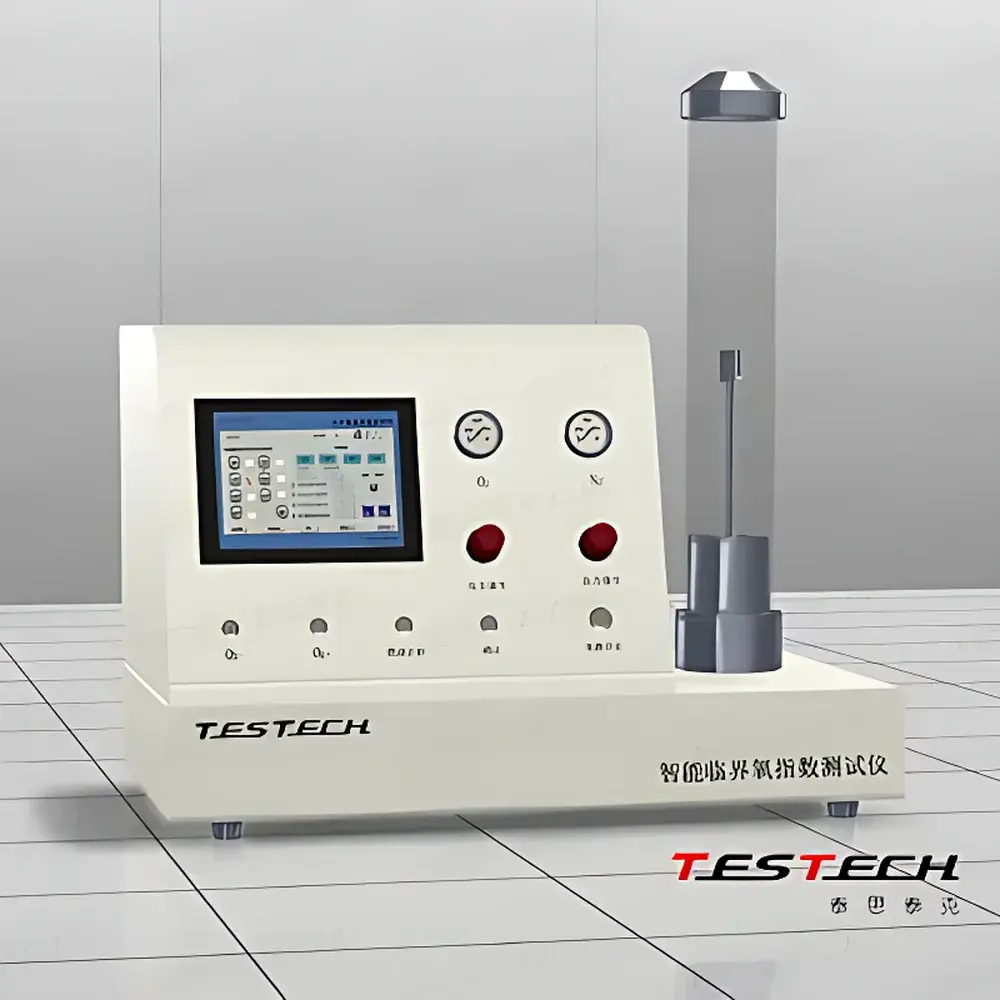
TESTech TTech-GBT2406-1 Intelligent Critical Oxygen Index Analyzer (Conformant to GB/T 2406, ASTM D2863, ISO 4589-2)
| Brand | TESTech |
|---|---|
| Origin | Jiangsu, China |
| Manufacturer | TESTech |
| Product Type | Domestic |
| Model | TTech-GBT2406-1 |
| Oxygen Concentration Range | 0–100% |
| Accuracy | ±0.1% O₂ |
| Response Time | <10 s |
| Gas Flow Velocity in Combustion Tube | 40 mm/s ± 2 mm/s (mid-height), 90 mm/s ± 10 mm/s (top) |
| Combustion Tube Dimensions | 500 mm height, 40 mm internal diameter (quartz glass) |
| Ignition Flame Height | 16 mm ± 4 mm (adjustable, downward jet) |
| Max Test Duration | 5 min |
| Dual Mass Flow Meters & Pressure Gauges | ±1% full-scale accuracy |
| Power Supply | AC 220 V, 50/60 Hz, 5 A |
| Dimensions | 435 × 550 × 670 mm (W×D×H) |
| Weight | 30 kg |
| Exhaust Flow Rate | 50 L/min |
Overview
The TESTech TTech-GBT2406-1 Intelligent Critical Oxygen Index Analyzer is a precision-engineered instrument designed to determine the Limiting Oxygen Index (LOI) of solid materials under standardized combustion conditions. Based on the fundamental principle of measuring the minimum oxygen concentration (by volume % in an O₂/N₂ mixture) required to support candle-like flaming combustion of a vertically oriented specimen, this analyzer complies with multiple national and international standards—including GB/T 2406.2–2009 (equivalent to ISO 4589-2), ASTM D2863, GB/T 5454–1997, GB/T 8924–2005, GB/T 10707–2008, and QB/T 1650–1992. The system employs a paramagnetic oxygen sensor—sourced from a Tier-1 European manufacturer—for direct, drift-free O₂ measurement with ±0.1% absolute accuracy and sub-10-second response time. Its robust architecture integrates mass flow control, real-time gas velocity regulation, and quartz-lined combustion geometry to ensure high reproducibility across repeated tests.
Key Features
- High-stability paramagnetic oxygen sensor with factory-calibrated traceability and long-term signal integrity
- Quartz-glass combustion column (500 mm height, 40 mm ID) resistant to thermal shock and halogen-induced corrosion
- Dual independent mass flow controllers for O₂ and N₂, enabling closed-loop concentration adjustment per user-set LOI target
- PLC-based control system with 7-inch industrial touchscreen HMI; supports programmable test sequences, automatic gas purging, and fault logging
- Adjustable downward-jet ignition source (16 ± 4 mm flame height) with integrated safety interlock and flame-out detection
- Real-time on-screen display of O₂ concentration (%), volumetric flow rates (L/min), elapsed time, and pass/fail status per ASTM/ISO criteria
- Dual analog flow meters and pressure gauges (±1% FS accuracy) for manual verification and system diagnostics
- Comprehensive electrical safety suite: overcurrent protection, gas leak detection circuit, emergency stop, and thermal cutoff at 85°C
Sample Compatibility & Compliance
The TTech-GBT2406-1 accommodates a broad range of specimen geometries and material classes—including homogeneous plastics, laminates, elastomers, textile fabrics, foams (rigid and flexible), thin films (<1 mm), and fiber-reinforced composites. Specimen holders support both self-supporting (e.g., rods, plaques ≥3 mm thick) and non-self-supporting configurations (e.g., films, gels, or low-density foams), conforming to Clause 7 of ISO 4589-2. All mechanical and pneumatic subsystems meet CE machinery directive requirements. The instrument’s operational protocol aligns with GLP documentation practices: audit trails for parameter changes, timestamped test records, and exportable CSV reports satisfy basic FDA 21 CFR Part 11 readiness when deployed in regulated QC environments. Calibration certificates for the oxygen sensor and flow controllers are provided with NIST-traceable references.
Software & Data Management
No proprietary desktop software is required—the embedded PLC firmware handles all test execution, data acquisition, and result calculation autonomously. Each test generates a timestamped record containing initial O₂ setpoint, actual measured concentration profile, flow stability metrics, ignition timing, burn duration, and final LOI determination. Data exports via USB flash drive in plain-text CSV format, compatible with LIMS integration and statistical process control (SPC) platforms. Optional RS-485 Modbus RTU interface enables remote monitoring and centralized fleet management in multi-instrument labs. Firmware updates are delivered via secure HTTPS portal with version-controlled release notes and validation summaries.
Applications
- Quality assurance of flame-retardant additives in polyolefins, PVC, polyesters, and engineering thermoplastics
- Regulatory pre-compliance screening for UL 94 HB/V-2/V-0 classification pathways
- R&D evaluation of intumescent coatings, mineral-filled composites, and nanocellulose-reinforced biopolymers
- Comparative fire performance benchmarking across supplier batches or recycled content variations
- Academic research on ignition kinetics, char formation efficiency, and gas-phase radical inhibition mechanisms
- Technical support for certification bodies performing third-party testing per IEC 60695-2-12 or EN ISO 4589-2
FAQ
What standards does the TTech-GBT2406-1 fully support?
It is validated for GB/T 2406.2–2009, ISO 4589-2:2017, ASTM D2863–22, GB/T 5454–1997, GB/T 8924–2005, GB/T 10707–2008, and QB/T 1650–1992.
Is the oxygen sensor field-replaceable and recalibratable?
Yes—the paramagnetic sensor module is modular and can be replaced without tooling; factory recalibration is recommended annually or after 2,000 test cycles.
Can the instrument operate continuously for extended qualification runs?
Designed for routine lab use, it supports up to 120 consecutive tests per day with ≤5-minute cooldown between cycles; ambient temperature must remain within 15–30°C.
Does it include exhaust gas handling provisions?
The unit features a dedicated 50 L/min exhaust port (Φ50 mm) compatible with standard fume hood ducting or active scrubber systems; no internal catalytic converter is installed.
How is measurement traceability maintained?
O₂ sensor calibration is traceable to NIST Standard Reference Material (SRM) 1680c; flow controllers are certified per ISO 6706; calibration certificates are supplied with each delivery.



