
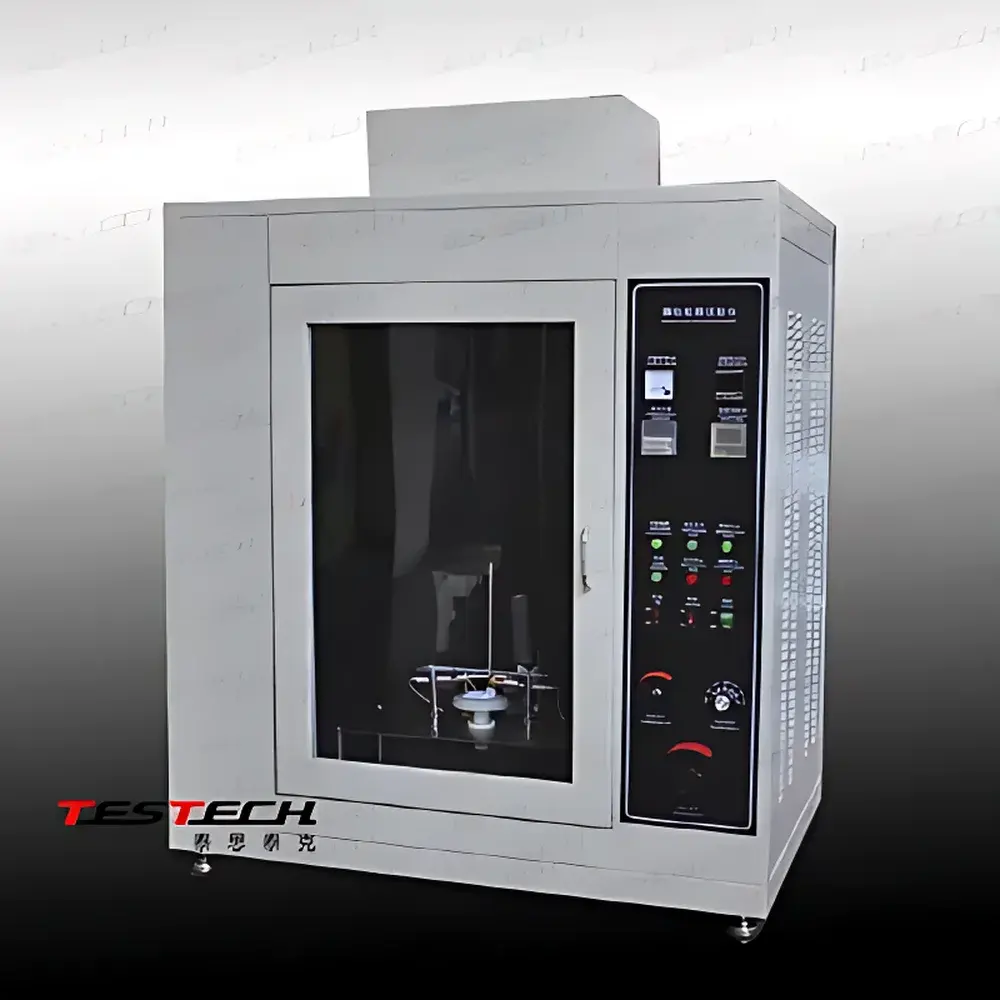
TESTech TTech-GBT4207 Comparative Tracking Index (CTI) and Proof Tracking Index (PTI) Tester
| Brand | TESTech |
|---|---|
| Model | TTech-GBT4207 |
| Compliance | GB/T 4207–2012, IEC 60112:2020, ASTM D3638–92, UL 746A, GB 4706.1 |
| Electrode Material | 99.9% Pt (5 mm × 2 mm rectangular tip, 60° ± 5° included angle) |
| Electrode Force | 1.00 N ± 0.001 N |
| Electrode Spacing | 4.00 mm ± 0.01 mm |
| Droplet Height | 35 mm ± 5 mm |
| Droplet Volume | 0.380–0.489 g per 20 drops (0.019–0.0245 g/drop) |
| Droplet Interval | 30 s ± 5 s (programmable, 0–9999 cycles) |
| Test Voltage Range | 100–600 V AC (48–60 Hz), digitally displayed, ±1% accuracy |
| Short-Circuit Current Threshold | 1.0 ± 0.1 A (voltage drop ≤10%) |
| Safety Cut-off | Automatic shutdown if current ≥0.5 A for ≥2 s |
| Control System | PLC + 7-inch HMI touchscreen with audit-trail-capable data logging |
| Chamber Dimensions (standard) | 630 mm W × 390 mm D × 750 mm H |
| Internal Volume | 0.1 m³ (customizable to 0.5 m³ or 0.75 m³) |
| Construction | Stainless steel sample holder, epoxy-coated steel enclosure, 4 mm tempered glass viewing window |
| Accessories | NH₄Cl electrolyte (0.1% w/w), sodium alkylnaphthalene sulfonate surfactant, 4 mm gauge, platinum electrode alignment jig, calibration weights |
Overview
The TESTech TTech-GBT4207 Comparative Tracking Index (CTI) and Proof Tracking Index (PTI) Tester is a precision-engineered instrument designed to evaluate the electrical resistance of solid insulating materials to surface tracking under humid, contaminated conditions. It operates on the principle of controlled electrochemical degradation: two precisely dimensioned platinum electrodes are placed on the material surface at a fixed spacing and angle; a standardized conductive electrolyte solution (0.1% ammonium chloride in deionized water with surfactant) is dripped at regulated intervals and height onto the surface between the electrodes while an AC voltage is applied. The resulting leakage current, carbonization path formation, and time-to-failure are monitored to determine CTI (the highest voltage at which no tracking occurs after 50 drops) and PTI (the lowest voltage at which tracking *does* occur within 50 drops). This test method is fundamental to assessing long-term reliability of insulation systems in low-voltage equipment operating in non-ideal environmental conditions—particularly relevant for components used in household appliances, industrial control panels, lighting fixtures, and IT infrastructure where dust, moisture, and ionic contamination may accumulate over time.
Key Features
- Precision platinum electrodes (99.9% purity, 5 mm × 2 mm cross-section, 60° ± 5° tip angle) mounted on adjustable stainless-steel holders with calibrated force application (1.00 N ± 0.001 N) and micron-level spacing control (4.00 mm ± 0.01 mm).
- Automated, programmable droplet delivery system featuring gravity-fed reservoir, PTFE-lined needle valve, and optical drop-counting sensor—capable of delivering 30 ± 5 s intervals with repeatable volume (0.019–0.0245 g/drop) and height (35 mm ± 5 mm).
- Digital AC power supply (100–600 V, 48–60 Hz) with real-time voltage display (±1% accuracy) and integrated short-circuit protection: automatic shutdown triggered when leakage current exceeds 0.5 A for ≥2 seconds.
- PLC-based control architecture with 7-inch industrial touchscreen HMI, supporting full test sequence automation, parameter presetting, and timestamped event logging—including voltage ramping, drop initiation, current monitoring, and failure detection.
- Robust safety enclosure: powder-coated steel chassis, stainless-steel sample stage, 4 mm tempered safety glass viewport, interlocked access door (test inhibited when open), and dedicated exhaust ducting for fume management.
- Compliance-ready design: built-in traceability features including user-accessible calibration logs, operator ID fields, and exportable CSV reports—facilitating adherence to GLP, ISO/IEC 17025, and FDA 21 CFR Part 11 requirements where electronic records are mandated.
Sample Compatibility & Compliance
The TTech-GBT4207 accommodates flat, rigid specimens up to 150 mm × 150 mm × 12 mm (standard configuration), with optional larger chambers available for extended testing geometries. It supports both thermoset and thermoplastic insulating materials—including phenolic resins, polyamide (PA6/PA66), polybutylene terephthalate (PBT), polycarbonate (PC), and reinforced engineering plastics—as well as molded connectors, terminal blocks, PCB substrates, and encapsulated assemblies. All mechanical and electrical parameters conform strictly to the dimensional, procedural, and performance criteria defined in IEC 60112:2020 (Ed. 4.0), GB/T 4207–2012, ASTM D3638–92, UL 746A, and GB 4706.1. The system includes certified reference electrolytes (NH₄Cl and sodium alkylnaphthalene sulfonate), calibrated gauges for electrode alignment and spacing verification, and documentation templates aligned with ISO 17025 clause 7.8 for uncertainty estimation and result reporting.
Software & Data Management
The embedded HMI firmware provides intuitive workflow navigation, multi-user authentication (with role-based permissions), and real-time visualization of voltage, current, drop count, and elapsed time. All test sessions are automatically timestamped and stored in non-volatile memory with metadata (operator ID, sample ID, ambient temperature/humidity if externally interfaced, calibration status). Data export is supported via USB flash drive in CSV format, compatible with LIMS integration and statistical process control (SPC) platforms. Audit trail functionality records all parameter changes, manual overrides, and system events—including login/logout timestamps and firmware update history—ensuring full compliance with regulatory data integrity expectations. Optional Ethernet connectivity enables remote monitoring and centralized database synchronization in enterprise QA environments.
Applications
This tester serves critical quality assurance and R&D functions across multiple sectors: component manufacturers validating material substitutions prior to production release; appliance OEMs qualifying housing and internal insulation for UL/CE certification; automotive Tier 1 suppliers evaluating connector housings exposed to under-hood humidity and salt spray; and aerospace subcontractors verifying flame-retardant polymer performance per DO-160 Section 25. It is routinely deployed in third-party testing laboratories accredited to ISO/IEC 17025 for issuing formal CTI/PTI certificates required by IEC 60695-2-12 and IEC 60695-2-13. Additionally, it supports comparative studies of surface treatments (e.g., plasma activation, silane coating), filler effects (e.g., alumina trihydrate, magnesium hydroxide), and aging simulations (thermal cycling + humidity preconditioning) to predict field failure modes.
FAQ
What standards does the TTech-GBT4207 fully support?
It complies with IEC 60112:2020, GB/T 4207–2012, ASTM D3638–92, UL 746A, and GB 4706.1—covering all procedural, dimensional, and performance requirements for CTI and PTI determination.
Can the chamber volume be customized for larger samples?
Yes—standard internal volume is 0.1 m³, but optional configurations of 0.5 m³ and 0.75 m³ are available upon request to accommodate oversized components or multi-specimen trays.
Is the electrolyte solution supplied with the instrument?
Yes—each unit ships with two sealed reagent bottles: one containing 0.1% (w/w) ammonium chloride solution and one containing sodium alkylnaphthalene sulfonate surfactant, both prepared to IEC-specified purity and concentration tolerances.
How is electrode alignment verified during routine operation?
The system includes a certified 4 mm gauge block and platinum electrode alignment jig; users perform mechanical verification before each test series per Clause 7.2 of IEC 60112.
Does the instrument support automated report generation?
Yes—CSV-formatted test reports include raw data, pass/fail status per IEC 60112 Annex A, CTI/PTI classification, and operator-auditable metadata; integration with external reporting tools (e.g., LabWare, Empower) is achievable via standard API protocols.



