
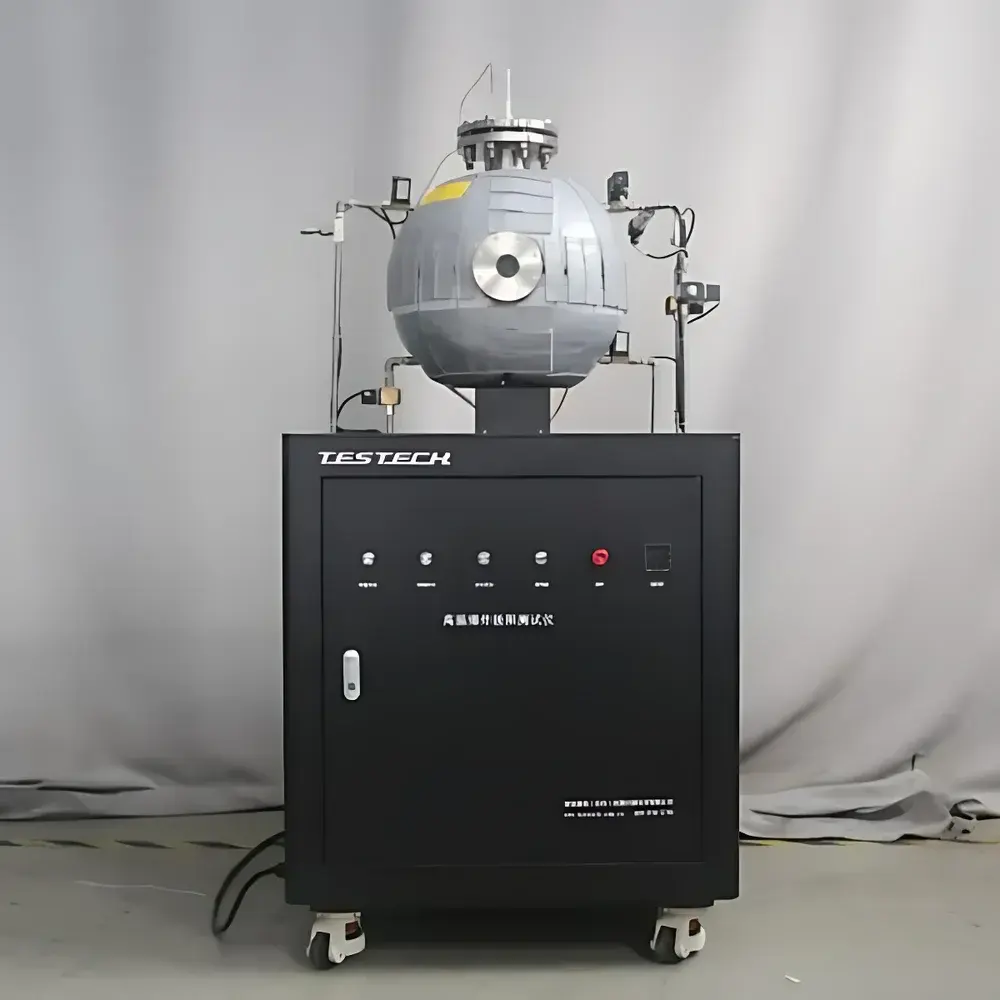
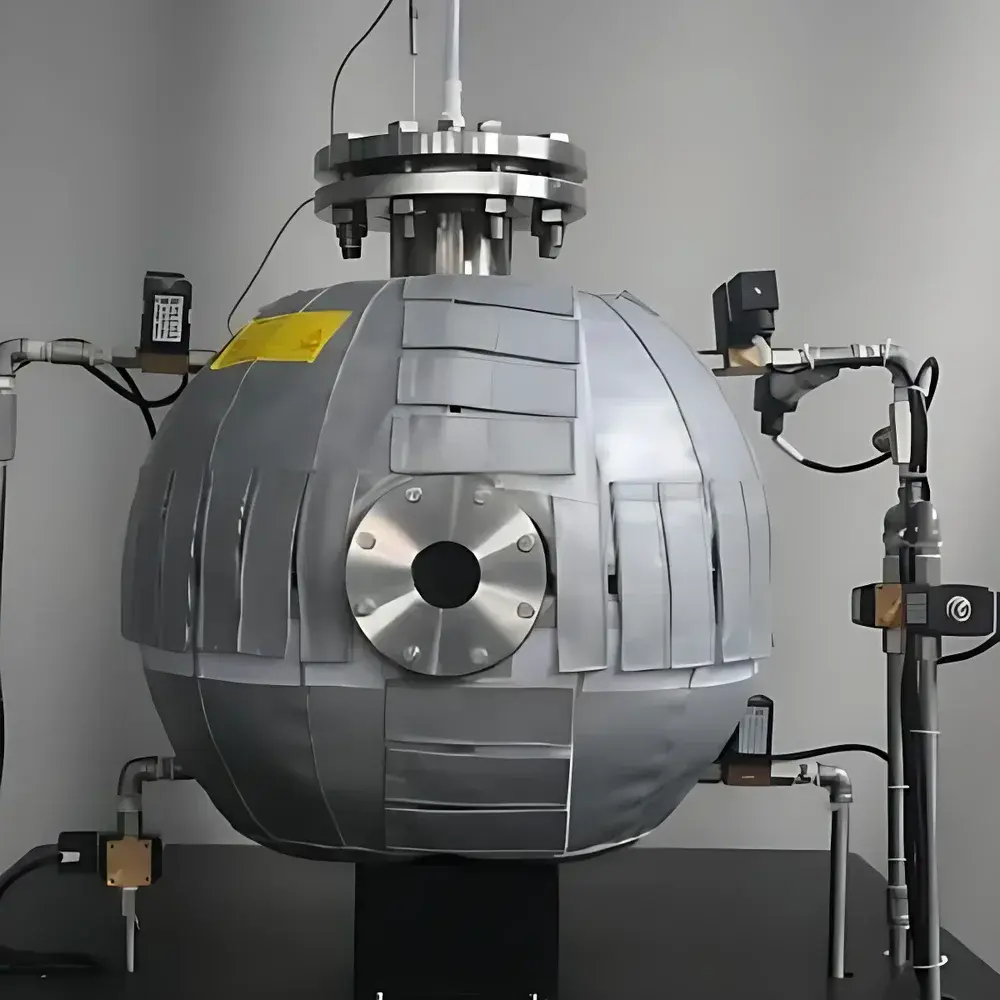
TESTech TTech-UL9540A-3 UL 9540A Gas Explosion Limit Testing System
| Brand | TESTech |
|---|---|
| Origin | Jiangsu, China |
| Manufacturer Type | Manufacturer |
| Country of Origin | China |
| Model | TTech-UL9540A-3 |
| Price Range | USD 1,500 – 3,000 (FOB) |
| Vessel Volume | 20 L |
| Maximum Operating Pressure | 2.0 MPa |
| Pressure Sensor Range | 0–2.0 MPa |
| Linearity | ±1.0% FS |
| Temperature Control Stability | ≤±5 °C |
| Ambient Operating Conditions | −5 to 45 °C, <95% RH |
| Gas Mixing Method | Dalton’s Law of Partial Pressures |
| Automation Level | Fully Automated (Vacuum, Gas Dosing, Stirring, Data Acquisition) |
Overview
The TESTech TTech-UL9540A-3 UL 9540A Gas Explosion Limit Testing System is a fully automated, research-grade apparatus engineered for quantitative assessment of flammability and explosion characteristics of gases and vapors evolved during thermal runaway events in lithium-ion battery cells and modules. It operates in strict alignment with the experimental methodology defined in UL 9540A, Annex D — “Determination of Combustible Gas Generation and Flammability Characteristics.” The system employs a standardized 20 L spherical stainless-steel explosion vessel conforming to ASTM E1226 and IEC 60079-20-1 requirements for dust/gas explosion testing. Combustion behavior is evaluated under controlled initial conditions (temperature, pressure, stoichiometry), enabling precise determination of lower and upper explosive limits (LEL/UEL), maximum explosion pressure (Pmax), rate of pressure rise ((dP/dt)max), and explosion severity index (KG). These parameters are essential inputs for hazard classification (e.g., ATEX/IECEx Group IIA/IIB), vent sizing calculations (ISO/IEC 80079-10-1), and safety-critical design of battery energy storage systems (BESS).
Key Features
- 20 L spherical explosion vessel fabricated from 316 stainless steel, rated for continuous operation up to 2.0 MPa and equipped with certified rupture disc (set pressure: 2.0 MPa)
- Integrated high-stability heating system enabling precise pre-test temperature conditioning of the internal atmosphere (±5 °C control accuracy over 20–200 °C range)
- High-fidelity pressure measurement using traceable, imported piezoresistive transducers (0–2.0 MPa full scale, linearity ±1.0% FS, sampling rate ≥10 kHz)
- Automated gas dosing subsystem implementing Dalton’s law of partial pressures for accurate binary/multi-component gas mixture preparation (e.g., H2, CO, CH4, C2H4, HF decomposition products)
- Programmable vacuum-purge-dose-stir sequence executed without operator intervention; magnetic stirring ensures homogeneous gas-phase distribution prior to ignition
- Real-time synchronized acquisition of temperature, absolute pressure, and time-series data with automatic post-processing for LEL/UEL interpolation, Pmax extraction, and KG derivation
Sample Compatibility & Compliance
The TTech-UL9540A-3 accepts gaseous samples directly or vaporized volatiles generated ex-situ from thermally stressed battery materials (e.g., electrolyte decomposition products, off-gassing from NMC/LFP cells). It supports testing of pure gases, binary mixtures (e.g., H2/air), and complex multi-component streams representative of real-world battery failure signatures. The system complies with core elements of UL 9540A Section 8.3, ASTM E1226 (Standard Test Method for Explosibility of Dust Clouds), ISO/IEC 80079-20-1:2016 (Explosive atmospheres — Part 20-1: Material characteristics for gas and vapour classification), and EN 1839 (Determination of explosion limits). All calibration records, sensor traceability certificates (NIST-traceable where applicable), and software audit logs are structured to support GLP/GMP-aligned validation and regulatory submissions.
Software & Data Management
The embedded Windows-based control software provides intuitive workflow sequencing, real-time visualization of pressure/temperature transients, and automated compliance reporting per UL 9540A templates. Raw data files (.csv, .tdms) retain full metadata (operator ID, test date, ambient conditions, calibration status). Audit trail functionality meets FDA 21 CFR Part 11 requirements for electronic records and signatures, including user access controls, change history logging, and immutable data archiving. Export modules generate PDF reports containing annotated curves, calculated parameters, uncertainty estimates (based on sensor specifications and statistical interpolation), and comparative analysis against reference databases (e.g., NFPA 497, GESTIS Substance Database).
Applications
- Quantitative evaluation of thermal runaway gas flammability profiles for cell-level and module-level safety certification (UL 1973, UL 9540, UN 38.3)
- Supporting fire modeling inputs for CFD-based battery enclosure venting and suppression system design
- Comparative assessment of electrolyte formulations, separator coatings, and thermal barrier materials on off-gas composition and explosivity
- Generation of input data for hazard and operability studies (HAZOP) and layer-of-protection analysis (LOPA) in BESS facility engineering
- Research into decomposition kinetics and combustion chemistry of emerging battery chemistries (e.g., solid-state, sodium-ion)
FAQ
Does the system comply with UL 9540A Annex D test protocols?
Yes — the TTech-UL9540A-3 implements all mandatory procedural steps, including prescribed vessel geometry, ignition energy (5 kJ capacitive discharge), pressure sampling resolution, and data reduction algorithms specified in UL 9540A Edition 4, Annex D.
Can it test vapors from liquid electrolytes?
Yes — when coupled with an external thermal desorption unit or heated sample introduction manifold, the system accommodates vapor-phase testing of volatile organic compounds (VOCs) and fluorinated ethers typical of Li-ion electrolytes.
Is third-party calibration documentation included?
Each unit ships with factory calibration certificates for pressure sensors and temperature controllers, traceable to national standards; optional UKAS/NIST-accredited calibration services are available upon request.
What safety interlocks are integrated?
Hardware-enforced interlocks include overpressure cutoff, door-open inhibition, vacuum-failure abort, and emergency vent activation — all independently monitored via redundant PLC logic per IEC 61508 SIL2 requirements.
Is remote monitoring supported?
Yes — the system supports secure OPC UA connectivity for integration into centralized lab information management systems (LIMS) or industrial IoT platforms, enabling real-time status dashboards and predictive maintenance alerts.




