
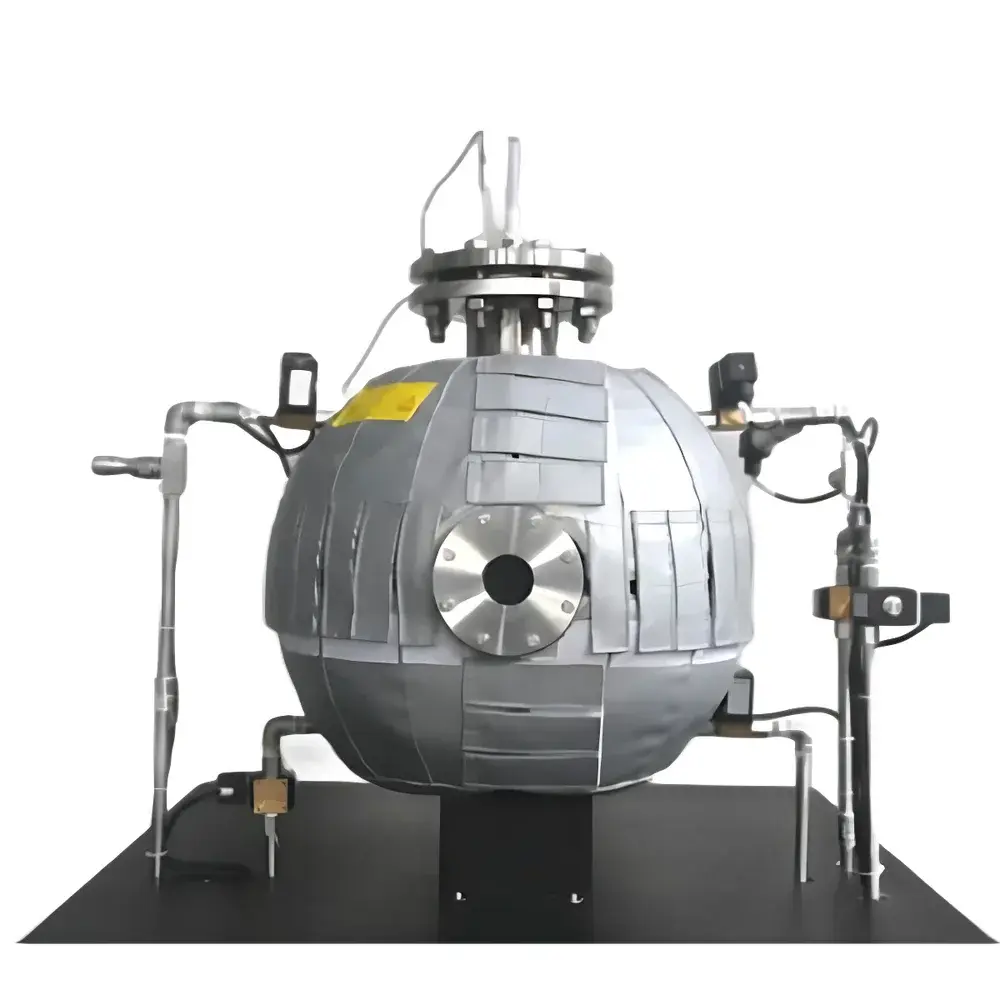
TESTech TTech-DHN Electrolyte Minimum Ignition Energy (MIE) Tester
| Brand | TESTech |
|---|---|
| Origin | Jiangsu, China |
| Manufacturer Type | Manufacturer |
| Country of Origin | China |
| Model | TTech-DHN |
| Price Range | USD 1–2 (Unit: per unit, FOB Jiangsu) |
Overview
The TESTech TTech-DHN Electrolyte Minimum Ignition Energy (MIE) Tester is a purpose-built apparatus engineered for quantitative assessment of the minimum electrical energy required to ignite aerosolized lithium-ion battery electrolytes under controlled atmospheric conditions. Unlike conventional flammability or explosion limit testers—such as those based on spark ignition in static gas mixtures—the TTech-DHN integrates a calibrated capacitive discharge ignition system with a sealed, pressure-rated test chamber and high-speed pressure transduction. It operates on the principle of electrostatic spark ignition within a defined volume, enabling precise determination of the lowest ignition energy threshold (in millijoules, mJ) that initiates flame propagation or deflagration in electrolyte vapor–air or electrolyte mist–air mixtures. This measurement directly supports hazard classification per IEC 60079-20-1, NFPA 497, and UN Manual of Tests and Criteria, Part I, Section 10.3, and serves as foundational input for intrinsic safety design, thermal runaway consequence modeling, and battery pack venting system validation.
Key Features
- Integrated capacitive discharge ignition circuit with adjustable energy output (0.1–100 mJ), calibrated traceably to NIST-traceable standards
- Explosion-resistant stainless-steel test chamber (rated to 20 bar peak overpressure) equipped with sapphire optical windows for high-speed imaging and flame diagnostics
- Real-time ignition energy monitoring via synchronized voltage/current waveform capture using 100 MS/s digitizers
- Automated mist generation system compatible with common carbonate-based electrolytes (e.g., EC/DMC/LiPF6) and solid-electrolyte interphase (SEI)-relevant volatiles
- Simultaneous acquisition of explosion pressure (Pmax), maximum rate of pressure rise ((dP/dt)max), and derived explosion index (KG, bar·m/s)
- Compliant with ISO/IEC 17025-accredited calibration protocols for pressure sensors and energy measurement subsystems
Sample Compatibility & Compliance
The TTech-DHN accommodates liquid electrolytes, volatile decomposition products (e.g., HF, CO, C2H4, CH3OH), and aerosolized electrolyte mists generated at defined droplet size distributions (D10 ≈ 5–20 µm, measured by laser diffraction). It supports testing across stoichiometric air–vapor ratios (0.5–2.0 λ) and ambient temperatures from 20 °C to 60 °C. All operational procedures align with ASTM E2019 (Standard Test Method for Determination of Minimum Ignition Energy of Dust Clouds), adapted for low-conductivity liquid mists, and referenced in UL 1642 Annex H for lithium battery safety evaluation. Data outputs satisfy audit requirements for GLP-compliant laboratories and are structured to support FDA 21 CFR Part 11–compliant electronic records when paired with optional validated software modules.
Software & Data Management
The TTech-DHN is supplied with TESTech MIE-Control v3.x, a Windows-based application featuring deterministic real-time triggering, waveform overlay analysis, and automated calculation of MIE per EN 13821. Raw pressure and ignition signals are stored in HDF5 format with embedded metadata (test ID, operator, timestamp, calibration certificate IDs, ambient RH/T). Export options include CSV, PDF test reports compliant with ISO/IEC 17025 reporting clauses, and XML schemas compatible with LIMS integration. Audit trails record all parameter changes, user logins, and data exports, fulfilling ALCOA+ principles (Attributable, Legible, Contemporaneous, Original, Accurate, Complete, Consistent, Enduring, Available).
Applications
- Determination of MIE for novel electrolyte formulations (e.g., fluorinated carbonates, sulfones, solid-state hybrid systems)
- Quantification of ignition sensitivity shifts induced by thermal decomposition pathways during battery abuse testing
- Input parameter generation for CFD-based explosion modeling of battery module enclosures and ventilation ducts
- Comparative hazard ranking of electrolyte additives (e.g., flame retardants, SEI stabilizers) under identical mist-generation conditions
- Supporting UN 38.3 Section 38.3.10 (thermal runaway propagation) and GB/T 36276–2018 Annex D test development
- Extension to non-battery applications: pharmaceutical solvent mists, fine chemical aerosols, and metal-organic framework (MOF) desorption vapors
FAQ
What ignition energy range does the TTech-DHN cover, and how is calibration verified?
The system delivers 0.1–100 mJ in 0.1 mJ increments, with energy accuracy ±2% of reading (k=2), verified annually using a NIST-traceable calorimetric load and oscilloscope-based waveform integration.
Can the TTech-DHN test pure vapor-phase electrolytes without aerosolization?
Yes—via optional vapor-phase injection manifold; however, mist-phase testing reflects more realistic thermal runaway aerosol generation and is recommended per IEEE 1624–2022 guidance.
Is the pressure measurement system intrinsically safe for Class I, Division 1 environments?
No—the instrument is designed for laboratory use only (non-hazardous area installation); external explosion-proof enclosures or purge systems must be implemented for field deployment.
Does the system comply with EU ATEX Directive 2014/34/EU for equipment used in explosive atmospheres?
The TTech-DHN itself is not ATEX-certified; however, its test methodology and output data support ATEX Category 2/3 equipment risk assessments per EN 60079-10-1.
How is mist uniformity ensured across repeated tests?
Using a dual-stage ultrasonic nebulizer with closed-loop feedback control of aerosol mass concentration (measured gravimetrically pre-test) and inline laser scattering verification (±5% RSD).






