
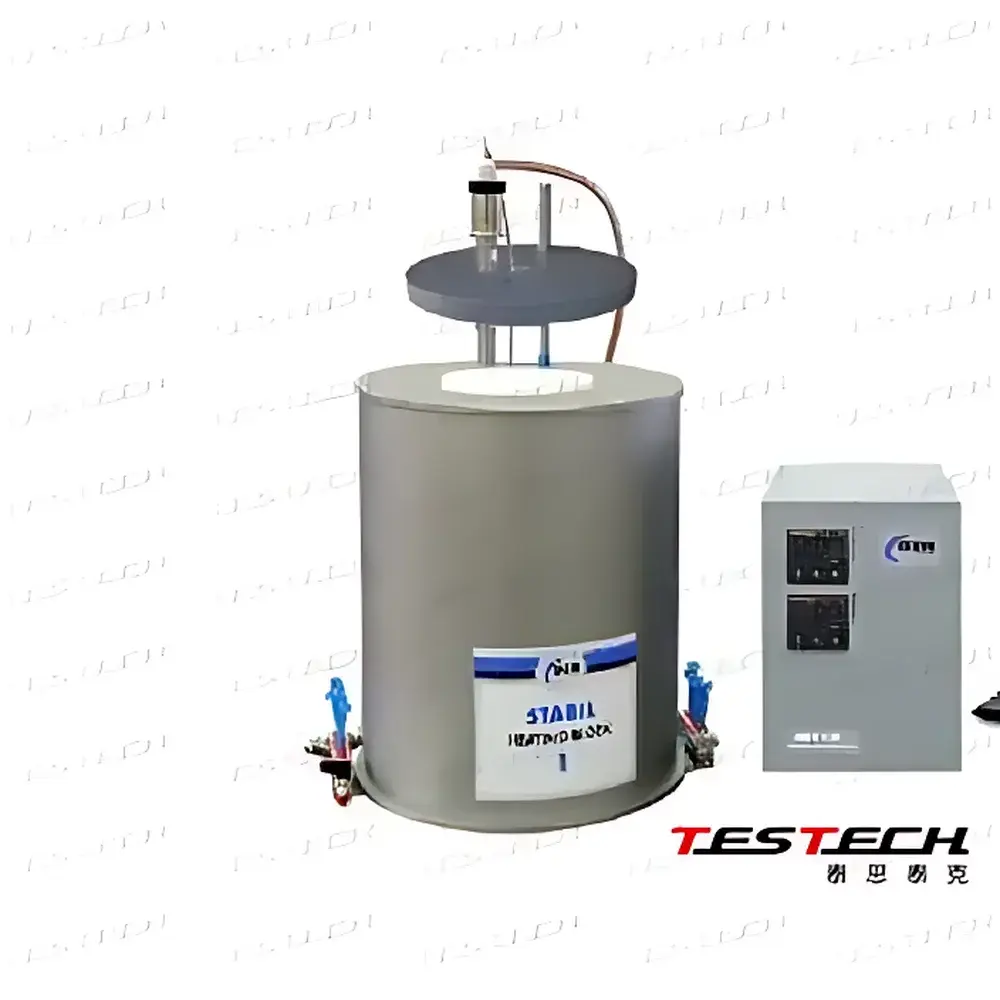
TESTech TTech-GBT2550 Non-Flammability Tester for Rubber Hoses (Compliant with GB/T 2550–2007 and ISO 3821:1998)
| Brand | TESTech |
|---|---|
| Origin | Jiangsu, China |
| Manufacturer Type | Direct Manufacturer |
| Model | TTech-GBT2550 |
| Power Supply | 220 V, 50 Hz |
| Heating Power | 350 W (furnace), 500 W (system total) |
| Oxygen Flow Range | 0–5 L/min (at 101.3 kPa, 15 °C) |
| Controlled Flow Rate | 2.0 ± 0.1 L/min |
| Furnace Dimensions | Ø50 mm × 150 mm depth |
| Tungsten Ignition Wire | 0.7 mm diameter, tapered tip, 20.0 ± 0.5 mm length |
| Temperature Measurement | Nitrogen-filled mercury-in-glass thermometer, 0–400 °C range, scale division ≤5 °C, immersion depth ≥200 mm above bulb |
| Test Tube | Custom borosilicate glass tube per GB/T 2550–2007 Annex A |
| Chamber Material | Stainless steel |
| Voltage Regulation | Continuously variable autotransformer |
| Accessories | Aluminum foil sheet included |
| Compliance | GB/T 2550–2007, ISO 3821:1998 |
Overview
The TESTech TTech-GBT2550 Non-Flammability Tester is a purpose-built combustion test apparatus engineered to evaluate the flame resistance of rubber hoses used in gas welding, cutting, and related industrial applications. It operates on the principle of controlled ignition under standardized oxygen-enriched conditions, as defined in Annex A of GB/T 2550–2007 and aligned with ISO 3821:1998. The system subjects a vertically mounted hose specimen to a precisely heated tungsten wire igniter within a thermally stable furnace environment maintained at 360–365 °C. Oxygen flow is regulated to 2.0 ± 0.1 L/min at standard ambient conditions (101.3 kPa, 15 °C), ensuring reproducible oxidative exposure. Unlike general-purpose burners or open-flame testers, this instrument delivers metrologically traceable thermal and gaseous boundary conditions—critical for pass/fail determination of hose compliance prior to field deployment in high-risk environments.
Key Features
- Stainless-steel test chamber with integrated borosilicate glass reaction tube, designed per dimensional and material specifications in GB/T 2550–2007 Annex A
- Calibrated tungsten ignition wire (0.7 mm diameter, 20.0 ± 0.5 mm length, conical tip) mounted on a rigid support for consistent contact geometry and thermal transfer
- Dual-stage oxygen delivery: precision needle valve + laminar-flow rotameter (0–5 L/min range), enabling stable 2.0 ± 0.1 L/min setpoint under atmospheric pressure and 15 °C reference conditions
- High-stability electric furnace (350 W, Ø50 mm × 150 mm internal cavity) with continuously adjustable heating via autotransformer (0–250 V output), facilitating accurate temperature ramping and dwell control
- Reference-grade nitrogen-filled mercury-in-glass thermometer (0–400 °C, ≤5 °C scale division, minimum 200 mm stem immersion above bulb) for direct furnace temperature verification
- Integrated aluminum foil shielding accessory to minimize radiant heat loss and improve thermal uniformity during test cycles
- Electrical safety compliance: grounded chassis, overcurrent protection, and insulated wiring per IEC 61010-1 requirements for laboratory electrical equipment
Sample Compatibility & Compliance
The TTech-GBT2550 is validated for testing rubber hoses conforming to GB/T 2550–2007 Section 6.5 (Non-flammability test) and ISO 3821:1998 Clause 6. Specimens must be straight, uncut segments of nominal inner diameter 6–25 mm, conditioned at 23 ± 2 °C and 50 ± 5 % RH for no less than 24 h prior to testing. The apparatus accommodates both smooth-bore and corrugated hose constructions, provided external diameter remains within mechanical clearance limits of the borosilicate test tube. All test procedures are fully documentable for GLP-compliant laboratories; raw data—including ignition timing, flame propagation distance, and self-extinguishing duration—can be recorded manually in accordance with regulatory audit requirements. While not certified to UL 94 or ASTM E84, the system satisfies mandatory national type-testing protocols for hose approval in China’s pressure equipment regulatory framework (TSG 23–2021).
Software & Data Management
This is a manually operated, hardware-dominant test system with no embedded microcontroller or digital interface. Temperature, flow, and timing parameters are monitored and recorded using calibrated analog instruments—consistent with the procedural intent of GB/T 2550–2007, which prescribes visual observation and manual stopwatch timing. Laboratories implementing electronic data capture may integrate external digital thermocouple loggers (e.g., calibrated Type K sensors with ±0.5 °C accuracy) or flow data acquisition modules compatible with Modbus RTU or analog 4–20 mA outputs (available via optional signal conditioning kits). All test records must include operator ID, ambient conditions, calibration certificate numbers for thermometer and flowmeter, and photographic evidence of pre- and post-test specimen condition to satisfy ISO/IEC 17025 clause 7.8 (Reporting of Results) and FDA 21 CFR Part 11 principles when used in regulated manufacturing settings.
Applications
- Pre-certification testing of acetylene, oxygen, propane, and mixed-gas rubber hoses for welding/cutting equipment manufacturers
- Quality assurance screening in hose production facilities subject to CCC (China Compulsory Certification) or CNAS-accredited testing
- Root cause analysis of fire incidents involving industrial gas delivery systems
- Technical validation support for material substitution studies (e.g., halogen-free elastomer formulations)
- Training and demonstration of flammability behavior under controlled oxidizing atmospheres in vocational technical institutes
FAQ
Does the TTech-GBT2550 comply with international standards beyond ISO 3821:1998?
Yes—it is functionally equivalent to ISO 3821:1998 and explicitly designed to meet the procedural and dimensional requirements of GB/T 2550–2007 Annex A. While not directly mapped to EN 559 or BS EN ISO 3821:2015, its operational parameters fall within the tolerance bands specified in those harmonized European standards.
Can the furnace temperature be verified independently during routine use?
Yes. The supplied mercury-in-glass thermometer is calibrated traceably to national standards (e.g., NIM or CNAS-accredited labs). Users are required to perform periodic verification against a secondary reference thermometer before each test series, as mandated by GB/T 2550–2007 Clause A.3.3.
Is oxygen purity specified in the standard?
GB/T 2550–2007 does not define oxygen grade, but best practice—per ISO 3821:1998 Annex B—recommends ≥99.5 % purity (v/v) medical or industrial grade, free of oil vapors and moisture, to prevent catalytic interference or premature quenching.
What maintenance intervals are recommended for the tungsten wire?
The tungsten igniter must be replaced after every 10 test cycles or immediately upon visible deformation, oxidation discoloration, or tip blunting—whichever occurs first—to maintain consistent ignition energy and geometric repeatability.
Is third-party calibration documentation available for purchase?
Yes. TESTech provides optional factory calibration certificates (traceable to NIM) for the thermometer and rotameter, including uncertainty budgets and as-found/as-left data, upon request at time of order.



