
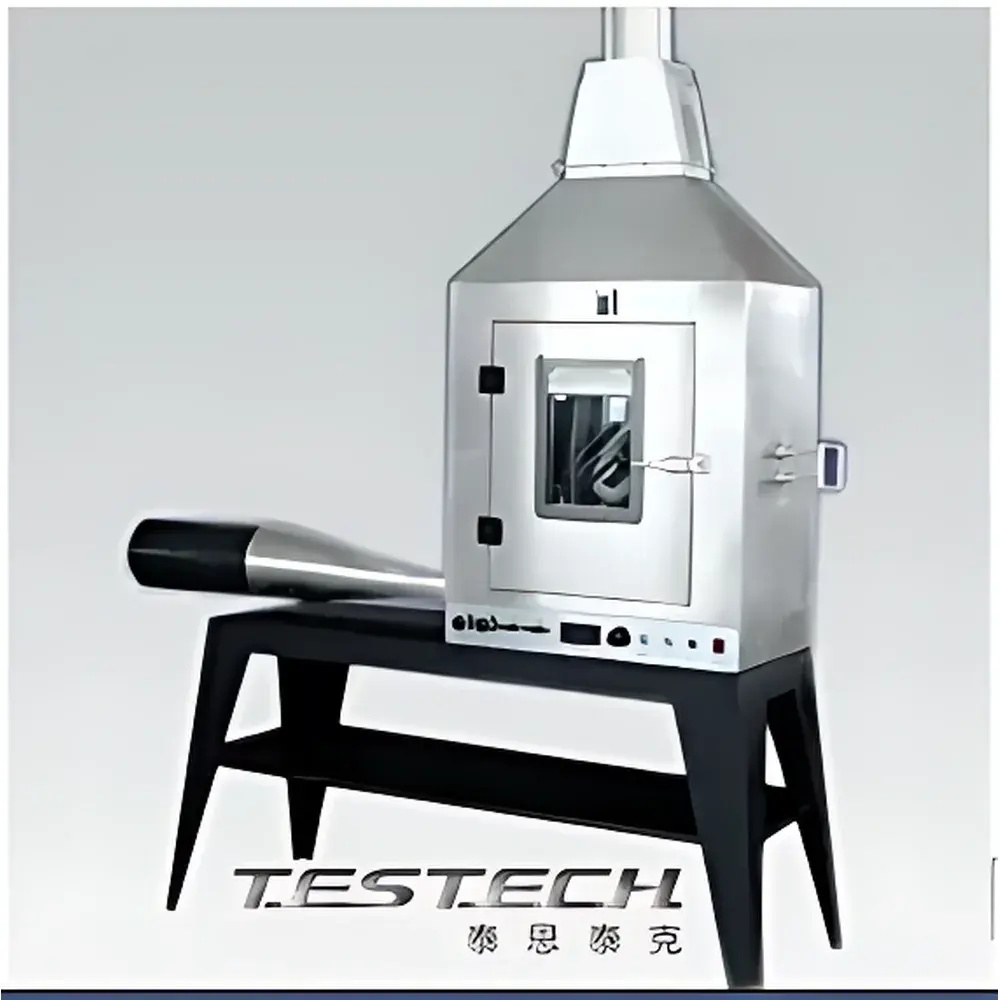
TESTech TTech-NFP92-501 Radiant Flame Spread Tester per NF P 92-501 & TB/T 2639.1
| Brand | TESTech |
|---|---|
| Model | TTech-NFP92-501 |
| Radiation Flux | 30 kW/m² |
| Dimensions (W×D×H) | 1900 × 460 × 2100 mm |
| Net Weight | 158 kg (main unit) |
| Power Supply | 220 V, 50 Hz, 550 W |
| Radiator Rated Power | 500 W |
| Power Meter Accuracy | Class 0.5 |
| Gas Valve Pressure Rating | < 0.1 MPa |
| Compliance | NF P 92-501, TB/T 2639.1 |
Overview
The TESTech TTech-NFP92-501 Radiant Flame Spread Tester is a precision-engineered apparatus designed to evaluate the surface flame spread behavior of rigid and semi-rigid materials ≥5 mm thick under controlled radiant heat exposure. It operates on the principle of exposing vertically mounted specimens to a uniform thermal radiation flux of 30 kW/m²—simulating the early-stage heat feedback conditions typical in compartment fires. Under this thermal load, materials undergo pyrolysis, releasing volatile combustible gases that ignite and propagate flames across the surface. The instrument quantifies critical fire performance indices—including flame spread index (i), average flame height index (S), maximum flame height index (h), and calorific index (C)—by optically tracking flame front progression and correlating combustion dynamics with real-time thermal and gas-phase data. Developed specifically for compliance with French national standard NF P 92-501 and Chinese railway industry standard TB/T 2639.1, it serves as a core tool for fire safety qualification of interior materials used in rail vehicles, including wall linings, ceiling panels, flooring substrates, and insulation composites.
Key Features
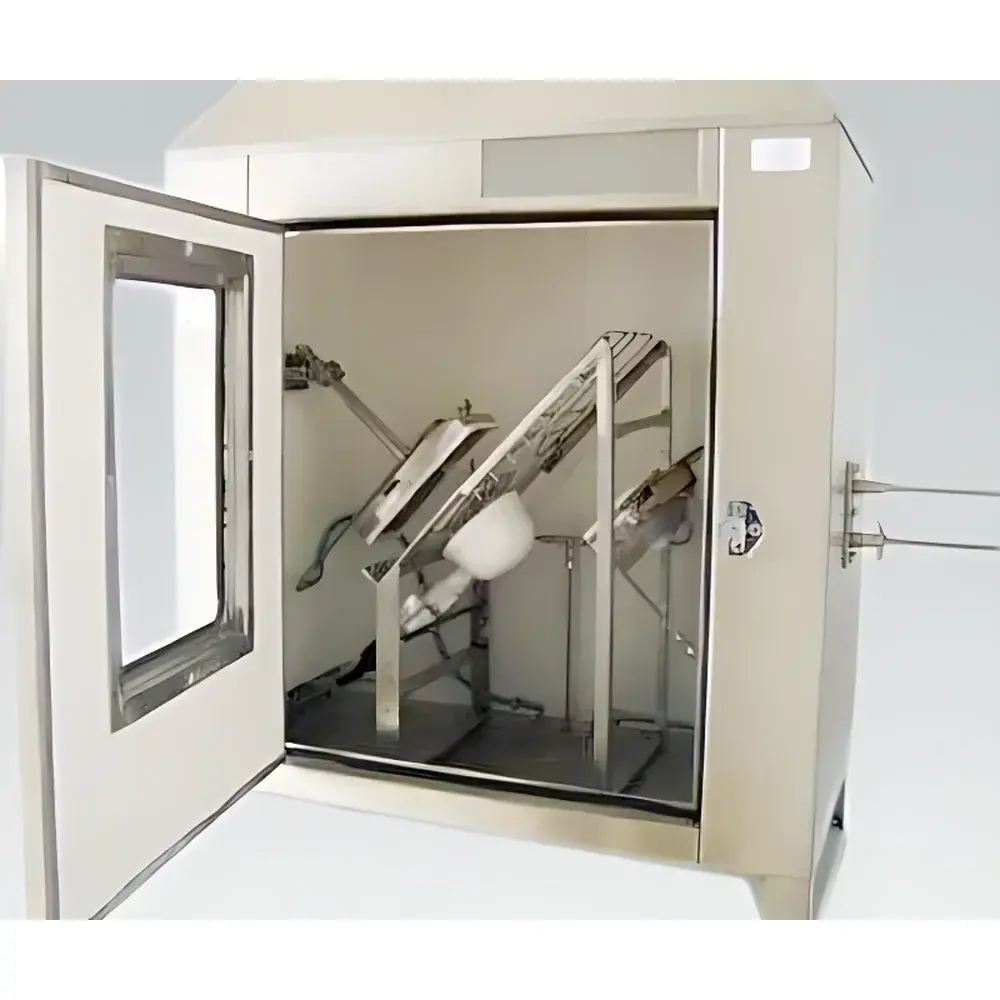
- Robust stainless-steel test chamber with fire-resistant internal lining and integrated tempered glass observation window for safe, unobstructed visual monitoring of flame propagation.
- 45° inclined specimen mounting frame fabricated from corrosion-resistant stainless steel, equipped with calibrated scale for precise measurement of flame travel distance along the sample surface.
- High-stability radiant heater assembly delivering a reproducible and spatially uniform 30 kW/m² heat flux; power output continuously adjustable via digital controller with front-panel real-time wattage display—eliminating routine recalibration requirements.
- Dual-position burner system: upper and lower stainless-steel burners positioned to reliably ignite pyrolyzate gases; each fitted with precision needle valves and dedicated flame-height gauges for repeatable flame stabilization.
- Pilot ignition subsystem featuring continuously burning micro-flames for rapid, consistent lighting of main burners prior to test initiation.
- Quarter-turn isolation valve manifold enabling immediate shutoff of fuel supply to both burners during emergency or post-test cooldown.
- Integrated thermocouple array—including top-chamber and inlet-air sensors—providing continuous differential temperature logging for ambient and boundary condition validation.
- Stainless-steel tubular air intake duct with particulate filtration system to minimize contamination of test environment and ensure stable airflow dynamics during flame development.
Sample Compatibility & Compliance
The TTech-NFP92-501 accommodates flat, non-dripping, self-supporting specimens measuring 1000 mm × 400 mm (L × W), with thickness ranging from 5 mm to 50 mm. It supports both rigid (e.g., phenolic laminates, aluminum composite panels) and elastic (e.g., cross-linked rubber sheets, elastomeric foams) materials commonly specified in rail vehicle interiors. All operational protocols, calibration procedures, and pass/fail criteria are fully aligned with the normative requirements of NF P 92-501 (Méthode de mesure du comportement au feu des matériaux sous effet de rayonnement) and TB/T 2639.1–2015 (Railway Rolling Stock Fire Performance Testing – Part 1: Radiant Panel Method). The system meets mechanical and electrical safety provisions of IEC 61000-6-3 (EMC) and IEC 61000-6-4, and supports documentation traceability required for GLP-compliant fire testing laboratories.
Software & Data Management
The embedded Windows-based control software provides full test automation, including pre-programmed sequence execution, real-time video-synchronized flame tracking, and automatic calculation of standardized fire indices (i, S, h, C) per NF P 92-501 Annex B. All raw sensor data—including radiant power, chamber temperatures, flame height profiles, and time-stamped video frames—are timestamped and stored in a structured binary format compliant with ISO/IEC 17025 audit requirements. Export functions support CSV, PDF, and XML formats; reports include operator ID, calibration status, environmental conditions, and digital signature fields. Software architecture incorporates role-based access control and electronic audit trail functionality meeting FDA 21 CFR Part 11 expectations for regulated environments.
Applications
- Fire safety certification of interior trim materials for high-speed trains, metro cars, and light rail vehicles.
- Comparative flame spread evaluation during material formulation development for polymer composites and intumescent coatings.
- Quality assurance testing in production environments where batch-to-batch consistency of flame retardancy must be verified against TB/T 2639.1 thresholds.
- Research into pyrolysis kinetics and flame inhibition mechanisms under intermediate radiant heat flux regimes.
- Third-party laboratory accreditation testing supporting EN 45545-2, GB/T 32304, and other harmonized rail fire standards requiring radiant panel methodology.
FAQ
What standards does the TTech-NFP92-501 explicitly support?
It is fully configured and validated for NF P 92-501 (France) and TB/T 2639.1–2015 (China Railway), including all geometric, radiometric, and procedural specifications outlined in those documents.
Can the radiant flux be adjusted below or above 30 kW/m²?
Yes—the digital power controller enables continuous adjustment from 15 kW/m² to 35 kW/m², though official compliance testing requires strict adherence to the 30 kW/m² nominal flux defined in the referenced standards.
Is the system compatible with automated data archiving in LIMS environments?
Yes—via configurable OPC UA or TCP/IP interface, raw and processed datasets can be streamed to external Laboratory Information Management Systems using vendor-neutral metadata schemas.
Does the instrument include factory calibration documentation?
Each unit ships with NIST-traceable calibration certificates for radiant flux verification (using calibrated heat flux transducers), thermocouple linearity, and gas flow metering accuracy—valid for 12 months from commissioning date.
What maintenance intervals are recommended for long-term operational reliability?
Radiant panel reflectivity inspection every 200 tests; burner nozzle cleaning after each test series; annual verification of gas pressure regulators and thermocouple drift per ISO/IEC 17025 Clause 6.4.6.



