
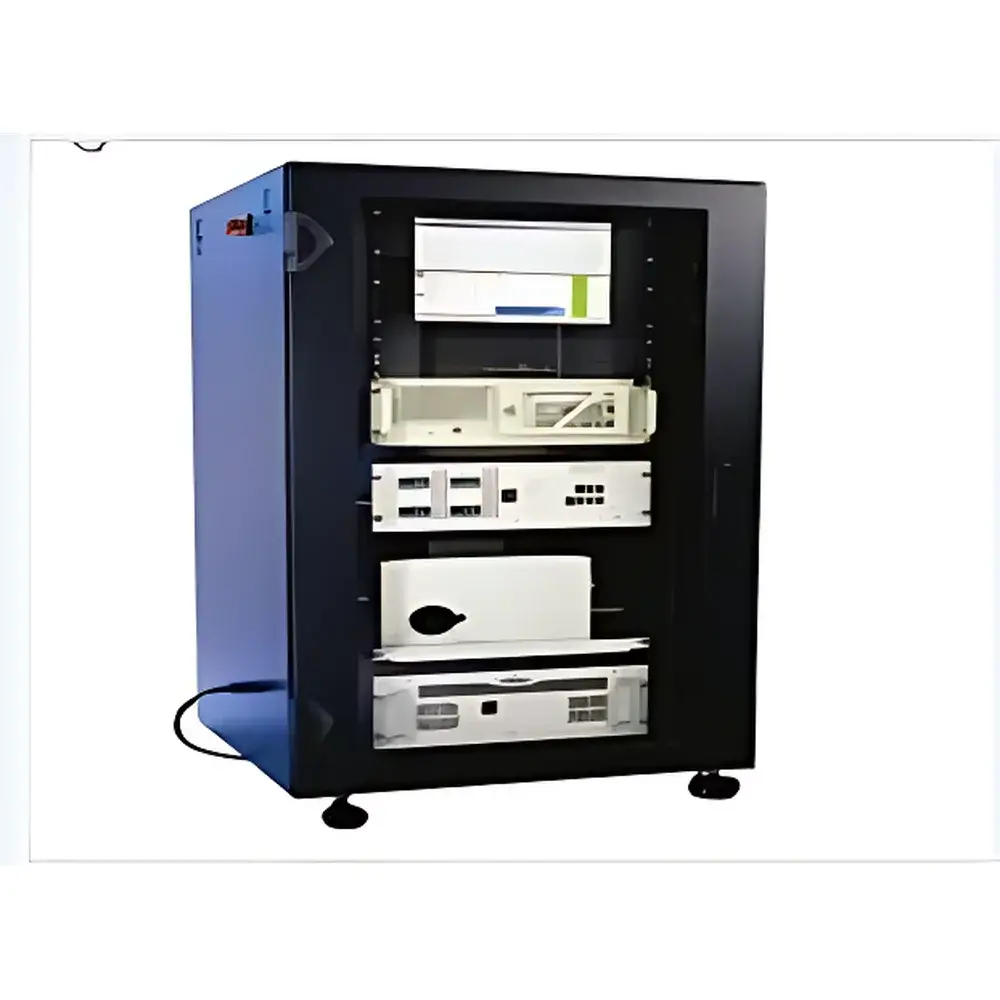
Gasmet CX4000 FTIR Smoke Toxicity Analyzer
| Brand | Gasmet |
|---|---|
| Origin | Finland (Manufactured under license by TESTech, Jiangsu, China) |
| Model | CX4000 |
| Measuring Principle | Fourier Transform Infrared (FTIR) Spectroscopy |
| Simultaneous Analytes | Up to 50 gas compounds |
| Spectral Resolution | 4 cm⁻¹ |
| Wavenumber Range | 500–4200 cm⁻¹ |
| Sample Cell Path Length | 5.0 m (multi-pass) |
| Max Sample Cell Temperature | 180 °C |
| Window Material | BaF₂ |
| Detector | Peltier-cooled MCT |
| Light Source | SiC (1550 K) |
| Beamsplitter | ZnSe |
| Response Time (T₉₀) | < 120 s |
| Zero Calibration Interval | 24 h (N₂ ≥ 5.0) |
| Zero Drift | < 2 % of FS per calibration interval |
| Linearity Deviation | < 2 % of FS |
| Temp. Drift | < 2 % of FS per 10 K |
| Pressure Compensation | Yes, ambient pressure measured & compensated |
| Gas Flow Rate | 120–600 L/h |
| Particulate Filtration Required | 2 µm |
| Power Supply | 100–115 V / 230 V, 50–60 Hz |
| Max Power Consumption | 300 W |
| Operating Temp. | 5–30 °C (non-condensing) |
| Storage Temp. | −20–60 °C |
| Enclosure Dimensions | 482 × 196 × 450 mm |
| Weight | 17 kg |
| Compliance | CE (EMC Directive 89/336/EEC), GLP/GMP-ready software architecture, compatible with FDA 21 CFR Part 11 audit trail requirements via Calcmet configuration |
Overview
The Gasmet CX4000 FTIR Smoke Toxicity Analyzer is a laboratory- and industrial-grade continuous emission monitoring system engineered for quantitative, real-time analysis of toxic combustion gases generated during fire testing and material flammability evaluation. Built upon robust Fourier Transform Infrared (FTIR) spectroscopy, the instrument delivers simultaneous, multi-component identification and concentration measurement of up to 50 hazardous species—including CO, CO₂, HCN, HCl, HF, SO₂, NO, NO₂, NH₃, CH₄, formaldehyde, acrolein, and other volatile organic compounds—directly from hot, humid, and corrosive smoke streams. Its design conforms to international fire safety test standards including ISO 5659-2 (smoke density), ISO 9239-1 (radiant heat flux), ASTM E1354 (cone calorimetry), and EN 45545-2 (railway material toxicity). Unlike extractive NDIR or electrochemical sensors, the CX4000 employs broadband mid-infrared absorption across 500–4200 cm⁻¹, enabling unambiguous compound identification via spectral fingerprinting and eliminating cross-sensitivity artifacts common in single-wavelength detection.
Key Features
- High-fidelity FTIR spectrometer with 4 cm⁻¹ resolution and 10 scans/second acquisition rate for dynamic smoke event capture
- Temperature-controlled, 5.0-meter multi-pass sample cell constructed from rhodium-coated aluminum, rated to 180 °C for direct integration with cone calorimeters, furnace-based fire tests, and large-scale room-corner tests
- BaF₂ optical windows optimized for broad spectral transmission in harsh, high-humidity environments where water vapor interference must be resolved
- Onboard signal processing using a 32-bit floating-point DSP (120 MFLOPS) and 95 dB dynamic range A/D converter ensures stable baseline integrity and low-noise quantification down to sub-ppm levels
- Single-gas calibration protocol compliant with ISO 14956 and ASTM D6348—enabling rapid method reconfiguration without full multi-point calibration
- Real-time pressure and temperature compensation algorithms that correct for sample dilution, thermal expansion, and path-length variance in variable-flow smoke ducts
- CE-marked enclosure (EMC Directive 89/336/EEC) with IP20-rated industrial housing; designed for permanent installation in fire testing laboratories and accredited certification facilities
Sample Compatibility & Compliance
The CX4000 accepts undiluted, particulate-filtered (≤2 µm) smoke effluent at flow rates of 120–600 L/h and temperatures matching the heated sample cell (up to 180 °C). It accommodates wet gas matrices with dew points up to 95 °C and tolerates trace halogen acids (HCl, HF), sulfur oxides, and nitrogen oxides without catalyst degradation or window etching. The analyzer meets functional requirements of ISO/IEC 17025 for testing laboratories and supports full traceability under GLP and GMP frameworks. When operated with Calcmet software configured for audit trail logging, electronic signatures, and user access control, the system satisfies FDA 21 CFR Part 11 data integrity criteria for regulated toxicity reporting. All measurement protocols align with CEN/TS 45545-2 Annex B, NFPA 262, and UL 94 VTM flame spread classifications.
Software & Data Management
Calcmet for Windows (v3.10+, compatible with Windows 7 32-bit and later LTS versions) serves as the primary analytical engine. It provides real-time spectral visualization, automated peak deconvolution, stoichiometric correction for combustion stoichiometry (e.g., CO/CO₂ ratio), and integrated calculation of LC₅₀-equivalent toxicity indices per ISO 13344. Data export supports CSV, XML, and PDF report generation with embedded metadata (operator ID, test standard, calibration history). The software architecture enables secure remote diagnostics via RS-232 interface and supports optional analog I/O modules for synchronization with calorimeter heat release rate (HRR) signals or chamber pressure transducers. All raw interferograms and processed spectra are stored with time-stamped headers, enabling retrospective reprocessing with updated spectral libraries.
Applications
- Quantitative smoke toxicity assessment of cables, textiles, composites, and interior automotive/railway materials per EN 45545-2, GB/T 17651, and IEC 61034
- Real-time gas speciation during cone calorimeter (ASTM E1354) and radiant panel (ASTM E162) fire tests
- Validation of fire-retardant additive efficacy by tracking HCN, HCl, and CO yield curves over time
- Smoke hazard modeling input generation for CFD-based fire simulation tools (e.g., FDS, PyroSim)
- Accredited third-party testing for UL, TÜV, and SGS certification reports requiring auditable, multi-analyte gas data
- Research into pyrolysis pathways of novel polymers, bio-based foams, and lithium-ion battery thermal runaway emissions
FAQ
Does the CX4000 require periodic recalibration with multi-component gas standards?
No. The analyzer uses fundamental spectroscopic calibration based on NIST-traceable single-component reference gases. Method updates for new analytes only require spectral library validation—not hardware recalibration.
Can the CX4000 operate unattended for extended fire tests exceeding 60 minutes?
Yes. With stable power conditioning and ambient temperature control (recommended 18–25 °C), the system supports continuous operation for >8 hours. Internal thermal management maintains spectrometer and detector stability within specification.
Is the sample cell compatible with ISO 5659-2 smoke density chamber exhaust?
Yes. The 5.0 m path length and 180 °C heating capability allow direct coupling to ISO 5659-2 chambers without dilution or condensation traps, preserving true smoke composition.
What spectral library formats does Calcmet support?
Calcmet natively imports HITRAN, NIST, and proprietary Gasmet reference libraries. Users may also generate custom libraries from pure-component measurements under controlled conditions.
How is moisture interference handled in high-humidity smoke?
Water vapor absorption bands are mathematically modeled and subtracted using real-time humidity-corrected reference spectra. BaF₂ windows minimize hygroscopic degradation versus KBr or CaF₂ alternatives.



