
TESTech TTech-ISO13506 Instrumented Manikin System for Thermal Protective Clothing Evaluation
| Brand | TESTech |
|---|---|
| Origin | Jiangsu, China |
| Manufacturer Type | Original Equipment Manufacturer (OEM) |
| Product Origin | Domestic (China) |
| Model | TTech-ISO13506 |
| Pricing | Available upon request |
Overview
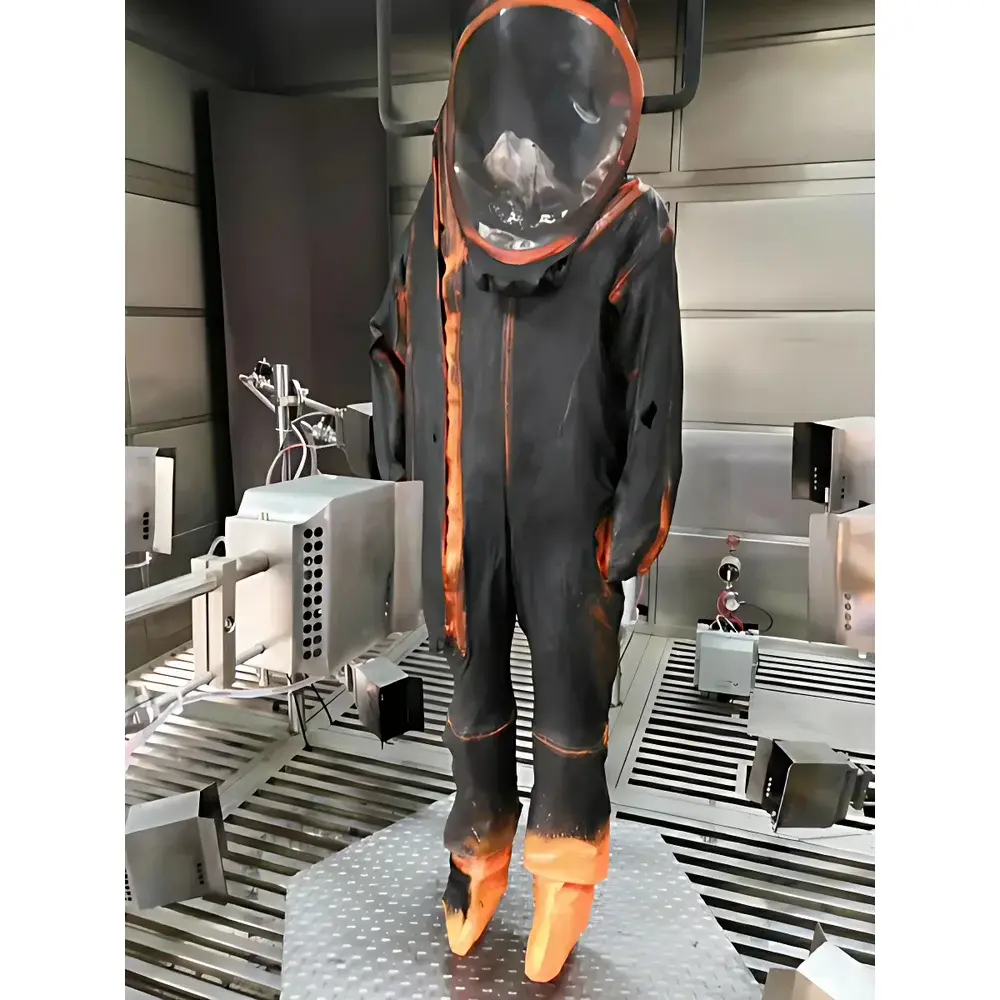
The TESTech TTech-ISO13506 Instrumented Manikin System is an engineered solution for quantitative evaluation of thermal protective performance of flame-resistant garments under flashover conditions. It operates on the principle of calibrated thermal energy transfer measurement using a full-scale anthropomorphic manikin equipped with 122 embedded thermocouple-based heat flux sensors. The system replicates standardized radiant and convective heat exposure environments defined in ISO 13506-1, ISO 13506-2, ASTM F1930, and GB/T 23467–2009. By capturing transient surface temperature responses across epidermal, dermal, and subcutaneous tissue layers—modeled via Pennes’ bioheat equation—the system computes predicted second-degree and third-degree burn areas, total burn surface area (TBSA), and cumulative absorbed thermal energy. This enables objective, repeatable, and regulatory-compliant assessment of garment insulation efficacy, thermal barrier integrity, and human injury risk prediction under controlled fire exposure scenarios.
Key Features
- Anthropomorphic manikin constructed from non-degrading, fire-resistant ceramic composite material, conforming to ASTM D6240 dimensional specifications and ISO 13506 mechanical articulation requirements (shoulder, elbow, knee, ankle joints)
- 122 high-fidelity copper-alloy heat flux sensors, each integrated with welded-type thermocouples; sensor surface coated with matte black high-temperature ceramic paint (emissivity ≥0.95)
- Thermal response time ≤0.1 s per sensor; radiative heat flux range: 0–167 kW/m²
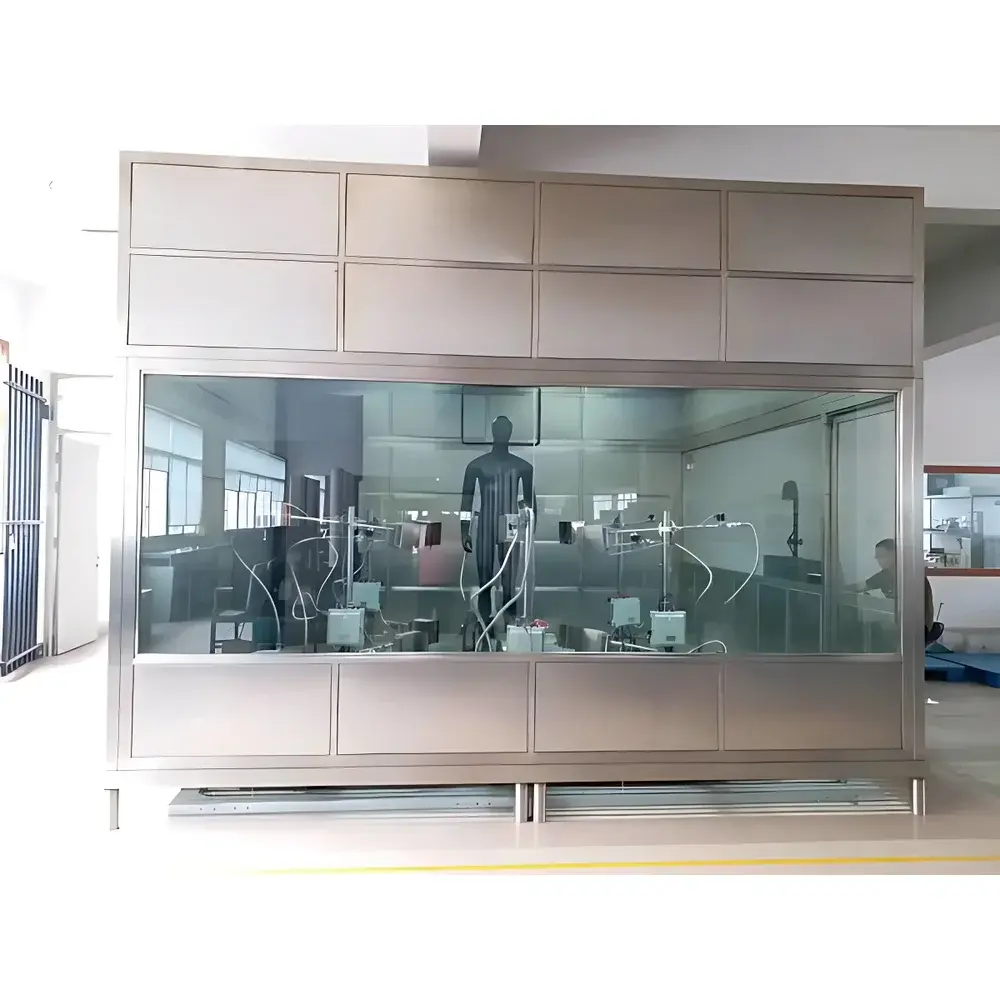
- Combustion chamber constructed with refractory quartz glass walls and structural steel framing (4.0 m L × 3.5 m W × 3.0 m H); includes integrated gas leak detection and door interlock safety monitoring
- 12 high-precision imported burner nozzles arranged in a hexagonal matrix (6 pairs, vertically staggered), delivering ≥84 kW/m² uniform incident heat flux across the manikin surface
- Stainless steel gas distribution manifold with flame-retardant flexible hose connections; explosion-proof solenoid valves (response time: 0.1 s) and mass flow controllers ensure reproducible fuel delivery
- Dedicated ventilation system with adjustable exhaust fan (≥25 m³/min nominal capacity), dual-mode operation for combustion support and post-test cooling
Sample Compatibility & Compliance
The TTech-ISO13506 system accommodates complete ensembles—including coveralls, hoods, gloves, and footwear—as specified in ISO 13506-1. Garment fit follows ASTM F1930 guidelines for snugness and mobility simulation. All test protocols are traceable to internationally recognized standards: ISO 13506-1 (energy transfer measurement), ISO 13506-2 (burn injury prediction algorithm), ASTM F1930 (flash fire simulation methodology), and GB/T 23467 (Chinese national standard for manikin-based evaluation). The system supports GLP-aligned documentation workflows and is compatible with audit-ready data archiving for regulatory submissions under NFPA 2112, EN ISO 11612, and OSHA 1910.269 compliance frameworks.
Software & Data Management
The system employs a LabVIEW-based modular software platform running on industrial-grade PC hardware. It provides synchronized acquisition across 124 channels (122 sensors + ambient reference + chamber pressure/temperature) at 95 Hz per channel, with ±0.29 °C absolute accuracy and 0.01 °C resolution. Each sensor channel supports individual calibration curve assignment, real-time thermal injury modeling (first-, second-, and third-degree burn thresholds), and spatial burn area mapping. Software modules include exposure condition validation (heat flux uniformity verification), TBSA computation, cumulative energy absorption analysis, and automated report generation compliant with ISO/IEC 17025 documentation requirements. Data export supports CSV, TDMS, and XML formats for integration into LIMS or enterprise QA systems.
Applications
This system serves R&D laboratories, certification bodies (e.g., UL, SGS, CNAS-accredited facilities), and PPE manufacturers engaged in the development and validation of flame-resistant workwear for oil & gas, electrical utilities, firefighting, military, and industrial furnace operations. It supports iterative garment design optimization—including fabric layer sequencing, seam construction, moisture management integration, and reflective outer shell evaluation. Validated outputs feed directly into hazard risk assessments (ASTM E2671), arc flash boundary calculations (IEEE 1584), and product labeling per NFPA 70E and IEC 61482-2.
FAQ
Does the system comply with FDA or 21 CFR Part 11 requirements?
While not a medical device, the software architecture supports electronic signature functionality, audit trail logging, and user access control—features aligned with 21 CFR Part 11 principles for regulated QA environments.
Can the manikin be used for radiant-only exposure testing?
Yes—the burner matrix allows independent modulation of convective and radiant components; optional radiant panel configurations can be integrated for pure radiant exposure per ISO 6942.
Is third-party calibration and certification available?
TESTech provides NIST-traceable sensor calibration certificates and offers on-site validation services by ISO/IEC 17025-accredited partners.
What is the minimum required laboratory infrastructure?
A dedicated 10 m × 8 m floor space with reinforced concrete flooring, 380 V/3-phase power supply, natural gas or propane line (≥25 m³/h capacity), and dedicated exhaust ducting to exterior are mandatory.
How is skin burn prediction validated against biological models?
Burn algorithms implement the Henriques integral model as prescribed in ISO 13506-2, with validation datasets derived from porcine skin studies published in peer-reviewed journals (e.g., Burns, Journal of Burn Care & Research).
Related Products



