
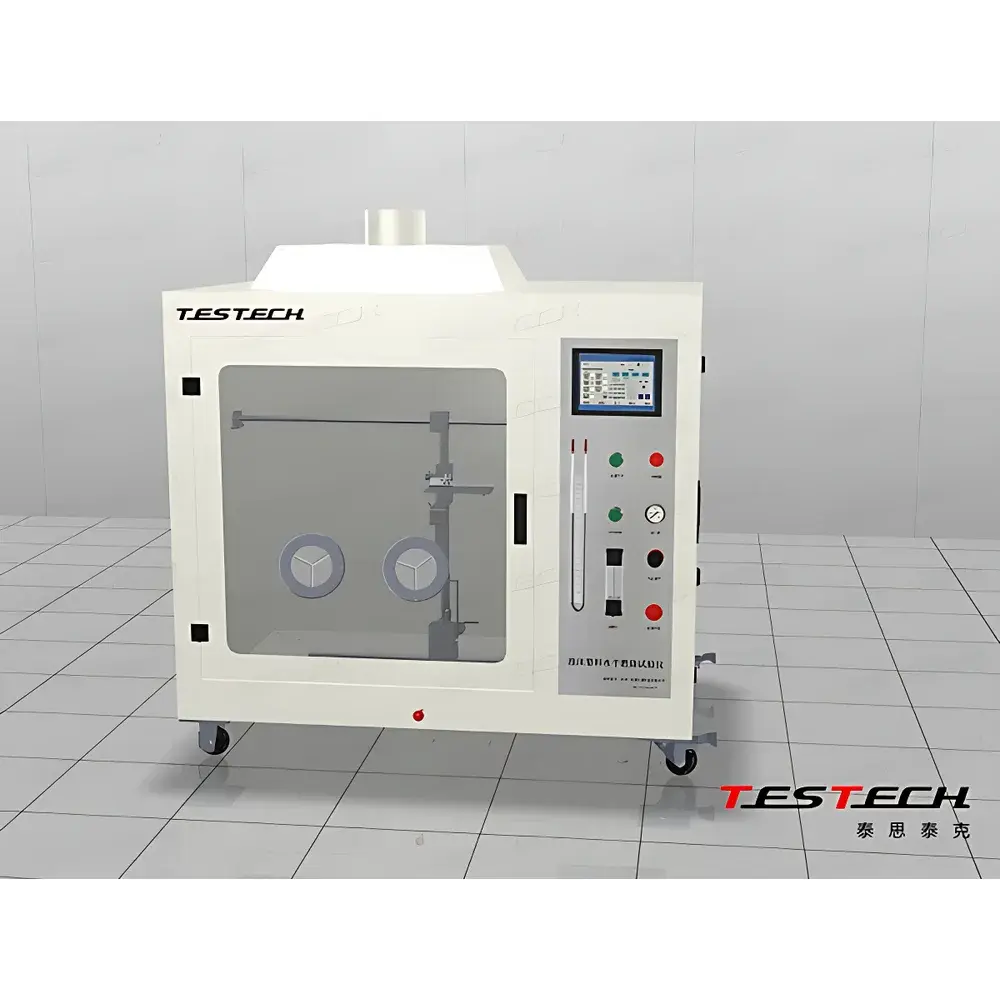
TESTech TTech-GBT8332 Horizontal Burning Test Chamber for Foam Plastics (Compliant with GB/T 8332–2008 and ISO 9772)
| Brand | TESTech |
|---|---|
| Model | TTech-GBT8332 |
| Standard Compliance | GB/T 8332–2008, ISO 9772 |
| Burner Specification | Bunsen burner per ISO 10093:1998 (tube length 100 ± 10 mm, inner diameter 9.5 ± 0.3 mm, flame height 38 ± 2 mm) |
| Chamber Volume | ≥ 0.5 m³ |
| Operating Environment | 10–35 °C, RH ≤ 75 % |
| Power Supply | AC 220 V ± 10 V, 50 Hz |
| Fuel Gas | Propane or natural gas (≥ 95 % purity) |
| Control System | PLC + industrial touchscreen HMI |
| Ignition | Pulse high-voltage electronic auto-ignition |
| Gas Flow Control | Mass flow controller + imported needle valve |
| Pressure Monitoring | Digital pressure gauge with touchscreen display |
| Timing | Dual independent timers (application time & total test time), automatic storage and report integration |
| Exhaust | Integrated exhaust port and centrifugal fan |
| Viewing Window | Large tempered glass observation window |
| Safety Features | Interlocked door control for burner positioning, flame failure detection |
Overview
The TESTech TTech-GBT8332 Horizontal Burning Test Chamber is a precision-engineered instrument designed to evaluate the flammability behavior of low-density cellular plastics—specifically those with densities below 250 kg/m³—using the standardized horizontal burning method. It operates in strict accordance with the Chinese national standard GB/T 8332–2008 and its internationally harmonized counterpart, ISO 9772:2016 (“Plastics — Determination of burning behaviour of cellular plastics — Horizontal burning test”). The test principle involves exposing a horizontally oriented specimen (typically 150 mm × 12.7 mm × thickness ≤ 13 mm) to a defined small-flame ignition source (a calibrated Bunsen burner meeting ISO 10093:1998 specifications) for a fixed duration (typically 30 s). Critical fire performance parameters—including burn rate (mm/min), afterflame time, afterglow time, extent of char propagation, and mass loss—are quantitatively recorded to support material classification, regulatory compliance documentation, and comparative fire safety assessment.
Key Features
- Integrated chamber-and-control architecture minimizes field installation complexity and ensures mechanical stability during thermal cycling.
- Large-dimension tempered glass observation window enables real-time visual monitoring of flame front progression, melt dripping, and char formation without compromising chamber integrity.
- ISO 10093-compliant Bunsen burner with traceable dimensional tolerances (100 ± 10 mm tube length; 9.5 ± 0.3 mm inner diameter) and digitally stabilized flame height (38 ± 2 mm) ensures repeatability across laboratories.
- PLC-based control system with industrial-grade touchscreen HMI supports fully programmable test sequences—including adjustable ignition duration, automated timing triggers, and dual independent timekeeping for flame application and post-ignition observation.
- Gas delivery subsystem features a certified mass flow controller, high-precision imported needle valve, and digital pressure transducer—all calibrated for propane or ≥95% purity natural gas, enabling consistent stoichiometric flame conditions.
- Interlocked door mechanism prevents burner movement during closed-chamber operation, enhancing operator safety and test reproducibility.
- Onboard data logging captures all critical timestamps, gas pressure readings, and calculated linear burn rates (V₁ through V₆), with export-ready structured output compatible with LIMS integration.
Sample Compatibility & Compliance
The TTech-GBT8332 accommodates rigid and semi-rigid foam specimens conforming to the dimensional and density requirements of GB/T 8332–2008 and ISO 9772. Specimens must be conditioned at 23 ± 2 °C and 50 ± 5 % RH for ≥48 h prior to testing. The chamber’s ≥0.5 m³ internal volume satisfies the draft-free enclosure requirement specified in both standards, minimizing convective interference during flame propagation. All hardware components—including burner geometry, gas supply calibration, and timer resolution—meet metrological traceability requirements for accredited testing laboratories operating under ISO/IEC 17025. The system supports audit-ready documentation generation aligned with GLP principles and facilitates evidence collection for regulatory submissions under China’s CCC framework or EU Construction Products Regulation (CPR) Annex ZA.
Software & Data Management
The embedded HMI firmware implements deterministic real-time control logic with non-volatile memory for test parameter presets, historical run logs, and raw sensor data archives. Each test record includes: start/stop timestamps, gas pressure (kPa), actual flame application time (s), measured burn distances (mm), calculated linear burn rates (mm/min), afterflame/afterglow durations (s), and mass loss (%). Reports are generated in PDF format with embedded metadata (operator ID, calibration certificate IDs, environmental monitoring logs) and comply with FDA 21 CFR Part 11 requirements for electronic records—supporting audit trails, user authentication, and electronic signatures when deployed in regulated QA/QC environments.
Applications
This instrument serves as a primary evaluation tool for R&D engineers and quality assurance personnel in polyurethane (PU), expanded polystyrene (EPS), extruded polystyrene (XPS), polyethylene (PE), and melamine-formaldehyde foam manufacturers. Typical use cases include: pre-certification screening of flame-retardant formulations; validation of batch-to-batch consistency in production; technical due diligence for building insulation material specifications; and generation of Class E or Class F flammability classifications per EN 13501-1. It is routinely employed by third-party testing labs accredited to CNAS (China National Accreditation Service) and UKAS for issuing formal test certificates recognized by MoHURD (Ministry of Housing and Urban-Rural Development) and international certification bodies.
FAQ
What standards does the TTech-GBT8332 explicitly support?
GB/T 8332–2008, ISO 9772:2016, and ISO 10093:1998 for burner specification.
Is the chamber volume verified and documented?
Yes—the internal volume is ≥0.5 m³ and verified via dimensional survey; calibration certificate includes volumetric measurement uncertainty.
Can test data be exported to external QA systems?
Yes—structured CSV and PDF reports support LIMS import; optional OPC UA interface available for enterprise SCADA integration.
Does the system meet electrical safety and EMC requirements for CE marking?
The unit complies with IEC 61000-6-3 (EMI) and IEC 61010-1 (safety); full Declaration of Conformity supplied with shipment.
What maintenance intervals are recommended for gas flow calibration?
Mass flow controller and pressure transducer require annual recalibration against NIST-traceable standards; burner tip inspection recommended every 200 test cycles.
Related Products



