
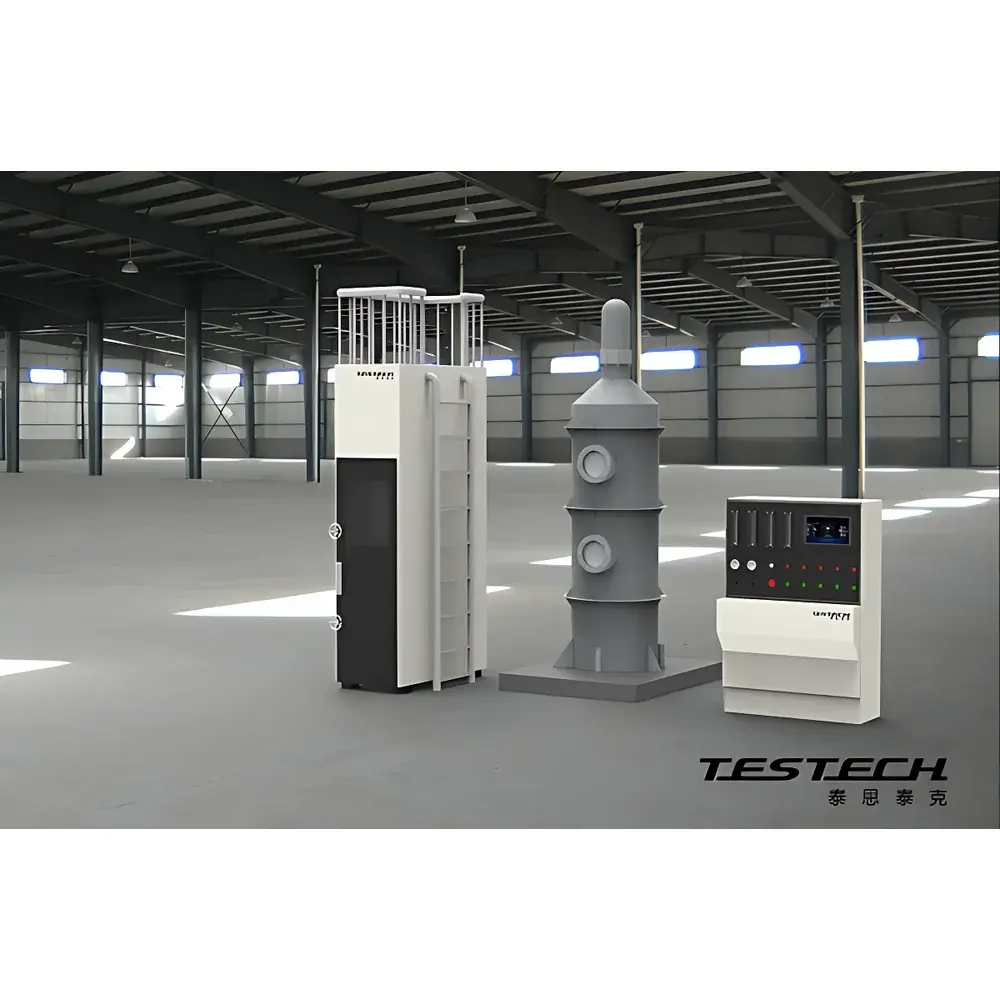
TESTech TTech-GBT18380B Vertical Tray Flame Propagation Tester for Cables and Optical Fibers (Compliant with GB/T 18380.3, IEC 60332-3-10, UL 1685, EN 50399)
| Brand | TESTech |
|---|---|
| Model | TTech-GBT18380B |
| Origin | Jiangsu, China |
| Manufacturer Type | Direct Manufacturer |
| Compliance Standards | GB/T 18380.31–36, IEC 60332-3-10, UL 1685, EN 50399, KS C IEC 60332-3-21 to -25 (Classes A–D), IEEE 383 (with 20° burner tilt option) |
| Test Chamber Dimensions | 1,000 ± 100 (W) × 2,000 ± 100 (D) × 4,000 ± 100 (H) mm |
| Airflow Rate | (5,000 ± 500) L/min |
| Propane Burner | 257 mm × 4.5 mm ribbon-type, 242 × Ø1.35 mm orifices in triple-row configuration (81/80/81), 3.2 mm pitch |
| Gas Supply | Technical-grade propane (≥95% purity), regulated at 100 kPa @ 20 °C |
| Ignition | Automatic spark ignition |
| Control System | PLC-based with 10.1″ industrial touchscreen HMI |
| Timing Resolution | 1 s, max duration 999 min |
| Thermocouple | K-type armored, Ø2 mm |
| Inlet Opening | 800 ± 20 (W) × 400 ± 10 (D) mm, located 150 ± 10 mm from front panel |
| Exhaust Duct | Stainless steel, integrated with optional gas analysis interface for HRR & SPR measurement |
Overview
The TESTech TTech-GBT18380B Vertical Tray Flame Propagation Tester is an engineered solution for evaluating the flame retardancy performance of vertically installed cable and optical fiber bundles under standardized fire exposure conditions. It operates on the principle of controlled vertical flame propagation assessment—measuring the extent to which a defined bundle of cables, mounted on a stainless-steel ladder inside a calibrated test chamber, resists upward flame spread when subjected to a precisely regulated propane-fueled burner. The system implements the core physical test methodology defined in IEC 60332-3-10 and GB/T 18380.3 series standards: flame application occurs at the base of the cable tray for a fixed duration (typically 20 minutes), after which char height, extent of flame spread, and self-extinguishment behavior are evaluated against pass/fail criteria. This method directly simulates real-world scenarios where bundled cables in vertical risers (e.g., data centers, high-rise building shafts, transit infrastructure) are exposed to localized ignition sources. Unlike single-wire tests, the TTech-GBT18380B replicates heat feedback, radiant flux coupling, and pyrolysis gas interaction between adjacent conductors—critical factors governing actual fire development in cable installations.
Key Features
- Stainless-steel test chamber (1,000 × 2,000 × 4,000 mm) with internal thermal insulation and elevated floor design to ensure uniform airflow distribution and eliminate ground-level convection interference.
- Standard-compliant stainless-steel ladder assembly per GB/T 18380.31, featuring corrosion-resistant construction, precise dimensional tolerances, and modular mounting for repeatable sample positioning.
- High-accuracy ribbon-type propane burner (257 mm × 4.5 mm) with 242 precision-drilled orifices (Ø1.35 mm) arranged in three rows; enables stable, laminar flame geometry essential for reproducible heat flux delivery (±5% spatial uniformity).
- Integrated dual-mass-flow control system for propane and combustion air, with real-time temperature and pressure compensation algorithms executed via embedded PLC firmware—eliminating manual correction errors common in legacy systems.
- Automated ignition sequence with flame-sensing safety interlock and flashback arrestor tube to prevent uncontrolled gas release during startup or flameout events.
- PLC-driven touchscreen HMI (10.1″ industrial display) supporting fully automated test execution: auto-start timing upon ignition confirmation, synchronized data logging, and configurable alert intervals (e.g., 40-min and 60-min prompts).
- Motorized sample hoist system for safe, repeatable elevation and lowering of cable trays—reducing operator exposure to residual heat and combustion byproducts.
- Optional 20° burner tilt mechanism enables compliance with IEEE 383 (IEEE 1202) vertical tray flame test requirements without hardware reconfiguration.
- Dedicated interface port for integration with oxygen depletion calorimeters or FTIR gas analyzers—supporting extended fire dynamics characterization including Heat Release Rate (HRR), Smoke Production Rate (SPR), CO/CO₂ ratios, and total smoke release (TSR).
Sample Compatibility & Compliance
The TTech-GBT18380B accommodates a broad range of low-voltage, medium-voltage, and communication cables—including PVC-, LSZH-, XLPE-, and fluoropolymer-insulated variants—as well as multi-fiber optical cables. Sample configurations follow strict geometric constraints: bundle cross-section ≤ 20,000 mm², minimum conductor size ≥ 0.5 mm², and ladder fill ratio per standard-defined limits (e.g., 70% for Class A, 50% for Class C). The instrument satisfies full regulatory alignment with international fire-test frameworks: it is validated for GB/T 18380.31–36 (China), IEC 60332-3-10 (IEC), UL 1685 (North America), EN 50399 (Europe), and KS C IEC 60332-3-21 to -25 (Korea). Its design supports GLP-compliant operation through audit-trail-enabled data logging, user-access controls, and electronic signature-capable reporting—facilitating FDA 21 CFR Part 11 readiness when paired with validated software modules.
Software & Data Management
Test execution, parameter configuration, and result archiving are managed via TESTech’s proprietary firmware running on the embedded PLC platform. All critical process variables—including burner gas flow rates, chamber airflow, thermocouple readings (up to 6 channels), elapsed time, and ignition status—are sampled at 1 Hz and stored locally with ISO 8601 timestamps. Data export is supported in CSV format for post-processing in third-party statistical or regulatory reporting tools (e.g., JMP, LabArchives, TrackWise). The system maintains a tamper-evident event log covering operator login/logout, method changes, calibration entries, and emergency stop activations—ensuring traceability for quality audits. Optional cloud-sync capability enables remote monitoring and centralized fleet management across multi-site laboratories operating under ISO/IEC 17025 accreditation requirements.
Applications
- Qualification testing of flame-retardant cable formulations prior to commercial release.
- Production lot verification for manufacturers supplying cables to rail, marine, nuclear, and aerospace sectors where fire safety certification is mandatory.
- Root-cause analysis of flame propagation failures during product development cycles.
- Supporting fire risk assessments (e.g., NFPA 130, BS 6701) for infrastructure projects requiring documented flame performance evidence.
- Research into synergistic flame inhibition mechanisms in halogen-free compounds (e.g., aluminum trihydrate, magnesium hydroxide, phosphinate systems).
- Validation of cable jacket integrity under combined thermal-mechanical stress (when used with optional load frames).
FAQ
What standards does the TTech-GBT18380B fully support out-of-the-box?
It natively complies with GB/T 18380.31–36, IEC 60332-3-10, UL 1685, EN 50399, and KS C IEC 60332-3-21 to -25. IEEE 383 compliance requires the optional 20° burner tilt kit.
Is propane the only approved fuel source?
The system is calibrated and validated for technical-grade propane (≥95% purity). Liquefied petroleum gas (LPG) may be used subject to recalibration and validation per ASTM E1321 Annex A1.
Can test data be exported for regulatory submission?
Yes—CSV exports include raw sensor values, timestamps, and metadata required for FDA 21 CFR Part 11 or ISO/IEC 17025 documentation packages.
What maintenance intervals are recommended for long-term accuracy?
Burner orifice inspection every 50 tests; K-type thermocouple calibration annually or per ISO/IEC 17025 internal procedure; airflow sensor verification quarterly using NIST-traceable anemometry.
Does the system support unattended operation?
Fully autonomous test execution is enabled, but operator presence is required during sample loading/unloading and post-test chamber cooling per IEC 60332-3-10 Clause 8.2.



