
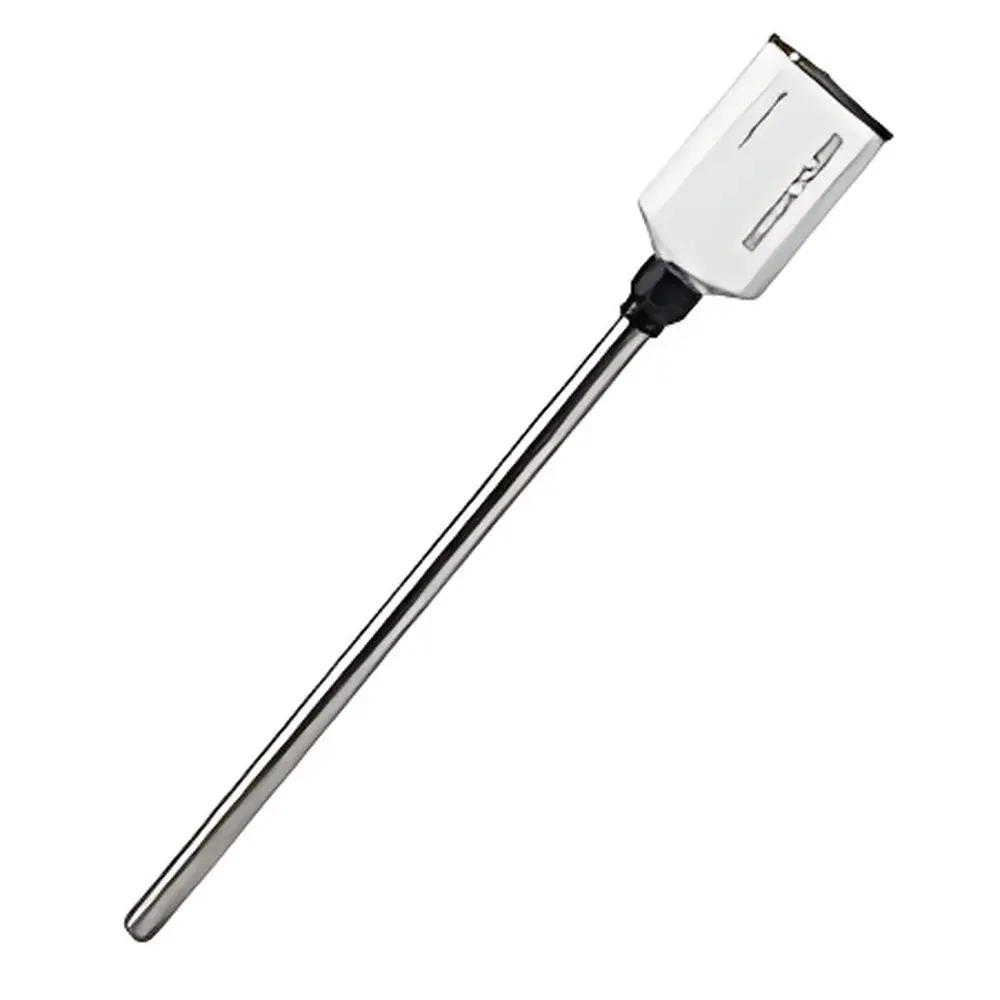
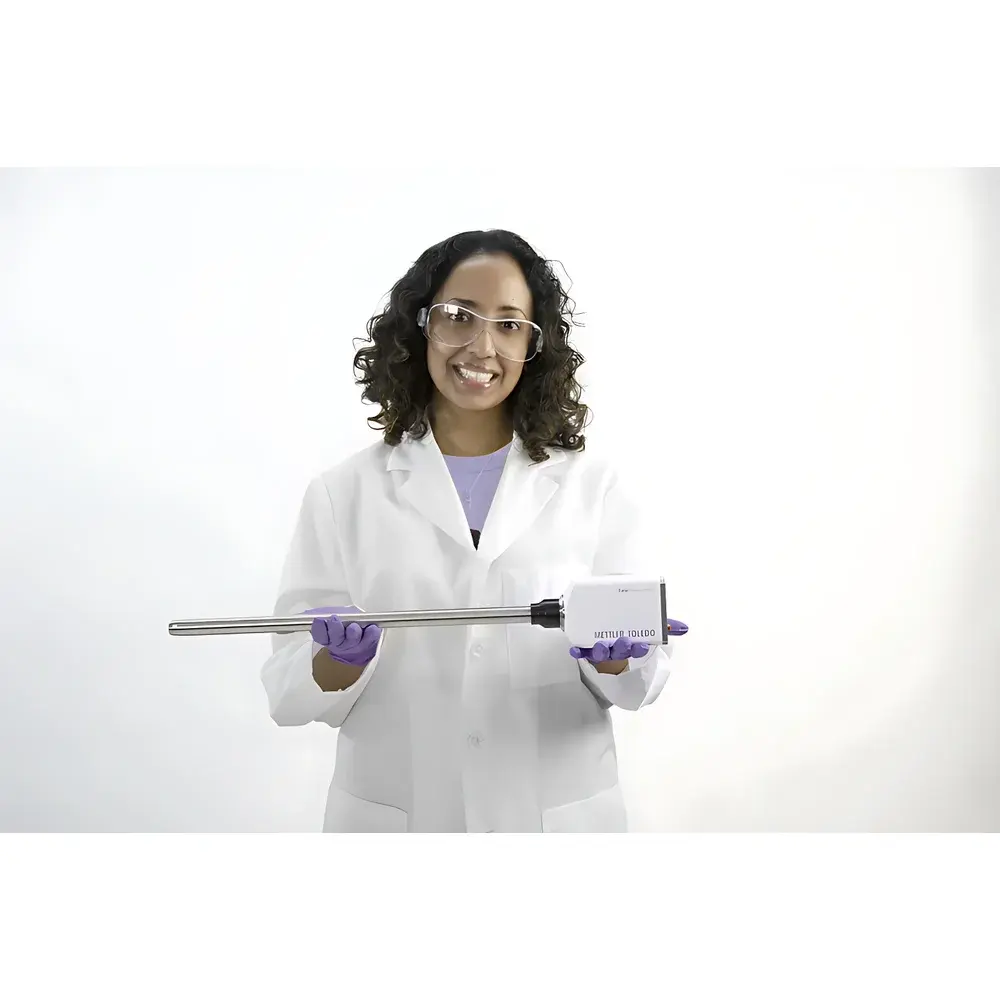
METTLER TOLEDO EasyViewer 400 In-line High-Resolution Particle Imaging and Size/Shape Analyzer
| Brand | METTLER TOLEDO |
|---|---|
| Origin | USA |
| Manufacturer Type | Authorized Distributor |
| Origin Category | Imported |
| Model | EasyViewer 400 |
| Instrument Type | In-line Dynamic Imaging System |
| Number of Lenses | 1 |
| Field of View | 1100 µm × 800 µm (±50 µm) |
| Image Resolution | 2200 × 1700 pixels |
| Sample Dispersion Method | In-situ liquid-phase flow-through measurement |
| Measured Parameters | Chord Length, Aspect Ratio, Equivalent Diameter, Length, Width |
Overview
The METTLER TOLEDO EasyViewer 400 is an in-line, high-resolution dynamic particle imaging system engineered for real-time, non-invasive observation and quantitative morphological analysis of particles in flowing liquid-phase processes. Based on digital microscopy with automated focus and illumination control, the EasyViewer 400 captures in-situ images directly from reactors, crystallizers, pipelines, or pilot-scale vessels—enabling continuous monitoring without sample extraction or offline dilution. Its core measurement principle relies on calibrated optical imaging combined with pixel-based geometric segmentation to derive statistically robust size and shape descriptors—including chord length distribution, equivalent spherical diameter (ESD), maximum Feret length, minimum Feret width, and aspect ratio. Designed specifically for process-critical environments in pharmaceutical development and manufacturing, the system delivers traceable, reproducible image data aligned with ICH Q5A, USP , and ASTM E2457 standards for particulate characterization.
Key Features
- In-line probe design with IP65-rated stainless-steel housing for direct insertion into pressurized or agitated vessels, compatible with ASME BPE-compliant sanitary connections.
- Automated focus, illumination, and exposure optimization ensures consistent image quality across variable turbidity, flow velocity, and particle concentration conditions.
- Real-time image acquisition at up to 30 fps with configurable trigger logic—synchronized with process parameters via analog/digital I/O or OPC UA integration.
- Onboard image preprocessing engine performs background subtraction, contrast enhancement, and noise reduction prior to export—minimizing post-acquisition computational load.
- Modular software architecture supports both standalone operation and seamless integration into DeltaV, DCS, or MES platforms for automated reporting and SPC charting.
- Calibration traceability to NIST-traceable stage micrometers; full audit trail including timestamped metadata (focus position, exposure time, gain, lens temperature) per image frame.
Sample Compatibility & Compliance
The EasyViewer 400 is validated for use with aqueous and organic suspensions, slurries, emulsions, and crystallization broths typical in API synthesis, bioprocessing, and formulation development. It operates under standard pharmaceutical process conditions: temperature range –10 °C to +80 °C, pressure up to 10 bar(g), and flow velocities from 0.1 to 3 m/s. The single-lens optical path is optimized for transparent-to-semi-transparent media; optional polarized illumination modules are available for enhanced contrast in birefringent crystals. All firmware and iC Vision software modules comply with FDA 21 CFR Part 11 requirements, supporting electronic signatures, role-based access control, and immutable audit logs. System validation documentation (IQ/OQ/PQ protocols) is provided per GMP Annex 15 and ISPE GAMP 5 guidelines.
Software & Data Management
iC Vision software serves as the central analytical interface, offering both out-of-the-box particle classification templates (e.g., needle vs. plate vs. block crystals) and a customizable Python-based scripting environment for user-defined feature extraction. Batch-level statistics—including number-weighted and volume-weighted distributions, shape factor histograms, and temporal trend overlays—are exportable in CSV, HDF5, or SQL formats. Raw image sequences are stored with embedded EXIF metadata and can be reprocessed retrospectively using updated algorithms without recapturing data. Integration with LabArchives ELN and Veeva Vault enables direct linkage of particle imagery to batch records, deviation reports, and regulatory submissions. Data integrity is enforced through SHA-256 hashing of all acquired frames and encrypted local storage compliant with ISO/IEC 27001 controls.
Applications
- Crystallization endpoint detection and polymorph tracking during antisolvent addition or cooling profiles.
- Monitoring of granule growth and attrition in fluidized bed dryers and high-shear mixers.
- Emulsion droplet coalescence kinetics in lipid nanoparticle (LNP) formulation for mRNA delivery systems.
- Validation of milling consistency across scale-up batches using comparative shape factor heatmaps.
- Root cause analysis of filter clogging events via retrospective image mining of upstream particle morphology shifts.
- Supporting Quality-by-Design (QbD) initiatives by establishing multivariate correlations between particle descriptors and final product performance attributes (e.g., dissolution rate, blend uniformity).
FAQ
Can the EasyViewer 400 be used in sterile manufacturing environments?
Yes—when installed with aseptic tri-clamp adapters and validated per PDA TR76, it meets Grade A/B environmental requirements for in-situ monitoring of sterile crystallization and lyophilization cycles.
Does it require periodic recalibration?
The optical calibration is stable over time; however, annual verification using certified reference slides is recommended and documented in the system’s calibration log.
How does it handle highly concentrated or opaque suspensions?
It employs adaptive illumination intensity control and multi-frame stacking to maintain usable signal-to-noise ratios; for extreme opacity, optional backlit flow cells are available.
Is particle identification (e.g., distinguishing API from excipient) supported?
While not a spectroscopic technique, supervised machine learning classifiers trained on labeled image datasets can achieve >92% accuracy in binary differentiation tasks when integrated via iC Vision’s Python API.
What cybersecurity measures are implemented?
The device runs a hardened Linux OS with disabled unused services, TLS 1.2+ encryption for remote access, and regular security patch updates aligned with METTLER TOLEDO’s Product Security Incident Response Team (PSIRT) policy.



