
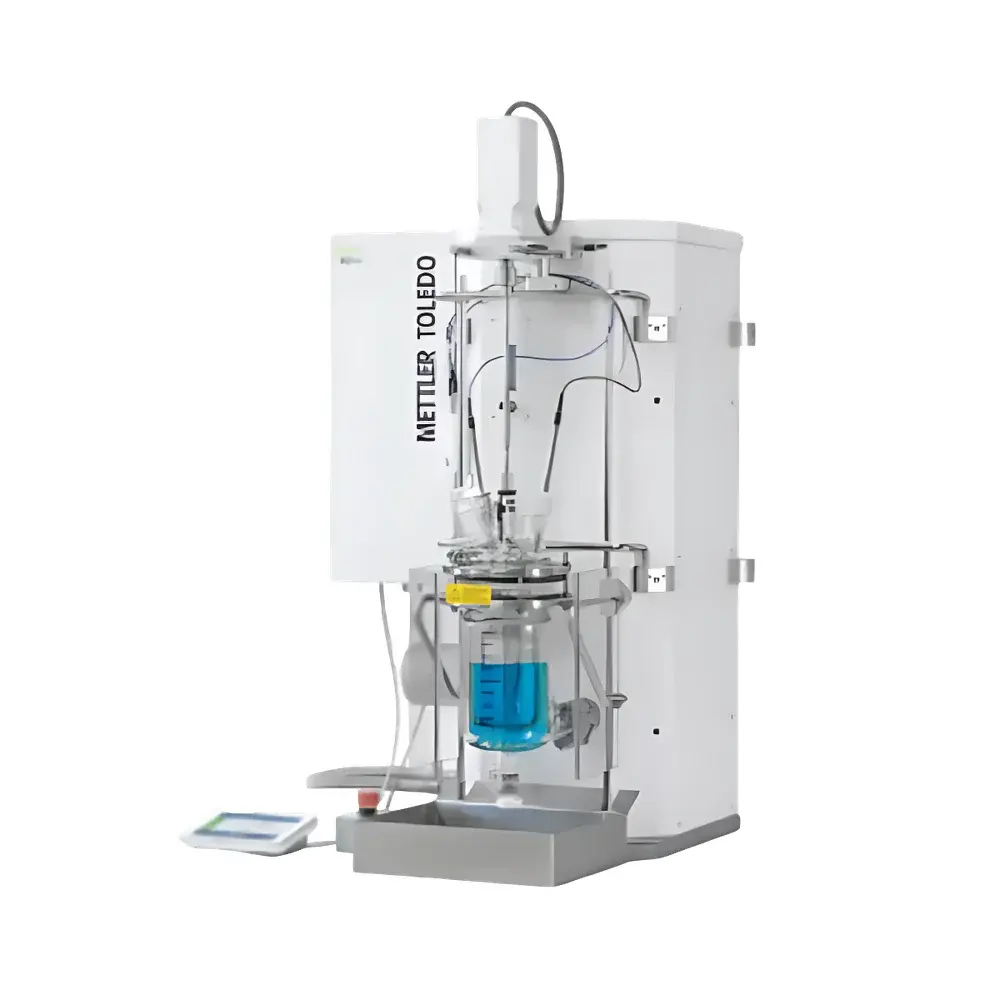
METTLER TOLEDO RC1mx Automated Laboratory Reaction Calorimeter
| Brand | METTLER TOLEDO |
|---|---|
| Origin | Switzerland |
| Model | RC1mx |
| Instrument Type | Reaction Calorimeter |
| Temperature Range | −70 °C to 300 °C |
| Temperature Resolution | 0.2 mK |
| Temperature Accuracy | ±0.5 K |
| Automation Level | Fully Automated |
| Compliance Context | Designed for GLP/GMP-aligned process safety development and regulatory submission support (e.g., ICH Q5, Q9, Q11 |
Overview
The METTLER TOLEDO RC1mx is a fully automated reaction calorimeter engineered for precise, real-time quantification of thermal behavior under chemically representative process conditions. It operates on the principle of heat flow calorimetry—measuring the heat exchanged between the reaction mixture and its controlled jacket environment via high-stability temperature differentials and calibrated heat transfer coefficients. Unlike adiabatic or differential scanning approaches, the RC1mx maintains dynamic thermal control while simultaneously acquiring thermodynamic and kinetic parameters—including reaction enthalpy (ΔHr), heat release rate (dQ/dt), cumulative reaction heat (Qr), and conversion-dependent thermal profiles (Xr). Its design enables direct correlation between laboratory-scale data and pilot- or production-scale thermal risk assessment, making it an essential tool for process safety evaluation, reaction mechanism elucidation, and scalable process definition in regulated environments.
Key Features
- Fully automated operation with integrated dosing, temperature control, stirring, and pressure management—minimizing operator intervention and human error during exothermic or hazardous reactions.
- High-fidelity thermal measurement architecture featuring dual-redundant temperature sensors and >3,000 independently monitored control valves, ensuring data integrity and long-term reproducibility across repeated experiments.
- Extended operational temperature range from −70 °C to 300 °C with 0.2 mK resolution and ±0.5 K absolute accuracy—enabling characterization of cryogenic nitration, high-temperature polymerization, and multi-step catalytic sequences.
- Real-time, synchronized acquisition of calorimetric, physical, and chemical parameters—including jacket heat flow, reactor temperature, dosing volume, stirrer torque, and pressure—within a single time-stamped dataset.
- Integrated emergency response protocols including rapid cooling activation, automatic reagent stoppage, and venting sequence initiation—activated by predefined thermal thresholds or user-defined logic rules.
Sample Compatibility & Compliance
The RC1mx supports a broad spectrum of reaction systems: homogeneous and heterogeneous catalysis, precipitation-driven crystallizations, gas-liquid hydrogenations, acid–base neutralizations, and photochemically initiated transformations. Vessel configurations range from 10 mL to 2 L, compatible with glass, Hastelloy, and stainless-steel reactors. All hardware and software components comply with international standards relevant to pharmaceutical and fine chemical development—including ICH guidelines for quality risk management (Q9), development lifecycle documentation (Q5/Q11), and ASTM E698 for kinetic analysis of thermal stability. The system supports 21 CFR Part 11-compliant electronic records and audit trails when deployed with METTLER TOLEDO’s iC Software Suite, facilitating FDA inspections and internal GLP/GMP audits.
Software & Data Management
Control and analysis are performed using METTLER TOLEDO’s iC Reaction Calorimetry software—a validated platform offering intuitive workflow templates, customizable alarm logic, and embedded thermokinetic modeling tools. Raw calorimetric data are stored in vendor-neutral HDF5 format with full metadata tagging (user, timestamp, version, instrument ID). Batch reports include annotated heat flow curves, derivative analysis (e.g., onset temperature, peak dQ/dt), and comparative overlays for DoE studies. Export options support CSV, PDF, and XML for integration into LIMS, MES, or statistical process control (SPC) environments. Audit trail functionality logs all parameter changes, user logins, and report generations with immutable timestamps—meeting ALCOA+ data integrity requirements.
Applications
- Process safety assessment per CCPS guidelines: determination of MTSR (maximum temperature of synthesis reaction), adiabatic temperature rise (ΔTad), and time-to-maximum-rate (TMRad) for thermal runaway evaluation.
- Reaction optimization: identification of optimal addition rates, temperature ramps, and stoichiometric windows to suppress side reactions and improve selectivity.
- Critical quality attribute (CQA) linkage: correlating thermal signatures with polymorph formation, particle size distribution, and impurity profiles during crystallization development.
- Scale-up justification: generation of heat transfer coefficient (U-value) and volumetric power dissipation (P/V) datasets required for reactor engineering calculations.
- Regulatory filing support: provision of auditable calorimetric evidence for drug substance manufacturing process descriptions in CMC sections of IND/NDAs.
FAQ
What distinguishes the RC1mx from traditional jacketed calorimeters?
The RC1mx integrates real-time reaction progress tracking (via in situ FTIR or Raman coupling options), closed-loop control of multiple process variables, and built-in safety interlocks—whereas conventional systems rely on manual setpoint adjustments and post-hoc data reconciliation.
Can the RC1mx be used for non-isothermal reaction profiling?
Yes—it supports dynamic temperature programs (ramps, holds, oscillations) while maintaining calorimetric accuracy, enabling Arrhenius analysis and kinetic modeling under realistic heating/cooling profiles.
Is remote monitoring supported?
Yes—via secure TLS-encrypted web interface and optional integration with enterprise SCADA or cloud-based analytics platforms for distributed team collaboration.
How is calibration traceability maintained?
Each system ships with NIST-traceable calibration certificates for temperature, volume, and heat flow sensors; periodic verification follows ISO/IEC 17025 procedures using certified reference materials (e.g., potassium hydrogen phthalate for enthalpy calibration).



