
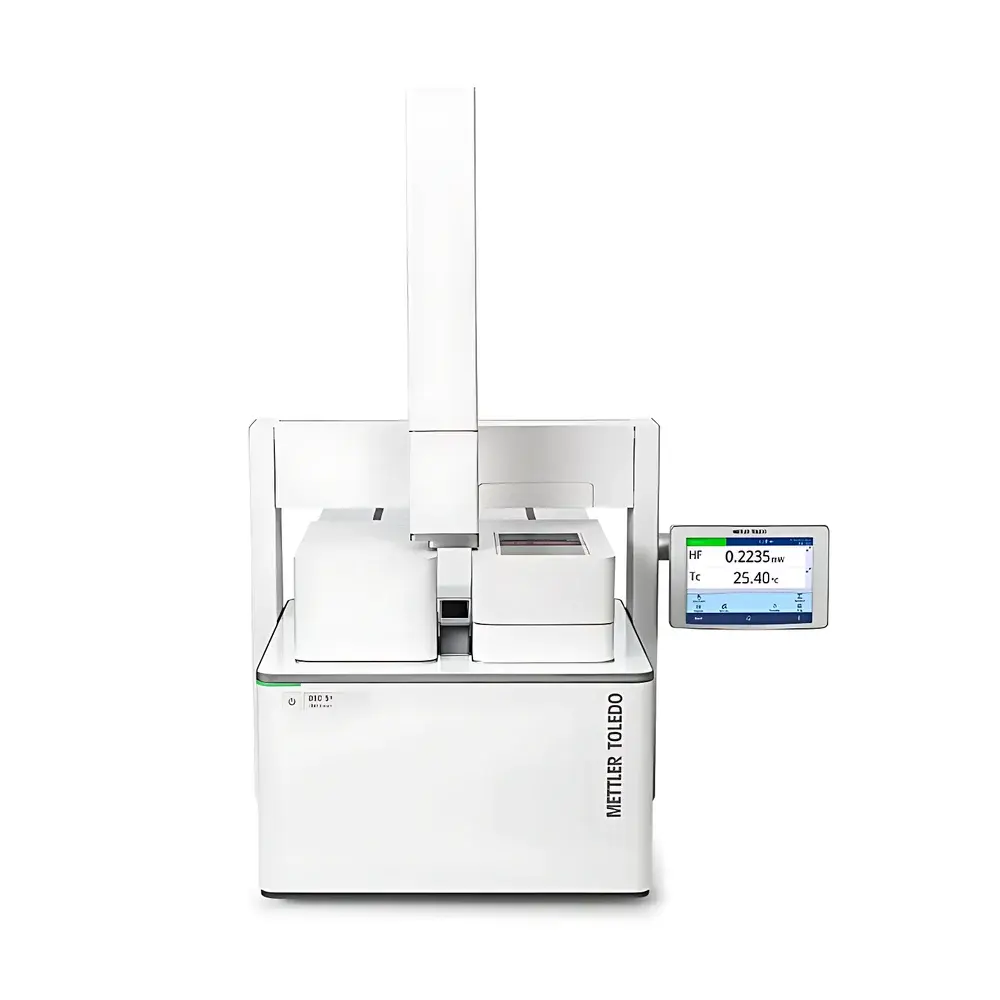
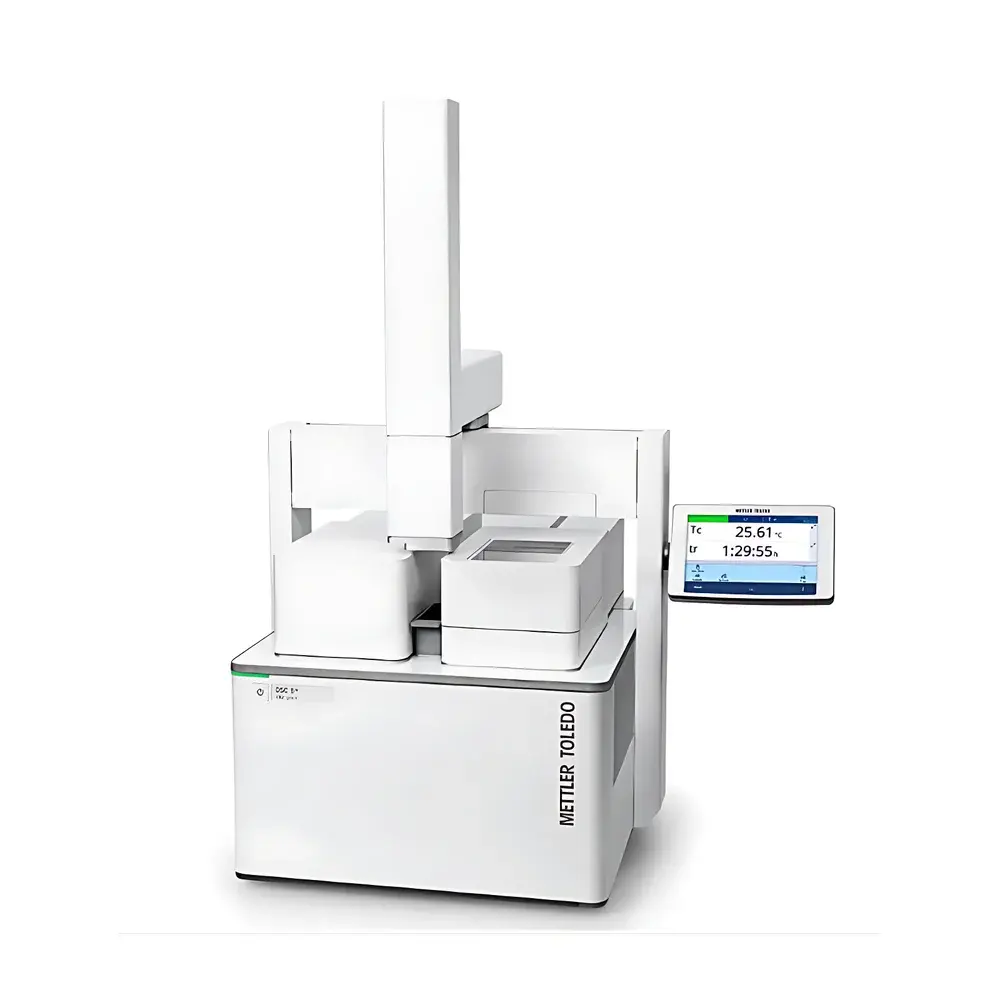
METTLER TOLEDO DSC 5+ Excellence Series Differential Scanning Calorimeter
| Brand | METTLER TOLEDO |
|---|---|
| Origin | Switzerland |
| Model | DSC 5+ |
| Instrument Type | Differential Scanning Calorimeter (DSC) |
| Sample Capacity | Multi-sample (automated) |
| Operating Modes | Power Compensation & Heat Flux (FlexMode™) |
| Sensor Configuration | MultiStar™ sensor with 136 thermocouple pairs |
| Calibration | FlexCal™ automated calibration |
| Atmosphere Control | Integrated gas-purged crucible chamber |
| Modular Architecture | Yes |
Overview
The METTLER TOLEDO DSC 5+ Excellence Series Differential Scanning Calorimeter is an advanced thermal analysis platform engineered for precision, reproducibility, and operational flexibility in regulated and research-intensive laboratory environments. It operates on the fundamental principle of differential scanning calorimetry—measuring the difference in heat flow between a sample and an inert reference as both are subjected to a controlled temperature program. This enables quantitative determination of enthalpy changes associated with phase transitions (e.g., melting, crystallization), glass transitions, curing reactions, oxidative stability, and decomposition kinetics. Designed and manufactured in Switzerland, the DSC 5+ integrates dual-mode thermal measurement architecture (power compensation and heat flux) via FlexMode™ technology, allowing users to select the optimal mode based on application-specific requirements—whether high-resolution separation of overlapping transitions or rapid screening under dynamic conditions.
Key Features
- FlexMode™ Dual-Mode Operation: Seamlessly switch between power compensation and heat flux measurement principles without hardware modification—ensuring adaptability across diverse material classes and regulatory workflows.
- MultiStar™ High-Density Sensor: Incorporates 136 precisely aligned thermocouple pairs arranged in a concentric geometry, delivering exceptional thermal resolution (<0.01 °C) and signal-to-noise ratio for deconvoluting closely spaced thermal events.
- Electro-Thermal Flow Regulation: Actively modulates heating/cooling rates in real time using proprietary feedback control, minimizing thermal lag and improving baseline stability—critical for accurate quantification of small enthalpy changes.
- Modular Excellence Platform: Built on a scalable, field-upgradable architecture that supports integration of optional modules including UV-light exposure, humidity control, and high-pressure cells—extending instrument utility beyond standard DSC applications.
- FlexCal™ Automated Calibration: Performs multi-point calibration (temperature, enthalpy, and sensitivity) using certified reference materials (e.g., indium, zinc, tin) with traceable NIST-traceable algorithms—fully compliant with ISO 11357 and ASTM E794.
- Gas-Purged Auto-Sampler (ASC): Features a sealed, inert-gas-flushed crucible chamber with programmable purge gas flow (N₂, Ar, O₂, synthetic air), eliminating atmospheric interference and enabling stable long-term measurements under controlled oxidative or reducing atmospheres.
Sample Compatibility & Compliance
The DSC 5+ accommodates a broad spectrum of sample forms—including powders, films, fibers, granules, gels, and cured composites—using standardized alumina, gold-plated, or high-purity aluminum crucibles (hermetic or vented). Its design conforms to international quality and safety standards, including CE marking, IEC 61010-1, and ISO/IEC 17025 requirements for testing laboratories. Data integrity meets FDA 21 CFR Part 11 criteria when operated with STARe software in audit-trail-enabled mode, supporting GLP and GMP compliance in pharmaceutical, polymer, and food science applications.
Software & Data Management
Controlled exclusively by METTLER TOLEDO’s STARe (Scientific Thermal Analysis Research) software, the DSC 5+ provides intuitive method setup, real-time visualization, and comprehensive post-processing tools—including peak deconvolution, kinetic modeling (e.g., Friedman, Ozawa-Flynn-Wall), and comparative overlay analysis. All raw data files (.sdt) are stored with embedded metadata (operator ID, instrument serial number, calibration history, environmental logs), ensuring full traceability. Export options include CSV, PDF reports, and ASTM E1981-compliant XML formats for LIMS integration.
Applications
The DSC 5+ serves critical roles across multiple sectors: polymer characterization (Tg, Tm, crystallinity, crosslink density); pharmaceutical development (polymorph screening, excipient compatibility, stability-indicating assays); battery materials (SEI formation, cathode degradation, thermal runaway onset); food science (fat crystallization, starch gelatinization, moisture migration); and nanomaterials (surface energy, ligand desorption enthalpies). Its high reproducibility (RSD < 0.3% for enthalpy of fusion of indium) makes it suitable for method validation per ICH Q5E and USP .
FAQ
What distinguishes FlexMode™ from conventional DSC architectures?
FlexMode™ enables true hardware-level switching between power compensation and heat flux modes—preserving the intrinsic advantages of each: superior resolution for weak transitions (power compensation) and faster throughput for routine screening (heat flux).
Is the DSC 5+ compatible with regulated pharmaceutical workflows?
Yes—when configured with STARe software in 21 CFR Part 11 mode, it supports electronic signatures, audit trails, user access levels, and secure data archiving required for FDA and EMA submissions.
Can the auto-sampler operate under reactive gas environments?
Yes—the ASC supports programmable gas switching (e.g., N₂ → O₂) during a single run, enabling oxidation induction time (OIT) and oxidative stability index (OSI) measurements per ASTM D3895 and ISO 11357-6.
How does the MultiStar™ sensor improve detection of overlapping peaks?
Its 136 thermocouple array delivers spatially resolved thermal gradients across the sample stage, increasing signal fidelity and enabling mathematical deconvolution of adjacent endo/exothermic events separated by as little as 0.5 °C.
What calibration standards are supported out-of-the-box?
STARe includes pre-loaded calibration protocols for indium (156.6 °C), tin (231.93 °C), zinc (419.53 °C), and bismuth (271.4 °C), all traceable to NIST SRMs and aligned with ISO 11357-1 Annex A.
Related Products



