PMI CFP Porometry and Pore Structure Analysis Service
| Brand | PMI (Porous Materials Inc.) |
|---|---|
| Origin | USA |
| Manufacturer Type | Authorized Distributor |
| Product Origin | Imported |
| Model | CFP |
| Pricing | Available Upon Request |
Overview
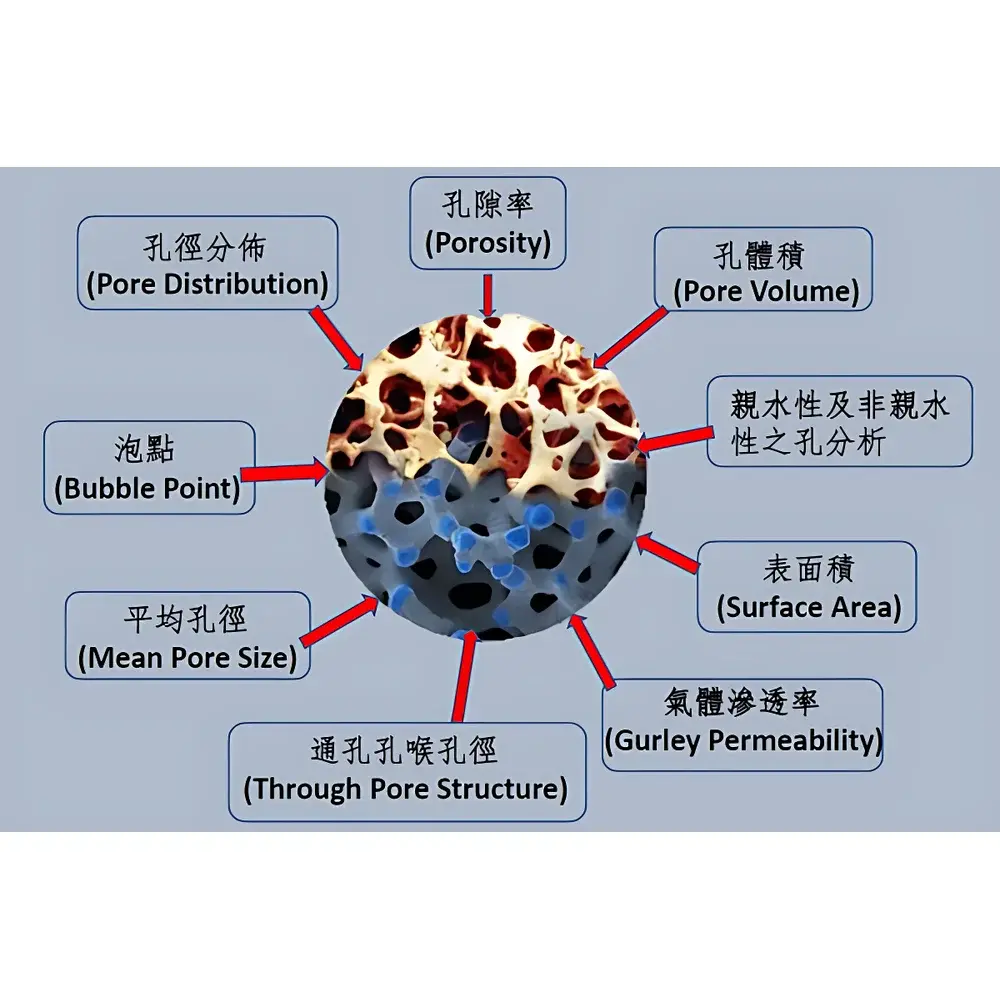
The PMI CFP Porometry and Pore Structure Analysis Service is a comprehensive laboratory testing offering engineered for precision characterization of porous materials using capillary flow porometry—a standardized technique based on the Washburn equation and controlled gas-liquid displacement. This service delivers quantitative, reproducible data on pore architecture critical for R&D validation, quality control, and regulatory documentation across filtration media, membranes, battery separators, catalyst supports, pharmaceutical excipients, and advanced ceramics. Unlike optical or imaging-based methods, capillary flow porometry provides direct functional measurement of through-pore size distribution under controlled wetting conditions, enabling correlation between structural metrics and performance-critical parameters such as filtration efficiency, breathability, and fluid transport behavior.
Key Features
- Capillary flow porometry per ASTM F316-22 and ISO 15901-1 standards, ensuring traceable, internationally recognized methodology
- Simultaneous determination of bubble point, mean flow pore size, and dry/wet curve hysteresis for pore interconnectivity assessment
- Dual-fluid capability supporting both hydrophilic (e.g., water/ethanol) and hydrophobic (e.g., perfluorinated liquids) wetting agents to characterize surface energy effects
- Full pore size distribution reporting from 0.01 µm to 500 µm, with resolution optimized for industrial-grade membranes and sintered metals
- Integrated permeability quantification aligned with industry-specific units: Frazier (ft³/ft²/min), Gurley (seconds/100 cc), and Darcy (cm²)
- Compliant test reporting with full audit trail, instrument calibration certificates, and raw pressure-flow datasets
Sample Compatibility & Compliance
This service accepts flat-sheet, tubular, or irregularly shaped porous specimens up to 50 mm in diameter and 10 mm thick—including nonwovens, sintered stainless steel, ceramic monoliths, polymer membranes, and powder compacts. All analyses are conducted under GLP-aligned laboratory practices. Test reports include references to applicable standards including ASTM E1194 (gas permeability), ISO 7231 (air permeability of textiles), and USP <846> (pore size characterization of sterile filtration membranes). Data packages support FDA 21 CFR Part 11 compliance when requested, with electronic signatures, version-controlled documentation, and secure data archiving.
Software & Data Management
Data acquisition and analysis are performed using PMI’s proprietary Porometer™ software v5.x, which implements automated baseline correction, differential flow rate derivation, and log-normal distribution fitting. Each report includes annotated dry/wet curves, cumulative and differential pore size histograms, tabulated metrics (bubble point, mean flow pore size, minimum pore size, pore volume, total porosity), and permeability coefficients normalized to standard temperature and pressure (STP). Raw data files (.csv and .prj) are delivered with metadata describing instrument configuration, operator ID, calibration date, and environmental monitoring logs (temperature ±0.5°C, humidity ±3% RH).
Applications
- Filtration & Separation: Validation of membrane integrity, pore uniformity, and lot-to-lot consistency for pharmaceutical sterile filtration and bioprocess clarification
- Battery Technology: Characterization of separator tortuosity, electrolyte wettability, and ionic transport pathways in Li-ion and solid-state systems
- Medical Devices: Verification of pore structure in wound dressings, surgical meshes, and tissue engineering scaffolds per ISO 13485 requirements
- Automotive & Aerospace: Evaluation of air filter media efficiency, fuel cell GDL porosity, and thermal barrier coating permeability
- Materials Science R&D: Correlation of sintering parameters with pore network evolution in metal injection molding (MIM) and additive manufacturing feedstocks
FAQ
What sample preparation is required prior to submission?
Samples must be clean, dry, and free of surface contaminants or residual processing agents. For hydrophobic materials, no pre-treatment is needed; hydrophilic samples may require vacuum drying at ≤60°C for 2 hours. We provide detailed prep guidelines upon project initiation.
Can you analyze coated or laminated multi-layer structures?
Yes—layer-specific pore analysis is possible if interfaces are mechanically stable under wetting pressure. Cross-sectional SEM or micro-CT may be recommended as complementary techniques for ambiguous architectures.
How long does turnaround time typically take?
Standard analysis requires 5–7 business days after sample receipt and method verification. Rush service (72-hour turnaround) is available with prior coordination and subject to instrument scheduling.
Do you offer method development for non-standard materials?
Yes—we collaborate on custom wetting agent selection, pressure ramp optimization, and dual-liquid protocols for complex surfaces, with full SOP documentation provided upon completion.
Is this service suitable for regulatory submissions?
All reports include instrument calibration records, analyst qualifications, uncertainty estimates per ISO/IEC 17025 principles, and optional 21 CFR Part 11-compliant digital signing for use in IND, NDA, or CE technical files.
Related Products