
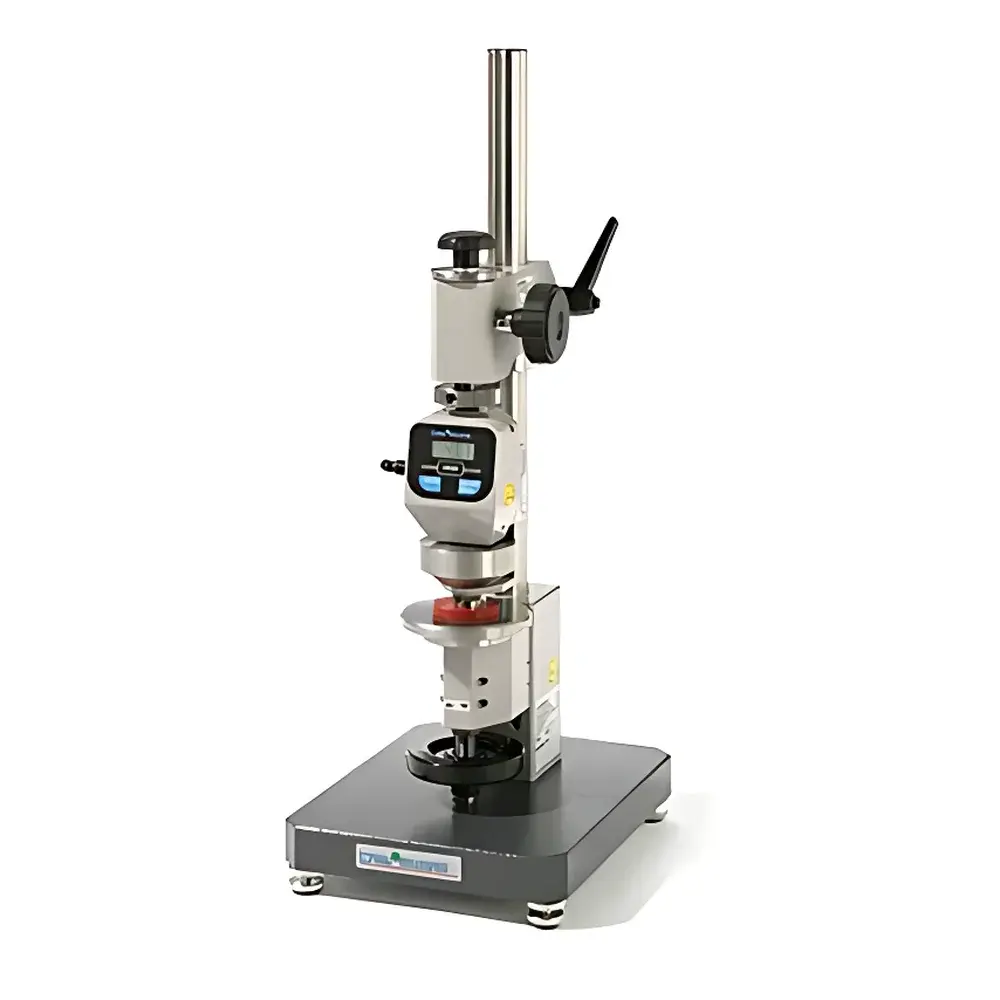
Bareiss CompactIII Series IRHD Hardness Tester
| Brand | Bareiss |
|---|---|
| Origin | Germany |
| Model | CompactIII |
| Instrument Type | IRHD M and IRHD N Hardness Tester |
| Test Force | 153.3 mN (IRHD M) / 5.7 N (IRHD N) |
| Indenter | Ø0.4 mm sphere (IRHD M) / Ø0.25 mm sphere (IRHD N) |
| Penetration Depth | 0.3 mm (IRHD M) / 1.8 mm (IRHD N) |
| Measurement Time | 1–99 s |
| Base Dimensions | 200 × 250 × 570 mm |
| Base Weight | 9.0 kg |
| IRHD M Head | 160 × 100 × 140 mm, 1.4 kg |
| IRHD N Head | 70 × 90 × 150 mm, 1.9 kg |
| Load Release Unit | 100 × 100 × 150 mm, 1.3 kg |
| Display | LCD |
| Power Supply | 100–240 VAC, 50/60 Hz |
| Data Storage | 300 readings |
| Interface | RS-232 |
| Compliance | DIN ISO 48, ASTM D1415, JIS K6253, BS 903-A26, NF T 46-003 |
| Optional Accessories | Barofix, Centrofix, HardTest Software |
Overview
The Bareiss CompactIII Series IRHD Hardness Tester is a precision-engineered, semi-automated instrument designed for the quantitative determination of hardness in elastomeric and highly resilient materials according to the International Rubber Hardness Degree (IRHD) standard. Unlike conventional Shore or Rockwell methods, IRHD employs a defined spherical indenter under controlled static load and precise dwell time to measure the depth of indentation into the material surface—yielding a dimensionless hardness value directly traceable to DIN ISO 48 and internationally harmonized test protocols. The CompactIII system supports two distinct measurement modes: IRHD M (for thin-section components such as O-rings, seals, and tubing with minimum thickness ≥0.6 mm) and IRHD N (for bulk soft rubber, thermoplastic elastomers, and high-elongation compounds requiring ≥6.0 mm thickness). Its modular architecture—comprising a rigid aluminum base station, interchangeable test heads, and a dedicated load release unit—ensures mechanical stability, thermal inertia minimization, and long-term repeatability across laboratory and production QC environments.
Key Features
- Modular dual-mode configuration supporting both IRHD M and IRHD N testing standards within a single platform
- Electronically controlled indentation cycle with programmable dwell time (1–99 seconds), enabling compliance with time-dependent viscoelastic response requirements
- High-precision spherical indenters: Ø0.4 mm steel ball for IRHD M; Ø0.25 mm steel ball for IRHD N—both calibrated and certified per DIN 53519-1 & -2
- Integrated LCD display with real-time force and displacement feedback, eliminating reliance on external readout devices
- RS-232 serial interface compliant with industry-standard communication protocols for direct integration into LIMS or QA data acquisition systems
- Onboard memory capacity for up to 300 test records with timestamp, mode identifier, and operator ID fields
- Quick-action lever mechanism for rapid sample positioning—reducing setup variability and operator-induced error
- Lightweight, exchangeable test heads (1.4–1.9 kg) facilitate ergonomic handling and minimize vibration coupling during measurement
Sample Compatibility & Compliance
The CompactIII is validated for use with vulcanized rubber, silicone elastomers, thermoplastic rubber (TPR), polyurethane (PU), and other low-modulus polymers exhibiting significant creep and recovery behavior. It complies fully with DIN ISO 48 Parts 2 (IRHD M) and 4 (IRHD N), ASTM D1415 (Standard Test Method for Rubber Property—International Hardness), JIS K6253, BS 903-A26, and NF T 46-003. For geometrically constrained samples—including curved O-rings, extruded gaskets, and molded bushings—the optional Barofix and Centrofix fixtures provide repeatable radial centering and axial alignment, ensuring consistent contact geometry and minimizing edge effects. All mechanical components are constructed from anodized aluminum alloy, offering dimensional stability across ambient temperature fluctuations (15–30 °C) and resistance to chemical exposure common in rubber processing facilities.
Software & Data Management
When paired with the optional HardTest software (Windows-based), the CompactIII transforms into a GLP-compliant data management workstation. HardTest supports full audit trail functionality—including user login authentication, electronic signatures, and immutable record archiving—meeting FDA 21 CFR Part 11 requirements for regulated laboratories. Users can generate customizable reports with statistical summaries (mean, SD, CV%), trend charts, and pass/fail thresholds aligned with internal specifications or customer-facing quality agreements. Raw RS-232 data streams are parsed in real time, preserving original sensor resolution without interpolation or rounding. Export formats include CSV, PDF, and XML, enabling seamless import into SAP QM, LabWare LIMS, or Minitab for advanced SPC analysis.
Applications
- Quality control of automotive sealing systems (door gaskets, trunk seals, HVAC hoses)
- In-process verification of vulcanization degree in rubber compounding lines
- Material qualification for medical-grade elastomers (ISO 10993-18 compliant applications)
- Hardness profiling across cross-sections of thick-walled extrusions and injection-molded parts
- Comparative aging studies (heat, ozone, UV exposure) tracking modulus evolution over time
- Supplier certification testing against OEM-specified IRHD tolerances (e.g., ±3 IRHD units)
FAQ
What is the difference between IRHD M and IRHD N measurement modes?
IRHD M uses a 0.4 mm spherical indenter and 153.3 mN test force, optimized for thin, flexible specimens ≥0.6 mm thick. IRHD N applies 5.7 N force with a 0.25 mm indenter, intended for thicker, softer materials ≥6.0 mm where deeper penetration is required to capture bulk modulus behavior.
Does the CompactIII require annual recalibration?
Yes. Bareiss recommends annual traceable calibration against certified reference blocks (e.g., NIST-traceable IRHD standards) performed by an ISO/IEC 17025-accredited service provider to maintain metrological integrity and audit readiness.
Can the instrument be integrated into automated test cells?
While the CompactIII is semi-automated, its RS-232 interface supports SCPI-like command sets for remote triggering, data polling, and status interrogation—enabling integration with PLC-controlled conveyors or robotic sample handlers via custom middleware.
Is HardTest software included with the base system?
No. HardTest is an optional licensed application sold separately. The instrument operates independently with onboard display and storage, but advanced reporting, statistical analysis, and regulatory compliance features require HardTest installation.
What environmental conditions are recommended for optimal accuracy?
Testing should occur in a temperature-controlled environment (23 ±2 °C) with relative humidity 50 ±5 %RH, per ISO 23529. Specimens must be preconditioned for ≥16 hours prior to measurement to ensure thermal and hygroscopic equilibrium.



