
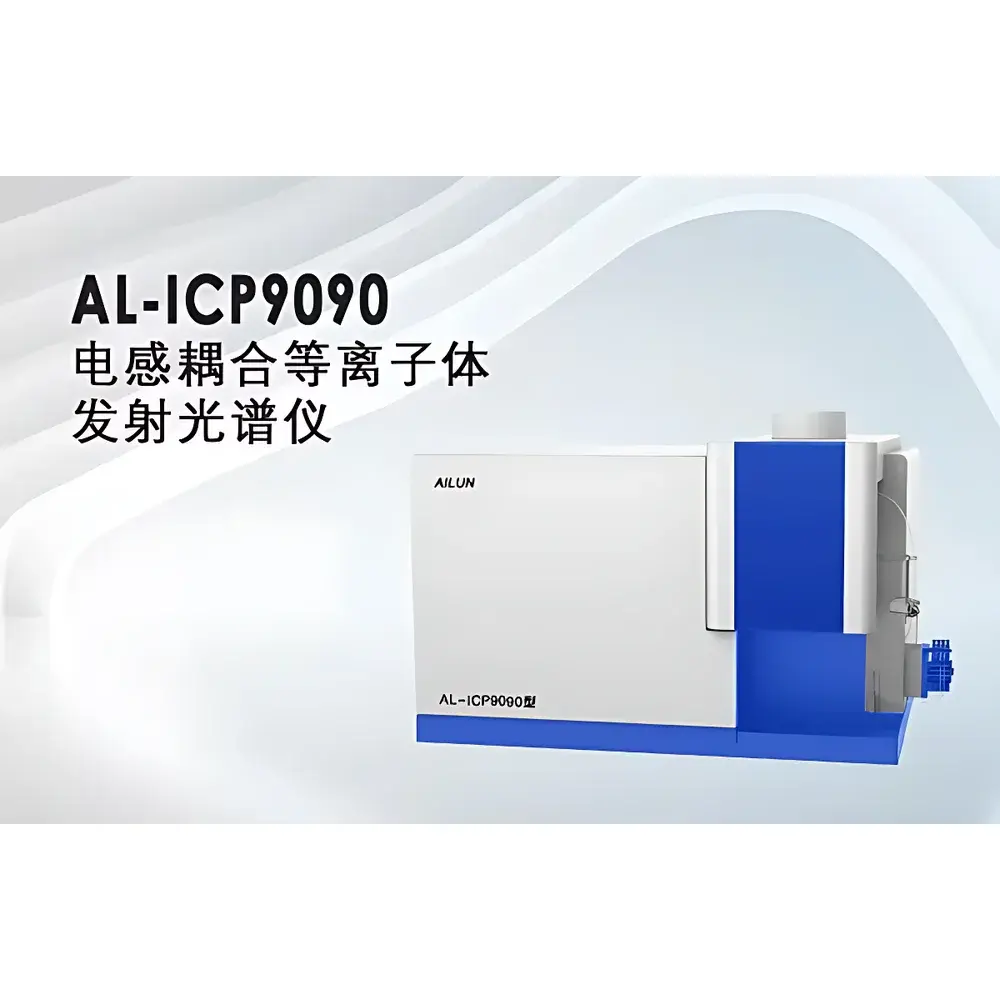
Ailun AL-ICP9090 Inductively Coupled Plasma Optical Emission Spectrometer
| Brand | Ailun General / Qingdao Ailun |
|---|---|
| Origin | Shandong, China |
| Manufacturer Type | Authorized Distributor |
| Regional Classification | Domestic (China) |
| Model | ICP9090 |
| Pricing | Upon Request |
Overview
The Ailun AL-ICP9090 is a full-spectrum direct-reading inductively coupled plasma optical emission spectrometer (ICP-OES) engineered for high-precision elemental analysis across diverse laboratory environments. Based on the fundamental principle of atomic emission spectroscopy, the instrument atomizes and excites liquid samples in a high-temperature argon plasma (~6,000–10,000 K), causing elements to emit characteristic wavelengths of UV-Vis light. These emissions are dispersed via a robust echelle grating-based two-dimensional optical system and detected by a thermoelectrically cooled, overflow-protected CCD sensor. Unlike sequential or limited-line ICP-OES systems, the AL-ICP9090 captures the entire spectral range (typically 165–900 nm) simultaneously—enabling multi-element quantification with high throughput, excellent linearity, and superior inter-element interference correction capability. Its design targets laboratories requiring regulatory-compliant trace metal analysis at sub-pptr detection levels, particularly where sample volume, matrix complexity, or throughput demands preclude manual or semi-automated alternatives.
Key Features
- Full-spectrum acquisition architecture with simultaneous detection across the UV-Vis range (165–900 nm), eliminating sequential scanning delays and enabling real-time spectral evaluation.
- Echelle grating optical system with optimized beam path geometry, delivering high spectral resolution (≤10 pm at 200 nm) and ultra-low stray light (<0.1% at 220 nm), critical for accurate background correction and low-level detection.
- Stable all-solid-state RF generator with auto-tuning impedance matching: 700–1600 W continuous power range, <0.1% short-term power stability, water-cooled thermal management, and integrated over-temperature/power fault protection.
- Automated impedance matching network with sub-second convergence time, ensuring consistent plasma ignition and stable operation across variable sample matrices (e.g., high-salt, organic, or acidic digests).
- Four-channel peristaltic pump with 12-roller head design; flow rate digitally adjustable (0.1–5.0 mL/min) and synchronized with waste aspiration to maintain constant nebulization pressure and minimize memory effects.
- Modular torch assembly with self-aligning, segmented quartz construction; center tube exchangeable in minutes to accommodate high-solids, high-acid, or HF-resistant applications without realignment.
- FSC (Flexible Spectral Calibration) algorithm—a proprietary wavelength calibration and drift compensation method—maintains spectral fidelity over extended run times without daily recalibration.
Sample Compatibility & Compliance
The AL-ICP9090 supports aqueous solutions, acid-digested environmental/clinical/biological matrices, organic solvents (with oxygen ashing), and diluted industrial process streams. It accommodates standard nebulizers (e.g., concentric glass, microflow), high-efficiency PFA nebulizers, and high-salt-resistant Babington-type units. Integrated mass flow controllers regulate auxiliary, nebulizer, and plasma argon gas streams with ±0.01 L/min precision. The system meets foundational requirements for ISO/IEC 17025:2017 method validation, supports audit-ready data integrity practices, and enables configuration for GLP/GMP-aligned workflows—including user access control, electronic signatures, and full audit trail logging when paired with compliant software deployment.
Software & Data Management
The instrument operates under a fully localized English/Chinese bilingual software platform built on a modular, database-driven architecture. Core functions include qualitative spectral identification (library-matched peak search), semi-quantitative screening (using internal standard normalization), and quantitative analysis (calibration curve, standard addition, and internal standard methods). Advanced tools include offline spectrum reprocessing, dynamic background subtraction using polynomial and iterative algorithms, inter-element correction (IEC) matrices, and automated QC flagging (e.g., drift, signal-to-background ratio, integration window deviation). All raw spectra, processing parameters, and result metadata are stored in an ACID-compliant SQLite database with export to ASTM E1382-compliant .csv and .xlsx formats. Software logs retain full operator actions, method versions, and instrument state snapshots for traceability.
Applications
The AL-ICP9090 delivers validated performance in regulated and research-intensive domains: environmental monitoring (EPA Methods 200.7, 200.8, and ISO 11885 for wastewater, soils, and sediments); food safety testing (Cd, Pb, As, Hg in crops, infant formula, and seafood per EU 2023/915 and FDA Elemental Analysis Manual); geological exploration (multi-element rock geochemistry per ASTM D5684); metallurgical QC (Al, Cu, Fe, Mg, Zn in alloys and scrap); semiconductor cleanroom water monitoring (Na, K, Ca, Ni at ppt levels); clinical toxicology (trace metals in serum/urine per CLIA guidelines); and agricultural soil nutrient profiling (Ca, Mg, K, Mn, Zn, B). Its rapid washout kinetics and robust plasma stability make it suitable for high-throughput routine labs handling >100 samples/day.
FAQ
Does the AL-ICP9090 support compliance with FDA 21 CFR Part 11?
Yes—when deployed with configured user roles, electronic signature enforcement, and audit trail activation, the software satisfies core Part 11 requirements for electronic records and signatures.
What is the typical detection limit for common elements like Cd and Pb?
Under optimized conditions (standard nebulizer, 15 s integration, 3σ definition), typical detection limits range from 0.003 µg/L (Cd) to 0.005 µg/L (Pb) in 2% HNO₃ matrix.
Can the system be upgraded to support hydride generation or laser ablation?
Yes—the optical interface and plasma interface are mechanically and software-compatible with commercially available HG-ICP-OES and LA-ICP-OES accessories.
Is remote diagnostics and software update supported?
Remote maintenance is enabled via secure TLS-encrypted VNC tunnel; firmware and application updates are distributed as signed packages with SHA-256 verification.
What consumables require scheduled replacement?
Nebulizer capillary (every 3–6 months), torch center tube (6–12 months depending on matrix), and peristaltic pump tubing (every 2–4 weeks under continuous use) are the primary wear items with documented lifetime specifications.





