
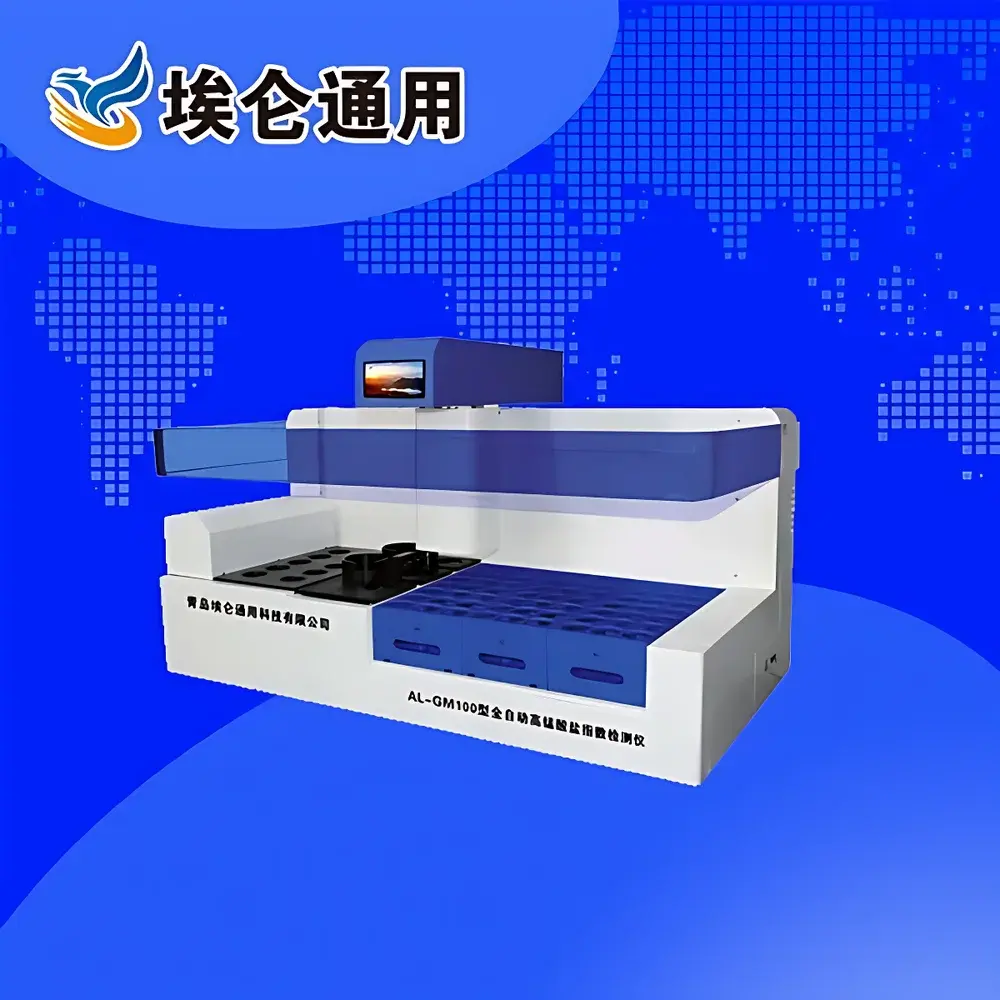
Ailun General AL-GM100 Automated Permanganate Index Analyzer
| Brand | Ailun General |
|---|---|
| Origin | Shandong, China |
| Manufacturer Type | Authorized Distributor |
| Country of Origin | China |
| Model | AL-GM100 |
| Measurement Principle | Acidic Potassium Permanganate Oxidation (Standardized Wet Chemical Method) |
| Instrument Type | Benchtop Laboratory Analyzer |
| Range | 0–5 mg/L |
| Repeatability | ±2% RSD |
| Accuracy | ±3% of reading |
| LOD | 0.05 mg/L |
| Dispensing Resolution | 1 µL |
| Analysis Time per Sample | 4 min |
Overview
The Ailun General AL-GM100 Automated Permanganate Index Analyzer is a fully integrated benchtop system engineered for precise, reproducible determination of the permanganate index (CODMn) in surface water, drinking water, groundwater, and wastewater samples. It implements the standardized acidic potassium permanganate oxidation method—strictly aligned with GB/T 11892 “Water Quality — Determination of Permanganate Index” and GB/T 5750.7 “Standard Methods for Examination of Drinking Water — Organic Comprehensive Indicators.” Unlike manual titration workflows—which introduce variability due to inconsistent heating duration, acid dosage, KMnO4 concentration control, and subjective endpoint detection—the AL-GM100 eliminates operator-dependent steps through hardware-synchronized automation of sample aspiration, reagent dispensing, micro-boiling water bath digestion, back-titration with sodium oxalate, and spectrophotometric endpoint recognition. The system operates on the fundamental principle of controlled oxidative digestion under acidic conditions at near-boiling temperature (≈97 °C), followed by quantification of residual permanganate via stoichiometric reduction and optical endpoint detection.
Key Features
- Integrated Digestion–Titration Architecture: Combines sample pretreatment, thermal oxidation, and redox titration within a single enclosed platform, minimizing cross-contamination and environmental interference.
- High-Precision Fluid Handling: Dual-syringe injection pumps deliver reagents and titrants with ≤0.6‰ volumetric accuracy (per ISO 8655-3), ensuring metrological traceability in acid, KMnO4, and Na2C2O4 delivery.
- Multi-Channel Micro-Boiling Water Bath: Independently controlled digestion zones maintain stable 96–98 °C temperature profiles using PID-regulated heating elements; integrated level sensors trigger automatic deionized water replenishment to prevent dry-run operation.
- Human-Vision-Mimicking Endpoint Detection: Industrial-grade colorimetric sensor calibrated to CIE 1931 chromaticity coordinates replicates human spectral sensitivity (380–780 nm), enabling robust discrimination of faint pink-to-colorless transitions despite turbidity or natural organic coloration.
- Adaptive Robotic Sample Handling: Low-noise servo-driven manipulator with force-sensing electric grippers autonomously loads vials, positions them in digestion racks, and verifies placement integrity prior to assay initiation.
- Chemical-Resistant Fluidic Pathway: All wetted components—including tubing, valves, and reaction cuvettes—are fabricated from PTFE, ETFE, and sapphire-reinforced ceramics, certified for continuous exposure to 1 mol/L H2SO4 and 0.01 mol/L KMnO4.
- Self-Cleaning Protocol: Programmable rinse cycles employ sequential aspiration of deionized water, dilute nitric acid, and air purge to eliminate carryover between analyses—validated per ASTM D5173 Annex A1.
Sample Compatibility & Compliance
The AL-GM100 accepts standard 25 mL glass or quartz digestion vials (with screw caps) and supports direct analysis of raw, filtered, or centrifuged aqueous matrices without pre-dilution within its 0–5 mg/L linear range. It complies with national regulatory frameworks governing environmental and potable water testing in China (MEP Order No. 84, MOH Order No. 37), and its operational logic adheres to GLP-aligned data integrity requirements—including full electronic audit trail, user-level access control, and immutable result archiving. While not FDA 21 CFR Part 11-certified out-of-the-box, the firmware architecture supports future validation packages for regulated laboratories requiring electronic signature and record retention compliance.
Software & Data Management
The embedded Linux-based control system features a 10.1″ capacitive touchscreen interface with intuitive workflow navigation, real-time status visualization (temperature, titrant volume, optical absorbance), and context-sensitive help. All analytical data—including raw sensor outputs, intermediate calculations, and final CODMn values—are timestamped, tagged with operator ID and instrument serial number, and stored in encrypted SQLite databases. Export options include CSV, PDF reports (with customizable templates), and direct USB/ethernet transfer to LIMS. Built-in thermal printer supports on-demand hardcopy output with QR-coded result authentication.
Applications
- Environmental monitoring stations performing routine surveillance of rivers, lakes, and reservoirs per China’s “Surface Water Environmental Quality Standards” (GB 3838–2002)
- Drinking water utilities verifying compliance with “Sanitary Standard for Drinking Water” (GB 5749–2022) organic load indicators
- Public health laboratories supporting disease prevention programs involving source water quality assessment
- Third-party testing organizations conducting accredited environmental testing (CNAS-CL01:2018 compliant workflows)
- Geological survey institutes evaluating aquifer vulnerability to organic contamination
FAQ
Does the AL-GM100 support method validation according to ISO/IEC 17025?
Yes—its documented uncertainty budget, calibration certificate traceability to NIM (National Institute of Metrology, China), and configurable QC check routines enable full validation against ISO/IEC 17025:2017 Clause 7.2 and 7.7.
Can the system analyze seawater or high-salinity samples?
Not without matrix-specific method adaptation; chloride interference above 300 mg/L requires pre-treatment per GB/T 11892 Annex B (e.g., addition of Ag2SO4 precipitation step), which is not automated in the base configuration.
What maintenance intervals are recommended for long-term reliability?
Daily: fluid path inspection and waste container emptying. Quarterly: syringe pump recalibration and optical sensor verification. Annually: full thermal bath calibration and gripper torque verification—detailed in the included Maintenance Logbook.
Is remote diagnostics supported?
Yes—via optional Ethernet-connected secure tunnel (SSH-based), allowing authorized service engineers to review system logs, update firmware, and perform guided troubleshooting without physical site access.







