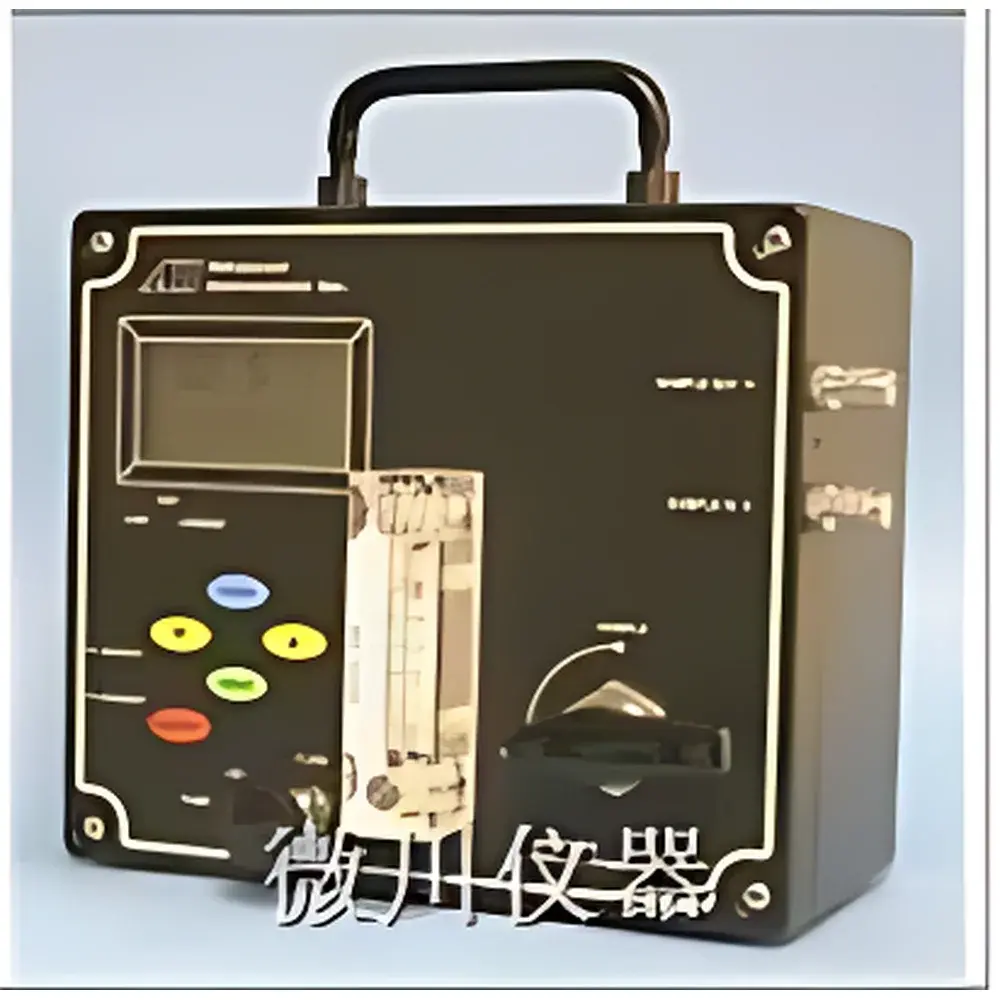
AII GPR-1200MS ppb Portable Trace Oxygen Analyzer
| Brand | AII |
|---|---|
| Origin | USA |
| Model | GPR-1200MS |
| Measurement Range | 0–1, 0–10, 0–100, 0–1000 ppm (selectable) |
| Detection Limit | 10 ppb |
| Accuracy | ±1% of full scale |
| Sensor Type | Electrochemical (GPR-12-2000MS), maintenance-free |
| Expected Sensor Life | 24 months at 25°C and avg. 100 ppm O₂ |
| Response Time (t₉₀) | 10 s |
| Recovery Time to 10 ppm in N₂ after air exposure | 20 min |
| Operating Temperature | 5–45 °C |
| Sample Pressure | 5–30 psig inlet, vent to atmosphere |
| Flow Rate | 0.25–2.5 L/min (recommended: 1 L/min) |
| Display | 2.75″ × 1.375″ LCD, resolution 0.01 ppm |
| Enclosure Rating | NEMA 4X |
| Dimensions | 8.6″ × 9″ × 3″ |
| Weight | 12 lbs |
| Power | Rechargeable battery (60 days standby, ~1 day with pump active) |
| Certifications | CE, ATEX/IECEx compliant intrinsic safety for Class I, Div. 1, Groups A, B, C, D |
| Sample Wetted Materials | 316 stainless steel |
| Output Signal | 0–1 V analog |
| Linearity | R² ≥ 0.995 across all ranges |
| Temperature Compensation | Built-in |
| User Interface | Rotary range selector, waterproof membrane keypad, LED status indicators (low battery, charging) |
| Optional Accessories | Integrated sampling pump, explosion-proof carry case, inline particulate filter |
Overview
The AII GPR-1200MS ppb Portable Trace Oxygen Analyzer is a field-deployable electrochemical instrument engineered for high-stability, low-level oxygen quantification in ultra-pure and process gas streams. It operates on the principle of galvanic cell electrochemistry—where molecular oxygen diffuses through a selective membrane and undergoes a controlled reduction reaction at a noble metal cathode, generating a current linearly proportional to partial pressure. This architecture delivers stable baseline performance without external power to the sensor, minimizing drift and enabling reliable detection down to 10 ppb in inert and reactive backgrounds. Designed specifically for use in hazardous locations, the analyzer meets stringent intrinsic safety requirements per IEC 60079-0 and IEC 60079-11, certified for Class I, Division 1, Groups A, B, C, and D—making it suitable for deployment in petrochemical refineries, semiconductor fab gas cabinets, hydrogen fuel infrastructure, and pharmaceutical nitrogen purge validation.
Key Features
- Four user-selectable measurement ranges (0–1, 0–10, 0–100, and 0–1000 ppm) via front-panel rotary switch, enabling optimal signal-to-noise ratio across applications
- True ppb-level sensitivity with verified 10 ppb lower detection limit and ±1% full-scale accuracy across all ranges
- Intrinsically safe design certified to ATEX/IECEx standards, eliminating need for purge or enclosure-based protection in Zone 0/1 environments
- Robust NEMA 4X aluminum enclosure rated for outdoor and washdown conditions, with IP66-equivalent ingress protection
- Integrated temperature and pressure compensation algorithms ensure measurement stability across ambient fluctuations (5–45 °C operating range)
- Maintenance-free GPR-12-2000MS electrochemical sensor with 24-month service life under typical exposure conditions (≤100 ppm average O₂ at 25 °C)
- Dual-mode power management: rechargeable Li-ion battery supports >60 days of standby monitoring or ~24 hours of continuous sampling with integrated pump enabled
- Real-time display of sample temperature, pressure, and O₂ concentration on a high-contrast 2.75″ × 1.375″ LCD with 0.01 ppm resolution
Sample Compatibility & Compliance
The GPR-1200MS is validated for trace oxygen analysis in non-corrosive, non-condensing gas matrices including high-purity nitrogen, argon, helium, hydrogen, carbon dioxide, and hydrocarbon streams (e.g., methane, ethylene). Its 316 stainless steel sample pathway ensures compatibility with aggressive industrial gases while resisting oxidation and adsorption artifacts. The analyzer complies with ISO 8573-1:2010 (Class 1 compressed air purity), ASTM D6866 (for biogas O₂ verification), and supports GLP/GMP documentation workflows through audit-ready calibration logs. While not FDA 21 CFR Part 11–compliant out-of-the-box, its analog 0–1 V output integrates seamlessly with validated DCS/SCADA systems configured for electronic record retention.
Software & Data Management
The GPR-1200MS operates as a standalone field instrument with no embedded firmware-based data logging. However, its 0–1 V analog output is compatible with third-party acquisition systems supporting IEEE 1451.2 transducer electronic data sheet (TEDS) configuration. Users may connect the output to programmable logic controllers (PLCs), distributed control systems (DCS), or PC-based DAQ platforms (e.g., LabVIEW, MATLAB) for time-stamped trend capture, alarm triggering, and CSV export. Calibration events are manually recorded using the device’s built-in timestamped display—supporting ISO/IEC 17025 traceability when paired with certified reference gases (e.g., NIST-traceable O₂-in-N₂ blends at 80% of selected span).
Applications
- Validation of inert gas blanketing in reactor vessels, storage tanks, and distillation columns
- Monitoring oxygen ingress in hydrogen fuel delivery lines and electrolyzer off-gas streams
- Quality assurance of ultra-high-purity (UHP) carrier gases used in GC, ICP-MS, and semiconductor CVD/PVD processes
- Leak detection in vacuum systems and gloveboxes via residual O₂ rise kinetics
- Pharmaceutical lyophilization cycle verification and nitrogen purge efficacy testing
- On-site verification of cryogenic liquid dewar headspace O₂ levels prior to transfer
FAQ
What calibration gases are required for routine verification?
Certified standard gases at approximately 80% of the selected measurement range are recommended—for example, 800 ppb O₂ in N₂ for the 0–1 ppm range. NIST-traceable certificates must accompany each cylinder.
Can the GPR-1200MS measure oxygen in humid or corrosive gas streams?
No. Condensable moisture and acidic gases (e.g., HCl, SO₂, Cl₂) will permanently damage the electrochemical sensor. Inline particulate and coalescing filters are mandatory for wet or dirty gas streams.
Is the built-in sampling pump intrinsically safe?
Yes—the optional integrated pump is fully certified within the same intrinsic safety boundary and does not require separate barrier installation.
How often should zero and span checks be performed?
A span check with certified gas is recommended before each critical measurement campaign; zero verification using high-purity nitrogen (<10 ppb O₂) is advised weekly in continuous operation environments.
Does the analyzer support digital communication protocols such as Modbus or HART?
No—it provides only a unidirectional 0–1 V analog output. Digital integration requires external signal conditioning or protocol converters.
Related Products