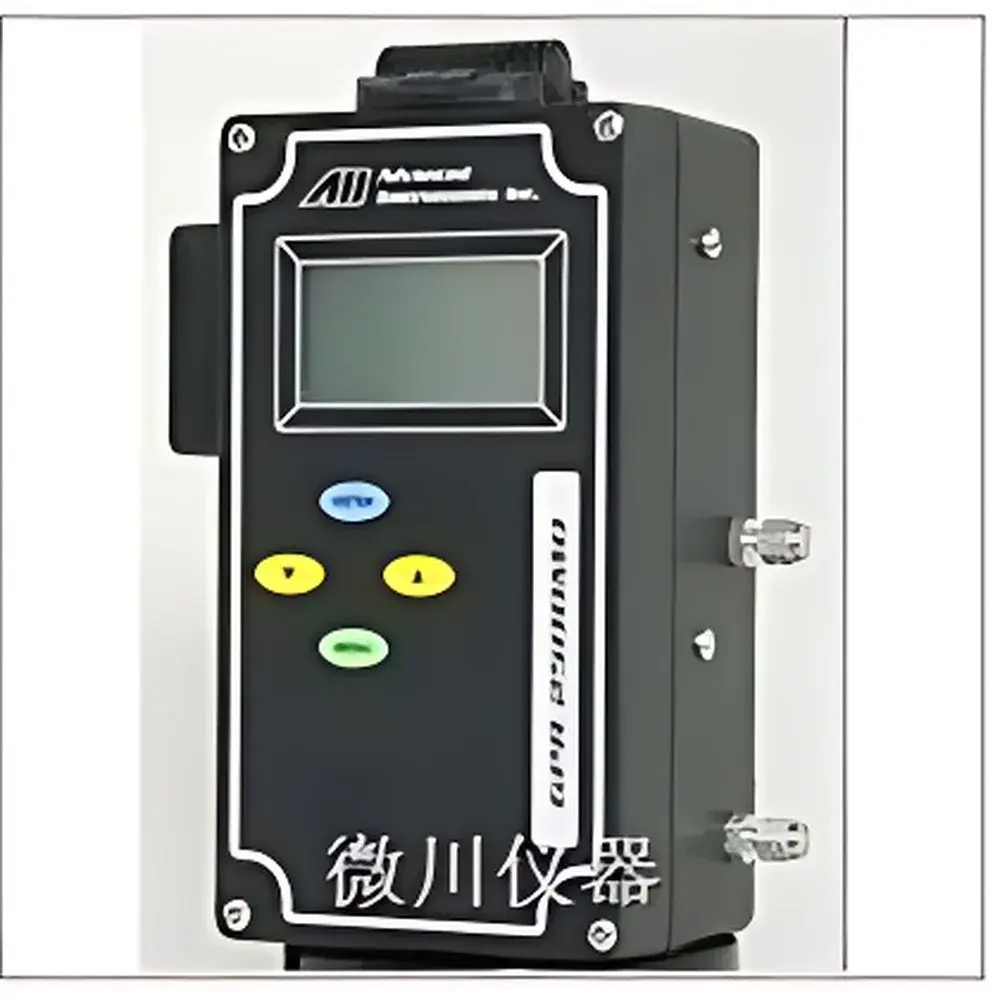
AII GPR-2500MO Online Oxygen Analyzer
| Brand | AII |
|---|---|
| Origin | USA |
| Model | GPR-2500MO |
| Measurement Range | 0–100% O₂ |
| Accuracy | ±1% FS (±0.1% FS when calibrated with 95–100% O₂ standard) |
| Sensor Type | GPR-11-120-4 electrochemical cell |
| Sensor Lifetime | 24 months at 25°C |
| Response Time (t₉₀) | 10 seconds |
| Operating Temperature | 5–45°C |
| Sample Pressure | 5–30 psig inlet, vent to atmosphere |
| Sample Flow Rate | 0.5–2.5 L/min (recommended: 1.0 L/min) |
| Output Signal | 4–20 mA (2-wire, 12–28 VDC |
| Display | 2.75″ × 1.375″ LCD, 0.1% resolution, real-time temperature & pressure readout |
| Enclosure Rating | NEMA 4X |
| Dimensions | 4″ × 9″ × 3″ |
| Weight | 8 lbs |
| Certifications | CE, intrinsically safe for Class I, Division 1, Groups A–D (with appropriate barrier) |
| Compensation | Automatic temperature and pressure compensation |
| Calibration | Single-point, using certified gas ≥80% of full scale |
| Sample Wetted Materials | 316 stainless steel |
| Optional | Remote sensor mounting kit |
Overview
The AII GPR-2500MO Online Oxygen Analyzer is a robust, field-deployable electrochemical analyzer engineered for continuous, high-fidelity measurement of oxygen concentration across the full 0–100% vol range in industrial process streams. It employs a proprietary, maintenance-free GPR-11-120-4 electrochemical sensor—designed for stable output and minimal drift under variable thermal and pressure conditions. Unlike paramagnetic or zirconia-based analyzers, the GPR-2500MO leverages galvanic cell technology optimized for inert and reducing atmospheres, including He, H₂, CO₂, N₂, Ar, and hydrocarbon-rich gases. Its architecture eliminates the need for sample conditioning systems (e.g., dryers, filters, or flow controllers), enabling direct-inlet analysis with minimal system complexity. The analyzer complies with IEC 60079-0 and IEC 60079-11 for intrinsic safety, supporting deployment in hazardous locations without external purging or pressurization.
Key Features
- Full-range 0–100% O₂ measurement capability with <1% full-scale accuracy, verified against traceable NIST-traceable calibration standards
- Integrated automatic temperature and pressure compensation—ensuring consistent readings across dynamic process conditions (5–45°C ambient, 5–30 psig sample pressure)
- NEMA 4X-rated aluminum enclosure for corrosion resistance and ingress protection against dust, water, and hose-directed spray
- Real-time dual-parameter display showing O₂ concentration (0.1% resolution), internal sensor temperature, and compensated pressure
- Two-wire 4–20 mA analog output compatible with DCS, PLC, and SCADA systems; supports intrinsic safety via certified barriers for Class I, Div 1, Groups A–D environments
- Field-calibratable using a single certified gas point ≥80% of full scale—no zero gas required due to sensor self-zeroing design
- Low-flow tolerance (0.5–2.5 L/min) with optimal performance at 1.0 L/min, minimizing purge gas consumption and system backpressure
Sample Compatibility & Compliance
The GPR-2500MO is validated for use in non-corrosive, non-condensing gas matrices typical of high-purity bulk gas production and purification systems. It is routinely deployed in nitrogen, hydrogen, and carbon dioxide generation skids where residual O₂ must be monitored from ppm-level purity verification up to enriched or medical-grade oxygen streams. All wetted parts—including inlet/outlet fittings and internal sensor housing—are constructed from 316 stainless steel, ensuring compatibility with ultra-high-purity (UHP) specifications per ASTM D7606 and ISO 8573-1 Class 1. The analyzer meets CE marking requirements for electromagnetic compatibility (EMC Directive 2014/30/EU) and low-voltage safety (LVD Directive 2014/35/EU). Its intrinsic safety certification enables compliance with site-specific hazardous area classification protocols aligned with NFPA 70 (NEC) and IEC 60079 series standards.
Software & Data Management
While the GPR-2500MO operates as a standalone analog transmitter without embedded firmware or digital communication protocols (e.g., Modbus, HART), its 4–20 mA output is fully compatible with industry-standard data acquisition systems that support audit-trail logging and alarm event tagging. When integrated into a validated control system compliant with FDA 21 CFR Part 11, the device supports electronic record retention of calibration dates, operator IDs, and calibration gas lot numbers—enabling GLP/GMP-aligned documentation for pharmaceutical, semiconductor, and food-grade gas applications. Configuration and verification are performed manually via front-panel waterproof membrane keys, eliminating software dependencies and reducing validation burden.
Applications
- On-line monitoring of O₂ breakthrough in pressure swing adsorption (PSA) and membrane-based nitrogen generators
- Final purity verification in cryogenic air separation units producing high-purity O₂ (>99.5%) for medical or metallurgical use
- Leak detection and blanketing gas quality assurance in semiconductor fab tool purge lines (He, N₂, Ar)
- Process control in hydrogen production via steam methane reforming (SMR), where O₂ ingress poses explosion risk
- Quality assurance in CO₂ recovery systems from fermentation or flue gas—verifying absence of oxidative contamination prior to beverage or EOR injection
- Monitoring inerting efficiency in transformer oil preservation and fire suppression systems
FAQ
What gas matrices are compatible with the GPR-2500MO?
The analyzer is validated for inert gases (N₂, Ar, He), reducing gases (H₂, CO), and acidic gases (CO₂). It is not recommended for use in strongly oxidizing, corrosive (e.g., Cl₂, NOₓ), or condensable vapor-laden streams.
Does the sensor require periodic replacement or recalibration?
The GPR-11-120-4 sensor has a rated service life of 24 months at 25°C ambient. Calibration is recommended quarterly or after exposure to extreme environmental shifts; no zero gas is required due to inherent baseline stability.
Can the GPR-2500MO be installed in an explosion-hazardous area?
Yes—when used with a certified intrinsic safety barrier (e.g., Pepperl+Fuchs KFD2-STC4), it meets Class I, Division 1, Groups A–D requirements per UL 913 and IEC 60079-11.
Is remote sensor mounting supported?
An optional remote sensor kit is available, allowing the electrochemical cell to be mounted up to 30 meters from the electronics module via shielded twisted-pair cabling—ideal for high-temperature or confined-space installations.
How is pressure and temperature compensation implemented?
Built-in RTD and piezoresistive transducers feed real-time T&P data to an onboard microcontroller, applying polynomial correction to the raw sensor signal per ISO 6145-7 and ASTM D6299 guidelines.